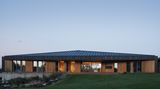
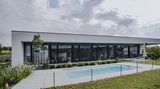
A recently completed private home project stands out for its unique collaborative design process. The architect designed the residence for his brother and family, incorporating personal memories and the raw aesthetic of a location steeped in family history.
The property borders agricultural buildings and barns that have belonged to the family for generations, and where both brothers spent their childhood. This connection to the past served as a significant source of inspiration for the design.
“The house evolved through a pleasant dialogue, with respect for the fact that We see primarily a family home,” said the architect, Lukáš Janout. “While the owners had clear ideas, they didn’t significantly interfere with the design, and I, as the architect, didn’t push anything against their wishes.”
Key Design Features
The home features large, frameless windows that offer expansive views of the surrounding landscape while maximizing natural light.
A high ceiling with wooden beams opens above the living area, highlighting a walkable gallery overlooking the kitchen. This vantage point provides a comprehensive view of the central part of the house, anchored by a spacious wooden table and black chairs.
Striking Exterior
The home’s exterior is defined by its unique facade, constructed from charred wood. This distinctive black finish is inspired by the ancient Japanese technique of shou sugi ban, traditionally used on cedar siding.
Beyond its aesthetic appeal, this wood treatment offers practical benefits, naturally protecting the exterior from the elements and pests.
The bold black aesthetic extends to the interior, notably in the matte black kitchen cabinetry and countertops. A matching island provides ample storage space. Elegant black pendant and circular lights complement the design, while a light-colored sofa offers a striking contrast against minimalist black cabinets under the television.
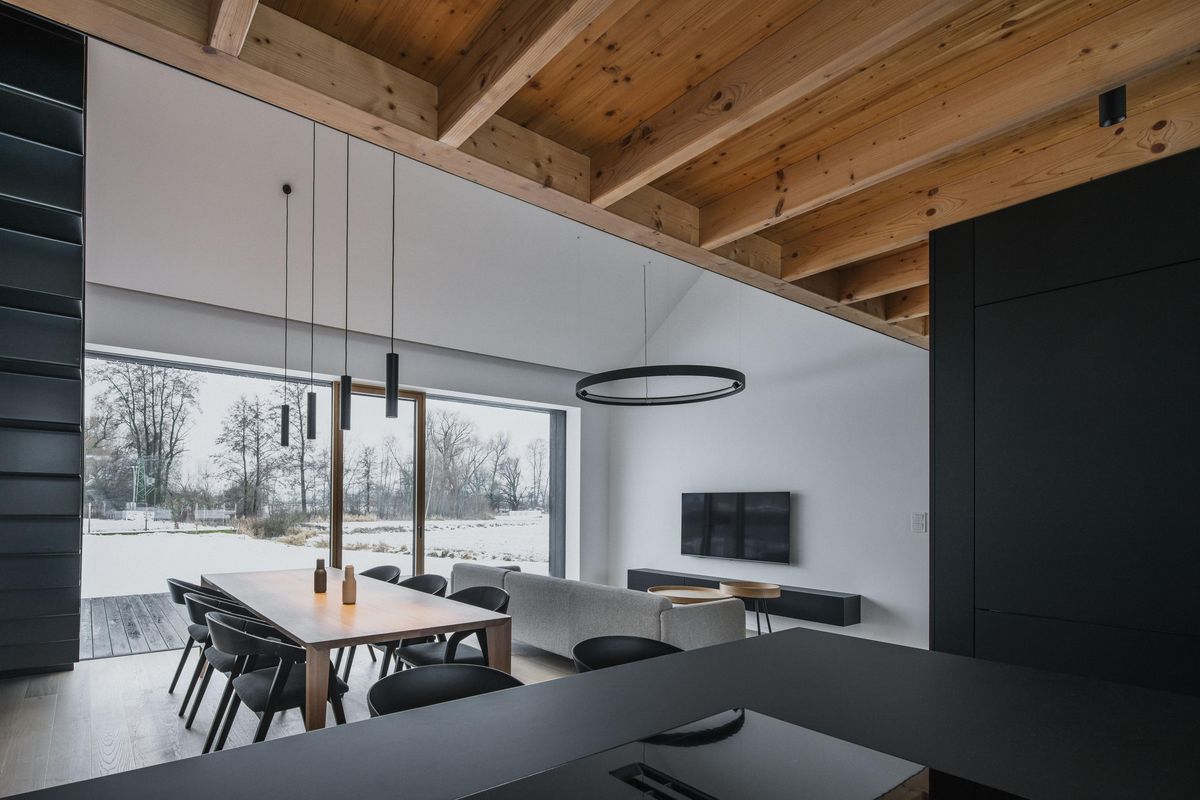
Photo: Petr Polák
Three Pillars of Design
Architect Lukáš Janout prioritized quality materials, modern technology, and energy efficiency throughout the project. The home’s dimensions were intentionally minimized to manage investment costs. The owners opted for exterior walls constructed with Ytong blocks and interior load-bearing walls and partitions made of calcium silicate bricks, combined with blown cellulose insulation. This insulation plays a key role in thermal and acoustic comfort.
The home’s energy system relies on a geothermal heat pump with a ground collector spanning 300 meters. A forced ventilation system with heat recovery is also included. This combination offers low operating costs, emission-free heating, and the potential for passive cooling.
Private Retreat
The private zone provides the necessary privacy for each family member. Frameless doors with hidden baseboards, used throughout the house, clearly delineate the boundary between the central living space and the private area: children’s rooms and the master bedroom.
The master bedroom features a hidden door leading to the master bathroom, creating a clean and uncluttered space. From the bed, the parents have a view of the landscape, while a low carpentry element maintains a sense of intimacy.
Both the parents’ and children’s bathrooms utilize light-colored, large-format tiles to visually expand the space. Unique vanities placed on wooden cabinets and recurring black accents—such as faucets, switches, and towel racks—add to the design. A practical feature is the toilet with integrated odor extraction.
Technical Specifications:
Architectural Studio: LUNI
Living Area: 76.78 m2
Usable Area: 192.60 m2
Manufacturers and Suppliers:
Structure: Ytong exterior walls, calcium silicate bricks Silka for interior load-bearing walls and partitions, Climatizer Plus blown cellulose insulation; aluminum roofing: Satjam Rapid DeLuxe, with AluMat RAL 9005 surface; gutters: Satjam Niagara; interior doors: Eclisse ČR; kitchen: Kuchyně&Interiéry Soukup; lighting: Profi lighting; tiles: Casalgrande Metropolis; faucets: Tres
Heating: geothermal heat pump with ground collector