
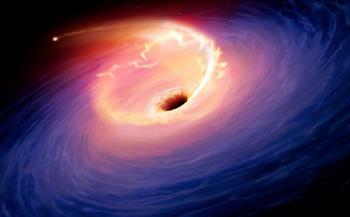
Astronomers have discovered a supermassive black hole from the early universe that is growing at an unprecedented rate, exceeding the theoretical maximum for black hole growth by a factor of thirteen. The finding, reported by the British newspaper Daily Mail, relied on advanced telescopes capable of peering back approximately 12 billion years, shortly after the universe’s formation.
During these observations, researchers identified a black hole with a mass roughly 440 million times that of our Sun. This suggests an exceptionally rapid growth rate during the early cosmic period. The discovery challenges existing physical models that posit an upper limit to how quickly black holes can grow.
Current physics dictates that as black holes consume matter, the resulting radiation pressure counteracts the inflow of gas and dust, limiting further accretion. Though, the black hole, designated ID830, appears to have overcome this limitation, making it a candidate for the fastest-growing supermassive black hole of its kind observed to date. This finding could reshape our understanding of black hole evolution in the early universe.
Scientists hypothesize that this accelerated growth may be the result of a collision between the black hole and a star or a massive clump of gas. Such an event would provide an additional influx of material and energy, accelerating the feeding process. The research highlights the dynamic and often chaotic conditions that characterized the early universe, where such collisions were likely more frequent.
