
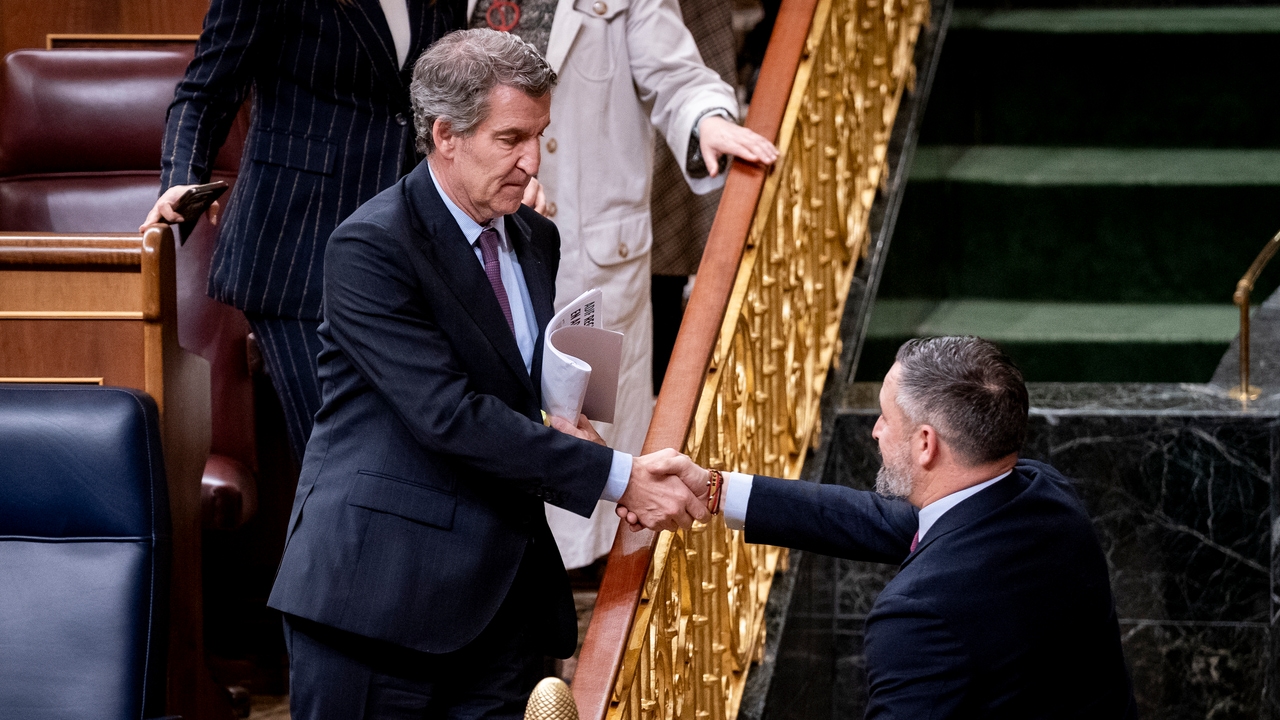
Alberto Núñez Feijóo has moved to rein in regional leaders amid contentious negotiations with Vox to form governing coalitions. The national leadership of the People’s Party will now directly oversee agreement-making with the far-right party, following uncertainty expressed by María Guardiola regarding securing Vox’s support for a regional government in Extremadura. This shift has been welcomed by Vox, with Secretary General Ignacio Garriga stating they will grant the ‘populares’ a “new opportunity” after the change in approach from party headquarters.
The move aims to facilitate agreements and ensure they align with the national party’s positions, according to Cuca Gamarra. Details of those “national positions” were outlined in a document released Monday, which lays out guidelines for negotiations, including what Feijóo later described as “red lines” in an interview with ‘Onda Cero.’ The PP publicly released what it called a “framework document for ordering agreements and providing stable governments to the autonomous communities of Spain.”
These “guidelines,” as the PP refers to them, incorporate positions favored by the far-right on issues such as migration and violence against women. The document acknowledges a “loss of control” over migration policy in Spain, raising concerns about “intolerable” levels of irregular migrants and reiterating support for banning the burqa and niqab – measures previously rejected by the Congress of Deputies. Regarding violence against women, the document condemns all forms of violence equally, stating that “the condemnation of all forms of violence must be unequivocal.” The PP also appears to align with Vox’s stance against “climate policies that destroy jobs, raise energy prices and expel industry.”
This strategy, intended to avoid a repeat election, was defended Monday evening by Feijóo, who said he had a telephone conversation of “approximately one hour” with Santiago Abascal on Sunday, a discussion he described as “long, fruitful and clarifying” that led him to believe a pact between the two formations “may be possible.”
“We set some order into this constant noise that seems to be entrenched in Spanish politics and that is also affecting the PP and Vox,” Feijóo explained in the ‘Onda Cero’ interview. “It would be irresponsible of both parties if they failed to accredit a viable alternative in our country. As far as I am concerned, I will not break the result of the polls. And the result is clear: the PP wins, does not have a majority and needs the support of Vox. It will not be for me to prevent it.”
From “Red Lines” to “Basic Lines”
This “order” takes shape in the document and seeks to calm the waters ahead of the elections in Castilla y León, where they may also need to negotiate with Abascal’s formation. In that region, Alfonso Fernández Mañueco already knows his government will require approval from party headquarters. The move underscores the challenges facing the PP as it attempts to forge governing coalitions.
The PP also appears to accept Vox’s reluctance to explicitly commit to joining regional governments. In recent weeks, the ‘populares’ had invited the far-right to participate in governments in Aragón and Extremadura, given Vox’s desire to avoid exposure while polls continue to show them as the fastest-growing party in Spain. Feijóo explained that Abascal wants “first a political agreement program” and, once achieved, “they will talk about whether or not they want to enter the governments,” leaving open the possibility that Vox may not join the governing coalitions.
the conversation has shifted from “red lines” to “basic lines” on which the PP –says– will not concede. Feijóo stated he will not agree with Vox to “anything against the Constitution” or support “an insubordinate program against the laws.” He also alluded to that “red line” when referring to EH Bildu, a formation with which he advances that he will not “talk or negotiate,” just as with “the independentists outside the Constitution.” This is the latest twist in the PP’s complicated relationship with Vox.
*Sigue a laSexta en Google. Toda la actualidad y el mejor contenido aquí.
