
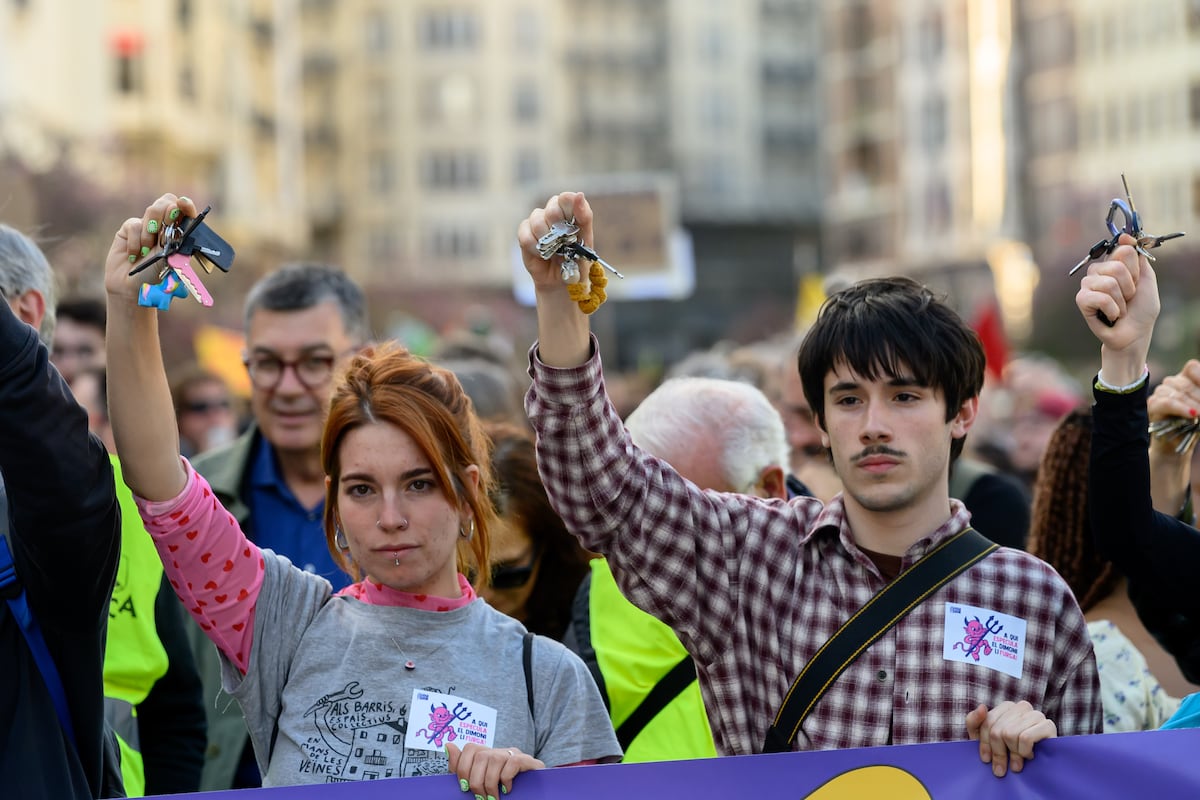
A growing number of young adults are distancing themselves from the term “feminist,” even whereas supporting the idea of gender equality, according to recent reports. The shift reflects a complex interplay of factors, including the rise of right-wing movements, economic anxieties, and a perception that the goals of feminism have already been largely achieved.
“I am a feminist, but it’s true that people now understand it as something completely different; if you ask, they’ll tell you they aren’t,” said Mónica Rubio, a 20-year-old student. Her sentiment underscores a key dynamic within the fourth wave of feminism – the movement that gained prominence over the last decade, bringing issues of sexual violence and pay inequality to the forefront – as it loses traction among those aged 14 to 29.
Multiple studies suggest the expansion of far-right movements has played a role, with these groups utilizing social media to disseminate messages criticizing perceived “excesses” of feminism and promoting a return to traditional gender roles. These trends are also linked to broader social and economic concerns, particularly around housing, and a belief that women’s advancements are, in some way, responsible for current hardships.
Recent legislative victories, such as the reform of abortion laws and the passage of the Sexual Freedom Law, have fueled a perception among some that women are gaining an unfair advantage and encroaching on opportunities for men. Addaia Martínez, a first-year education student, explained, “They say that women already have everything they need, that there’s no point in continuing to fight, and that we’re demanding more than we should. According to them, what we want is to prioritize ourselves over men.”
The Power of Language
In Spain, the percentage of young people identifying as feminist surpassed those who did not in 2019, peaking in 2021. Since then, the numbers have declined, with language playing a significant role in this shift. Paloma Narbona, a classmate of Rubio’s, noted that “now the term is being taken to a more radical point than it was before.” She clarified, “I identify with the idea that there needs to be equality.”
During an International Women’s Day event on March 4, Spanish Prime Minister Pedro Sánchez referenced “the ideologues of this reactionary wave” and acknowledged their success in making the word “feminism” a term uttered “with distrust,” particularly by men. He also pointed out that “many of those who say ‘I am not a feminist’ defend principles that are, such as their sister getting the same pay as them or their friend being able to come home alone without fear.”
Data from the Institute of Youth studies illustrates this trend. In 2019, 74% of people aged 15 to 29 identified with gender equality, and 64% with feminism. By 2023, both figures had fallen to 62% and 54%, respectively, maintaining the gap between the two.
This shift is part of a broader “culture war” where a reactionary discourse questioning the very concept of feminism – literally, equality between men and women – has gained traction, especially among Generation Z. Simultaneously, this discourse consistently attributes any negative consequences for men to the progress made by women.
A Sense of Grievance Among Men
A recent Ipsos report, released this past Wednesday with interviews conducted in 29 countries, revealed a paradox in Spain: it’s the only country analyzed where half the population (51%) identifies as feminist, yet also where men report the greatest sense of grievance regarding advancements in equality (60%), placing it “at the forefront of skepticism in Europe.” Martínez, the education student, observed, “The men aren’t in favor of it at all, and more and more women aren’t either.”
The Ipsos report further detailed that “the narrative of male grievance finds its catalyst among right-wing voters and younger men (especially centennials). While older generations and left-wing voters largely support shared responsibility, a segment of young people experiences equality as a clash of rights.”
A recent analysis by the European Policy Centre, a Brussels-based think tank, linked the success of parties like Vox among men under 30 to “frustration” over educational and wage setbacks compared to women. While data shows women have made gains in education over the past four decades, the employment gap persists, with the wage gap remaining stagnant at 20%, according to a February report from the Comisiones Obreras (CC OO) union. Despite this, many young men perceive a different reality: that these gaps no longer exist or that women are now privileged.

“I think it has improved. Both men and women are pursuing the careers they want,” said Salomé García, a 19-year-old chemistry student at Complutense University of Madrid. Maksim Myronenko, an 18-year-old law student at the same university, added, “I know that some earn less and I think that’s wrong. But companies are required to hire a certain number of women and that doesn’t happen with men. They are less qualified and secure preference.” Myronenko was referring to the Parity Law, which establishes a minimum of 40% representation for the underrepresented gender in leadership positions within listed companies, unions, and public administration.
The Illusion of Equality and Growing Disenchantment
This dynamic is connected to what’s being called the “illusion of equality” – the idea that the goals of the feminist movement have already been achieved and that certain injustices have been resolved, leading to the perception that any demands made by women are “going too far,” or even “discriminating against men.” A February survey by the Fad Juventud organization, dedicated to promoting youth well-being, found that 39.1% of women and 52.8% of men believe that feminism is a tool for political manipulation.
Anna Sanmartín, the organization’s research director and responsible for the report, explained that the high percentage of girls who say they don’t know or don’t want to take a position on feminism is also relevant, indicating a lack of clarity and a breakdown of consensus.
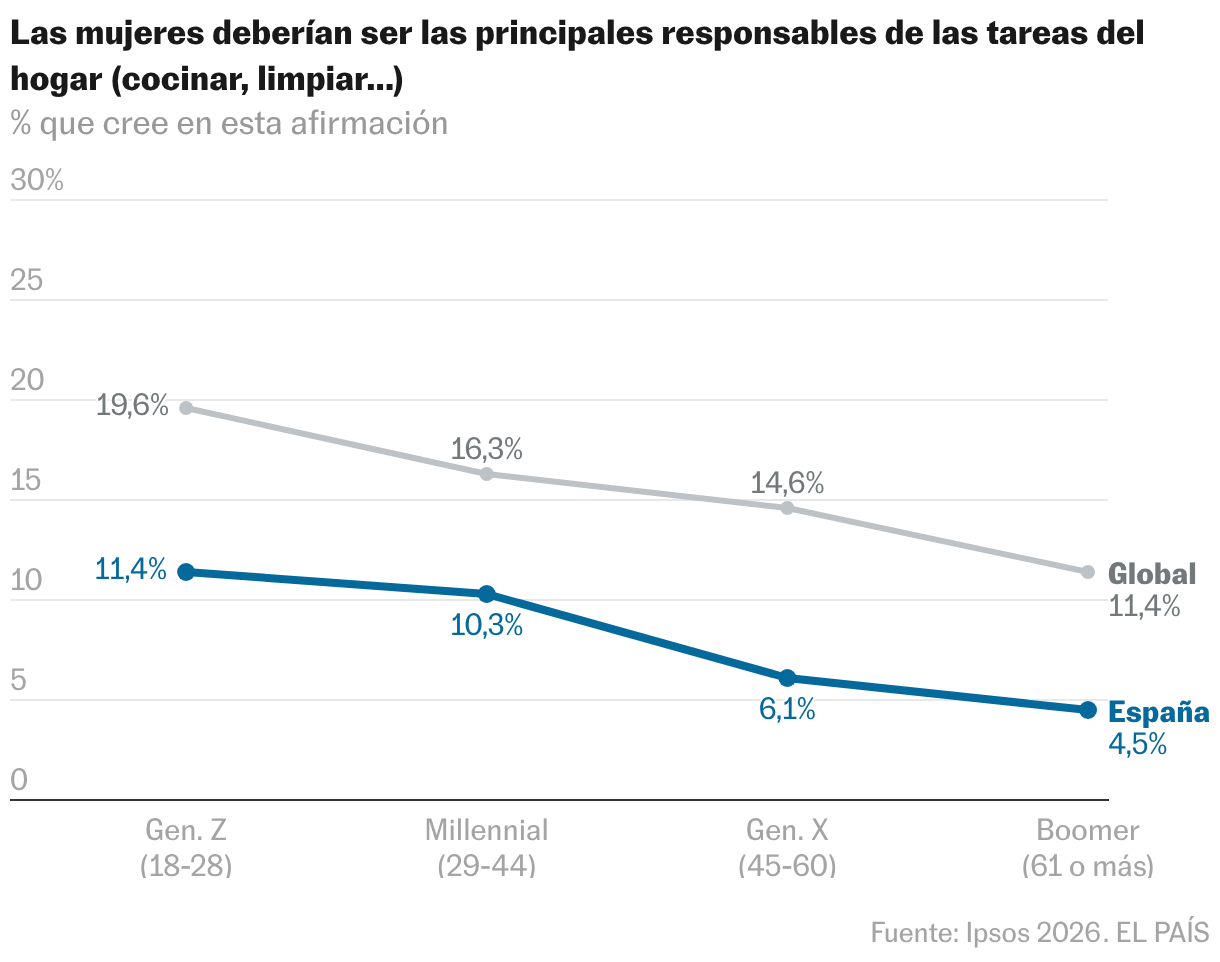
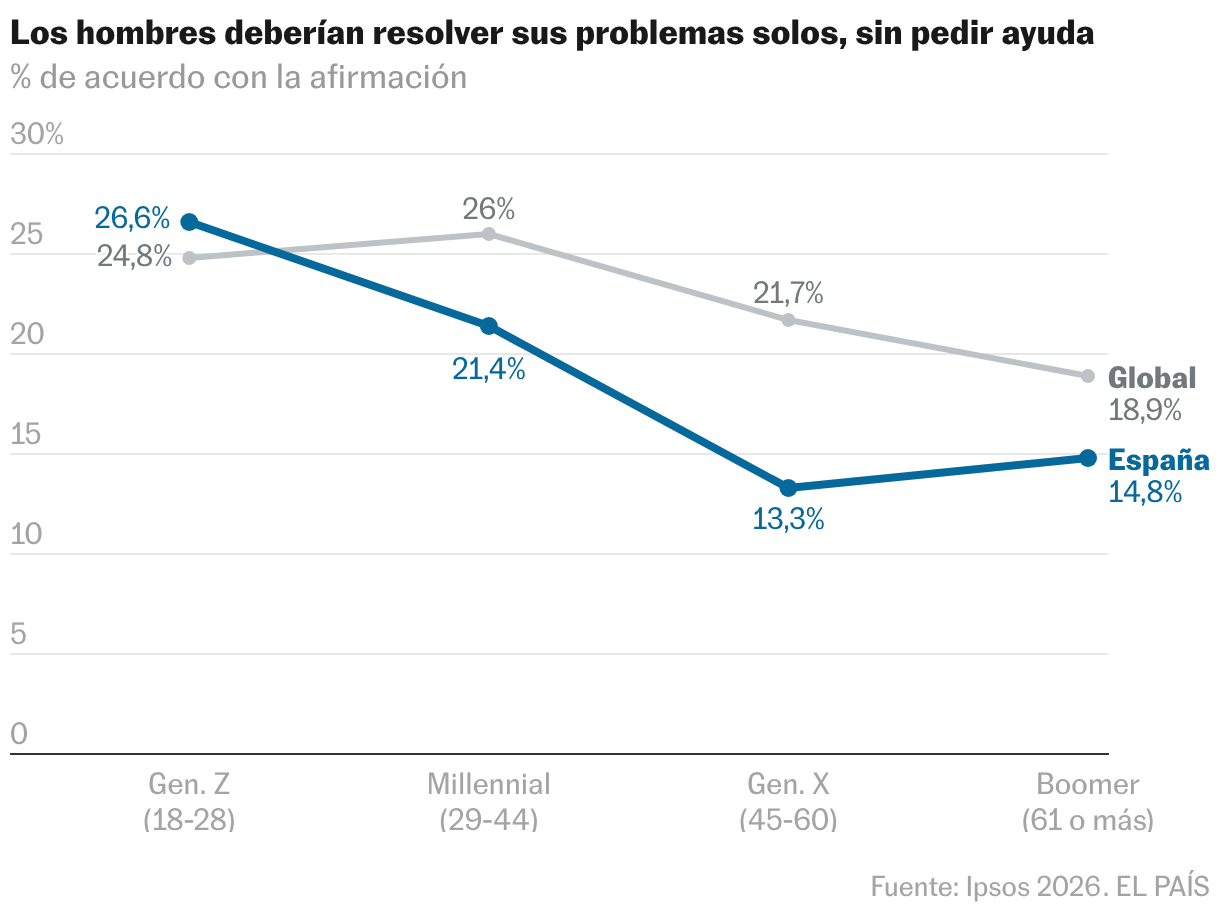
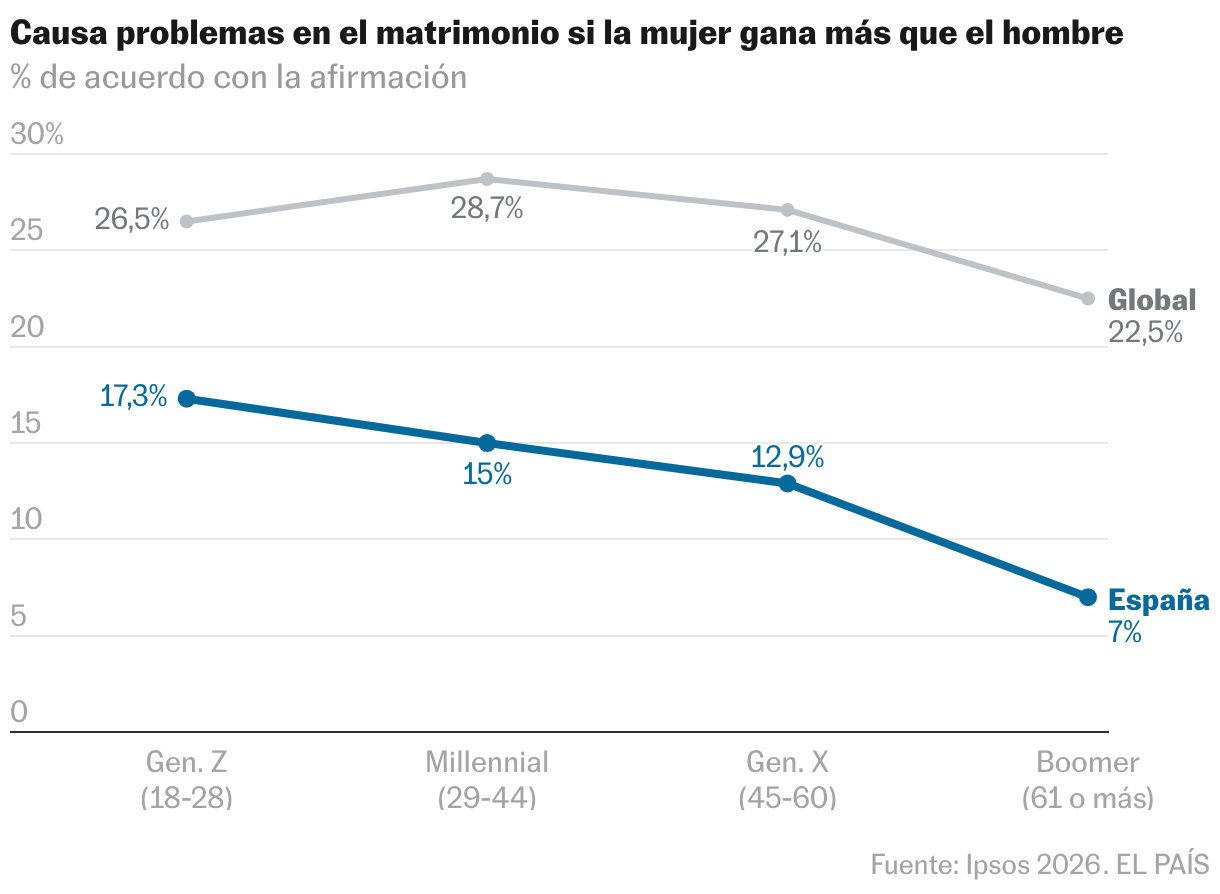
Underlying this is a widespread perception of the economic, political, and social situation. At the root of this disenchantment is a system that has failed to address their needs and concerns: confidence in politics has fallen to historic lows since the advent of democracy, and Notice no guarantees that education and hard work will lead to stable employment and homeownership.
According to sociologist and philosopher Lionel Delgado, sadness, anger, and confusion about the future, combined with a lack of progressive proposals and an overwhelming amount of conservative rhetoric, have led young men to view institutional feminism as a “lobby,” the enemy. The founder of Bróders – a forum for young men to share doubts and seek support – argues that progressivism failed to pay attention until it was too late, when Vox had already begun to rise in the polls.
In the latest barometer poll from 40dB for EL PAÍS and Cadena SER this past Wednesday, the Abascal’s party reached an estimated vote share of 18.8%, its highest in the series since the July 2023 elections. Among Generation Z men, that figure was 41%. This proves the party that dominates among men, ahead of the PSOE (23.9%) and the PP (16.5%). The PSOE leads among women, with 23%, followed by the PP (19.6%) and Vox (16.4%). The resistance to the rise of the far-right comes from women, in part because the right has structured its ideology, often with false or biased data and news, around attacks on them and feminism.
The Spread of ‘Fake News’
A key message has been the claim of false accusations. According to a Fad Juventud barometer, 43.4% of women and 57.6% of men believe that men are unprotected against false accusations. According to the latest report from the Public Prosecutor’s Office, released last September, there were 199,094 reports of gender-based violence in 2024, with just 17 cases involving false accusations – representing 0.009% of the total. In 9 cases, investigations were not initiated; 7 are currently underway; and 1 has a non-final conviction, representing 0.0005% of the total. Martina Farré, a 20-year-old business administration student, commented, “There are many false accusations, but when it’s real, I think they are too lenient, they should be sentenced to much longer prison terms.”

The far-right has been successful in capitalizing on the anxiety and confusion surrounding the increased exposure and visibility of male violence, particularly sexual violence. They have framed it within their own narrative, with Vox speaking about false accusations as a basis for arguing that male violence doesn’t exist, and advocating for a punitive approach – a common theme among far-right parties worldwide.
Delgado, the sociologist, describes the difficulties young people face in navigating these issues. He points out that in his workshops, girls no longer see themselves reflected in or locate useful the narratives for understanding how to relate to friends or boyfriends who “resist seeing the guys they have around as potential abusers,” which is what anti-feminist movements have promoted as the idea of feminism: that all men are abusers.
They, he says, “see that they are improving and are quite accessible or are concerned and are trying to do things the best they can.” He argues that the distancing “has to do with that very violence-centered discourse that is reaching a kind of conclude of cycle.” It no longer provides an outlet for their discontent.
A Need for Adaptation?
This push and pull dynamic among some young people is also related to the political context. Luis Miller, a researcher at the CSIC and author of the book Polarized, adds that in a moment of “great ideological confrontation,” it’s a powerful argument for the right that feminism within the left is fragmented. “A political strategy always tries to find what divides your rival.”
Gonzalo Sitges, a first-year international business student, believes that when certain political parties adopt something as a banner “they reject those on the other side” and that issue becomes associated with an ideology: “There are people who go too far: if you’re not with us, you don’t support equality.”
Miller believes it’s time for feminism to adapt how it communicates. The analyst argues, “This powerful message of a claim against grievances, because we came from an extreme situation, at some point has to change, because, if not, there are large parts of the population that understand it as an exaggeration.” At the same time, he says, “we are failing to recognize the advances that the movement has made in reducing that inequality.”
Soledad Murillo, a sociologist and former State Secretary for Equality, stresses that no one is interested in abstractions: “What resonates is an emotional discourse to explain that it is a movement of emancipation.” The professor is convinced that “equality policies have been experienced as something alien to the personal” and that it’s time to move from the language of rationality to that of emotion.
“It all has to do with subjectivity. Since they haven’t experienced feminism as something that offers advantages, but as something that restricts behaviors, it has been interpreted as an illegitimate invasion. Both in boys and girls.” When, in fact, feminism is the opposite: “freedom,” for them, and also for him.
