
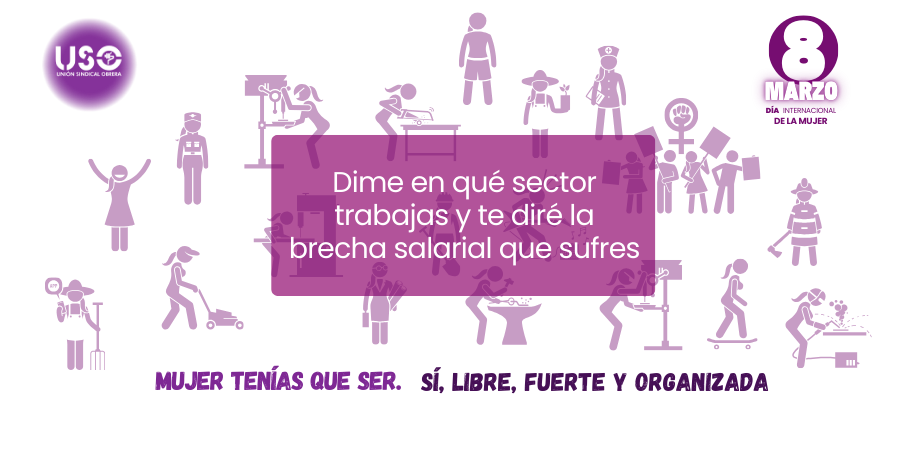
Gender Wage Gap Persists Across Key Sectors in Spain
A modern study reveals significant disparities in pay for women across various industries in Spain, highlighting a deeply ingrained structural inequality in the labor market. The report, titled “Gender Wage Gap by Productive Sectors” and conducted by Syndex for USO, found that 83% of employed women are concentrated in just four sectors: social services (23%), commerce, repairs and transport (22%), business services (15%), and other personal and leisure services (13%). This concentration contrasts with 65% of men working in those same areas.
The uneven distribution of men and women across industries isn’t accidental, but rather reflects established social dynamics and a historical division of labor. According to the study, jobs traditionally held by women are often undervalued, particularly those related to care, support, and personal services, despite their essential nature. This contributes to a systemic wage gap that impacts women’s earning potential.
Sector-Specific Disparities
While a wage gap exists across the entire economic system, its intensity varies by sector, and region. The gap is as low as 6% in construction and real estate, but reaches 30% in agriculture, livestock, forestry, and fishing. These differences highlight areas where focused negotiations are most critical.
The wage gap is a cumulative result of factors including sector, job type, working hours, and career trajectory. Regional variations also play a role, with the gap widening in areas where employment is seasonal or outsourced. The study emphasizes that the gender wage gap is a structural issue tied to the organization of the production system and the unequal distribution of care responsibilities.
Here’s particularly evident in feminized sectors like social services, where part-time work, discontinuity, and limited access to benefits are more common. Conversely, in male-dominated sectors like industry and energy, the gap widens with age due to seniority and benefits tied to availability and continuous employment.
Analyzing the wage gap by sector provides valuable data for developing targeted strategies to address gender inequality. The findings underscore the need for tailored approaches to close the gap and promote equal pay for equal work.
Notable Sector Findings
In agriculture, livestock, forestry, and fishing – a heavily masculinized sector employing 582,306 workers (71% men, 29% women) – the average annual salary is €11,425. However, women in this sector earn an average of €8,746 annually, compared to €12,534 for men, resulting in a 30% wage gap – the highest of all sectors analyzed. This disparity is attributed to women being concentrated in more temporary, discontinuous, and less-recognized roles like harvesting and processing.
The extractive industries, energy, and water sector, employing 231,094 people (75% men, 25% women), has an average annual salary of €33,997. Women earn €30,658 on average, while men earn €35,130, creating a 13% wage gap. The sector is characterized by strong masculinization and occupational segregation, with men dominating technical positions and having greater access to salary supplements.
The industrial sector, with 1,935,610 workers (70% men, 30% women), has an average annual salary of €29,354. Women earn €25,291, while men earn €31,122, resulting in a 19% wage gap. The study notes that gender roles and stereotypes continue to influence the industry, with women overrepresented in administrative and support functions and underrepresented in specialized roles offering greater opportunities for advancement and bonuses.
Construction and real estate, while highly masculinized, reveal the smallest wage gap at 6%. However, access to the sector remains unequal, and occupational segregation persists, with women primarily concentrated in office and support roles.
Commerce, repairs, and transport, the largest sector with 4,467,584 workers (56% men, 44% women), has a 25% wage gap. Women are primarily located in lower-paying retail and customer service positions, while men dominate higher-paying roles in transportation and management.
In information and communications, a competitive sector with an average salary of €38,548, women earn €33,393 compared to men’s €41,531, resulting in a 20% wage gap. This is attributed to occupational segregation, with women concentrated in support, coordination, and administrative roles, facing a “tech ceiling” and limited representation in high-demand ICT positions.
Financial and insurance entities, the highest-paying sector with an average salary of €50,614, have a 28% wage gap. Despite a relatively balanced gender ratio (53% women, 47% men), significant salary differences exist, with women underrepresented in higher-level positions.
Business services, employing a balanced workforce (52% women, 48% men), show a 28% wage gap, with women concentrated in administrative, auxiliary, and cleaning roles, while men occupy more technical, security, and sales positions with variable compensation.
Social services, a heavily feminized sector employing 65% women, has an 18% wage gap. The sector encompasses healthcare, social assistance, and care for the dependent, with wages varying significantly based on the specific service. Externalization and privatization exacerbate wage inequality.
Other personal and leisure services, employing 53% women, have a 24% wage gap, with lower overall salaries impacting women disproportionately due to occupational segregation, differing working hours, and limited job security.
Regional Variations
The analysis also revealed regional disparities. Andalusia shows high wage gaps in agriculture (34%), business services (31%), commerce and industry (29%), and social services (22%). Madrid exhibits large gaps in financial and insurance (34%), business services (30%), commerce (22%), and information and communications (19%). Catalonia shows more moderate but consistent gaps ranging from 0% in agriculture to 25% in commerce, repairs, and transport, and business services. The Valencian Community faces significant gaps in extractive industries, energy, and water (26%), as well as commerce, repairs, and transport (28%), and business services (28%).
USO emphasizes that the gender wage gap is not a temporary phenomenon but a direct result of the organization of the production system, the sexual division of labor, and the unequal distribution of care. Addressing this requires structural transformations in female-dominated sectors, focusing on reducing part-time work, discontinuity, outsourcing, and unequal access to benefits and promotions. Collective bargaining, equality plans, and public policies must prioritize sectors and regions with the most persistent gaps, incorporating specific measures to recognize and revalue feminized jobs.
Reducing the wage gap is not only a matter of social justice but also essential for building a fairer, more efficient, and truly equal labor market. USO is committed to closing these gaps and calls for comprehensive measures and targeted strategies to improve the working conditions for women.
