
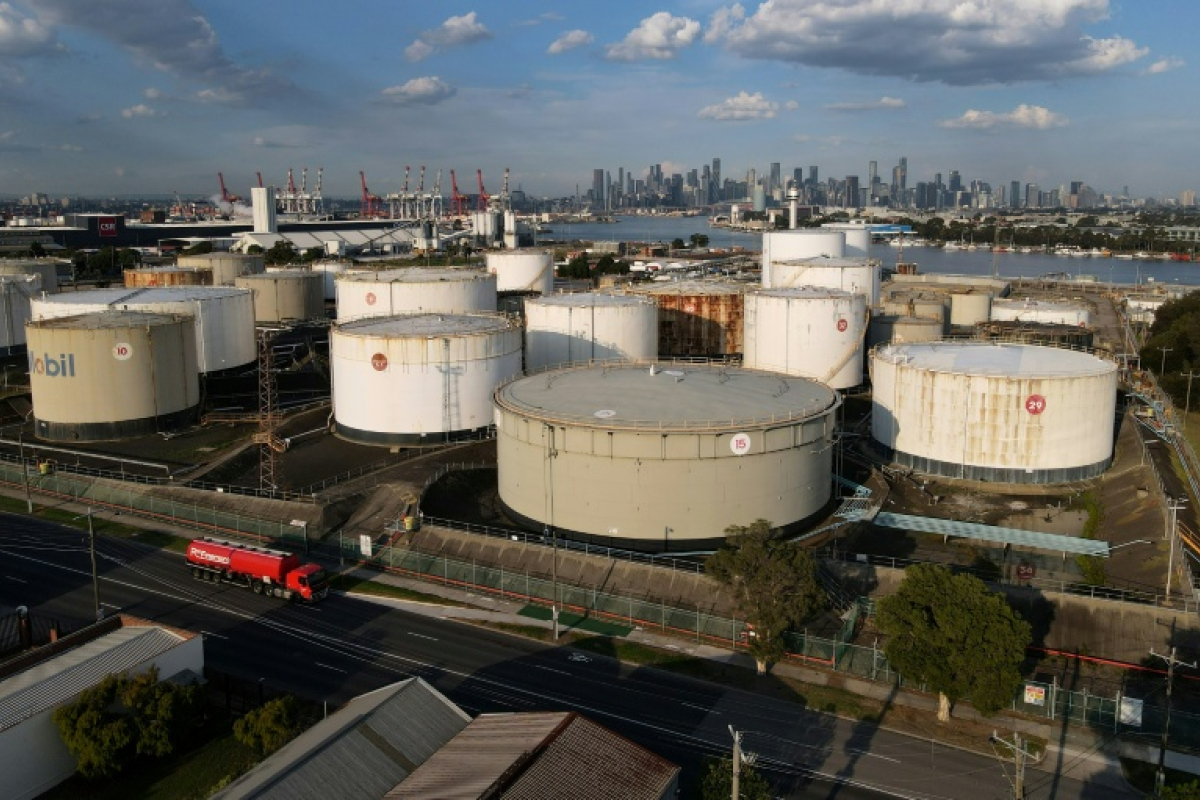
Le centre de distribution de carburant Mobil dans la banlieue de Yarraville, à Melbourne, le 23 mars 2026 ( AFP / William WEST )
Global economic developments are being closely watched on Tuesday, March 23, 2026, as the conflict in the Middle East enters its 25th day.
Trump Claims Iran Offered U.S. “A Very Big Gift” Related to Hydrocarbons
U.S. President Donald Trump stated Tuesday that Iran had offered the United States “a very big gift” concerning hydrocarbons, though he provided no specific details.
“It was a very big gift, the equivalent of a lot of money,” the President told reporters, adding that the U.S. Is currently negotiating “right now” with Iran for a ceasefire, with Steve Witkoff, Jared Kushner, JD Vance, and Marco Rubio participating in the discussions.
Dollar and Oil Rise, Wall Street Mixed
The U.S. Dollar strengthened Tuesday, benefiting from rising energy prices amid continued uncertainty surrounding potential negotiations between Washington and Tehran. As of 6:20 PM GMT, the greenback gained 0.22%, trading at 1.1587 dollars per euro.
Crude oil prices also surged, with Brent crude for May delivery jumping 4.55% to $104.49 per barrel by 7:00 PM GMT. West Texas Intermediate, also for May delivery, rose 4.79% to $92.35 per barrel. The price swings reflect the sensitivity of energy markets to geopolitical risk.
European stock markets finished Tuesday’s session with mixed results. Paris gained 0.23%, London rose 0.72%, and Milan increased 0.42%, while the German stock exchange declined 0.07%.
Wall Street also showed hesitancy. The Dow Jones gained 0.22%, while the Nasdaq fell 0.43% and the S&P 500 was nearly flat as of 7:15 PM GMT.
French Economy Minister Foresees “A New Oil Shock”
The ongoing conflict in the Middle East is causing “a new oil shock” that risks weighing on France’s economic growth, according to French Economy Minister Roland Lescure, speaking Tuesday to the National Assembly.
“This is an oil shock. We’ve experienced about ten since 1950,” Lescure stated. “The assumption of a temporary crisis, the economic consequences of which would disappear with the complete of the bombings, is unfortunately no longer realistic,” he added, before the Finance Committee.
France’s INSEE Revises Down First-Half Growth Forecast to 0.2%
France’s national statistics institute, INSEE, slightly lowered its economic growth forecasts for the first two quarters of 2026 to 0.2% for each quarter, compared to 0.3% previously, due to the surge in hydrocarbon prices, according to its latest economic report released Tuesday.
The increase in oil and gas prices is expected to lead to “a sharp rebound in inflation,” which “would exceed 2% in the spring” in France, INSEE added.
Early Impacts on Economic Activity
Indicators measuring business activity revealed early impacts of the Middle East conflict on an economy already grappling with rising energy prices and supply chain disruptions.
In the United States, the Flash PMI for March, published by S&P Global and based on business surveys, fell to 51.4 points, compared to 51.9 points in February, reaching its lowest level since April 2025.
In the Eurozone, growth in private sector activity registered a “near standstill” (50.5 points versus 51.9), falling to its lowest level in 10 months, according to S&P Global.
Lufthansa, Cathay Pacific, and Air France Extend Flight Suspensions to the Middle East
Lufthansa Group announced the extension of the suspension of flights by all its airlines to the Middle East until the end of April, and even until the end of October for some routes.
Hong Kong-based Cathay Pacific has also decided to extend the suspension of its flights to and from Dubai and Riyadh until May 31.
Air France will also extend the suspension of its flights, including those “to and from Dubai and Riyadh, until March 31, 2026 inclusive (i.e., until April 1, 2026, for flights departing from Dubai).”
