
Google AI Processes 1.3 Quadrillion Tokens Monthly, Raising Questions About Environmental Impact
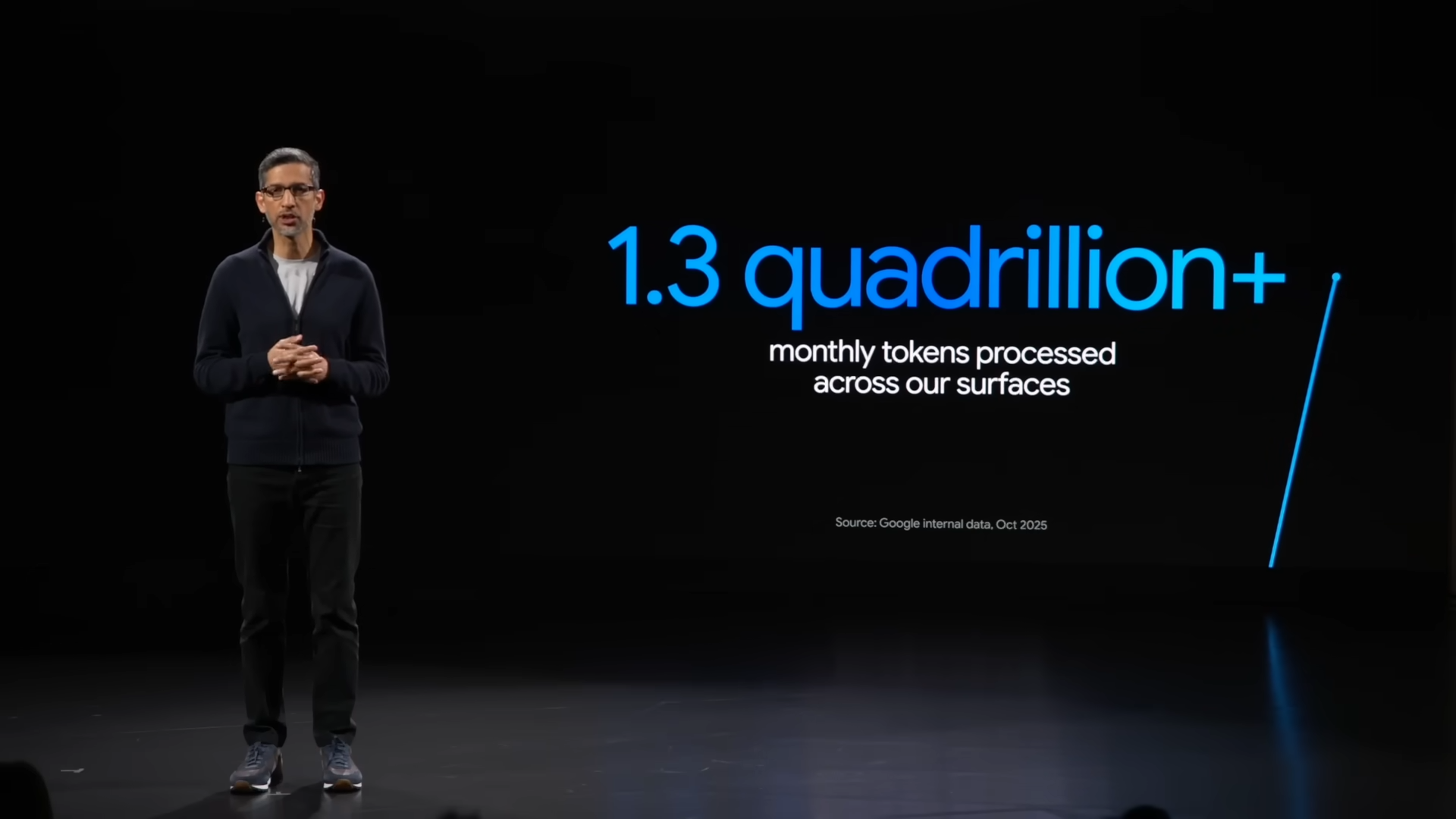
Google announced today that its artificial intelligence models now process more than 1.3 quadrillion tokens each month, a figure that highlights the rapidly increasing computational demands of AI development.
The milestone, revealed by Google CEO Sundar Pichai at a Google Cloud event, represents a significant jump from the 980 trillion tokens processed in June, though growth has begun to slow. Tokens are the fundamental units of processing for large language models, akin to fragments of words, and this massive number reflects the complexity of calculations performed by models like Gemini 2.5 Flash. This surge in processing power is enabling more sophisticated AI capabilities, but also raises concerns about energy consumption.
Analysis indicates that Gemini Flash 2.5 uses approximately 17 times more tokens per request than its previous version and is up to 150 times more expensive for reasoning tasks. The total also includes processing for video, image, and audio, though Google does not provide a detailed breakdown. The increasing token count is primarily a measure of backend computing load and infrastructure scaling, rather than a direct indicator of user activity. For more information on large language models, see IBM’s explanation of LLMs.
The announcement also casts a spotlight on Google’s environmental reporting, which claims a single Gemini request uses minimal resources – 0.24 watt-hours of electricity, 0.03 grams of CO₂, and 0.26 milliliters of water. Critics argue these estimates are based on simple text prompts and don’t account for the energy demands of more complex tasks. As reported in Wired, accurately assessing the environmental impact of AI remains a significant challenge. Google officials stated they will continue to refine their environmental assessments as AI technology evolves.
Google says it now processes more than 1.3 quadrillion tokens every month with its AI models. But this headline number mostly reflects computing effort, not real usage or practical value, and it raises questions about Google’s own environmental claims.
According to Google, it processes over 1.3 quadrillion tokens per month with its AI products and interfaces. This new brand was announced by Google CEO Sundar Pichai at a Google Cloud event.
Google announced the milestone during a recent Google Cloud event, with CEO Sundar Pichai highlighting the figure. Back in June, Google said it had reached 980 trillion tokens, more than double May’s total. The latest jump adds about 320 trillion tokens since June, but growth has already slowed, a trend not reflected in Pichai’s presentation.
Token consumption is growing faster than actual usage
Tokens are the smallest unit processed by large language models, similar to word fragments or syllables. A huge token count sounds like surging usage, but in reality, it’s primarily a measure of rising computational complexity.
Ad
The main driver is likely Google’s rollout of reasoning models like Gemini 2.5 Flash. These models perform far more internal calculations for every request. Even something as basic as “Hi” can trigger dozens of processing steps in today’s reasoning models before returning an answer.
A recent analysis showed that Gemini Flash 2.5 uses about 17 times more tokens per request than its previous version and is up to 150 times pricier for reasoning tasks. Moreover, complex features like video, image, and audio processing are likely factored into the total, but Google doesn’t break those out.
So, the token number is mostly a measure of backend computing load and infrastructure scaling, not a direct indicator of user activity or actual benefit.
Google’s token consumption vs. Google’s environmental claims
Google’s new token stats also highlight a key issue with Google’s own environmental report: by focusing on the smallest unit of computation, the study glosses over the real scale and environmental impact of AI operations. It claims a single Gemini request uses only 0.24 watt-hours of electricity, 0.03 grams of CO₂, and 0.26 milliliters of water—supposedly less than nine seconds of TV time.
These estimates are based on a “typical” text prompt in the Gemini app. Google doesn’t clarify whether this reflects lightweight language models (likely) or the much more resource-intensive reasoning models (unlikely). The study also leaves out heavier use cases like document analysis, image or audio generation, multimodal prompts, or agent-driven web searches.

Viewed in this light, Google’s 1.3 quadrillion tokens mainly highlight how rapidly its computing demands are accelerating. Yet this surge in system-wide usage doesn’t appear in Google’s official environmental assessment. It’s a bit like an automaker touting low fuel consumption while idling, then calling the entire fleet “green” without accounting for real-world driving or manufacturing.
