
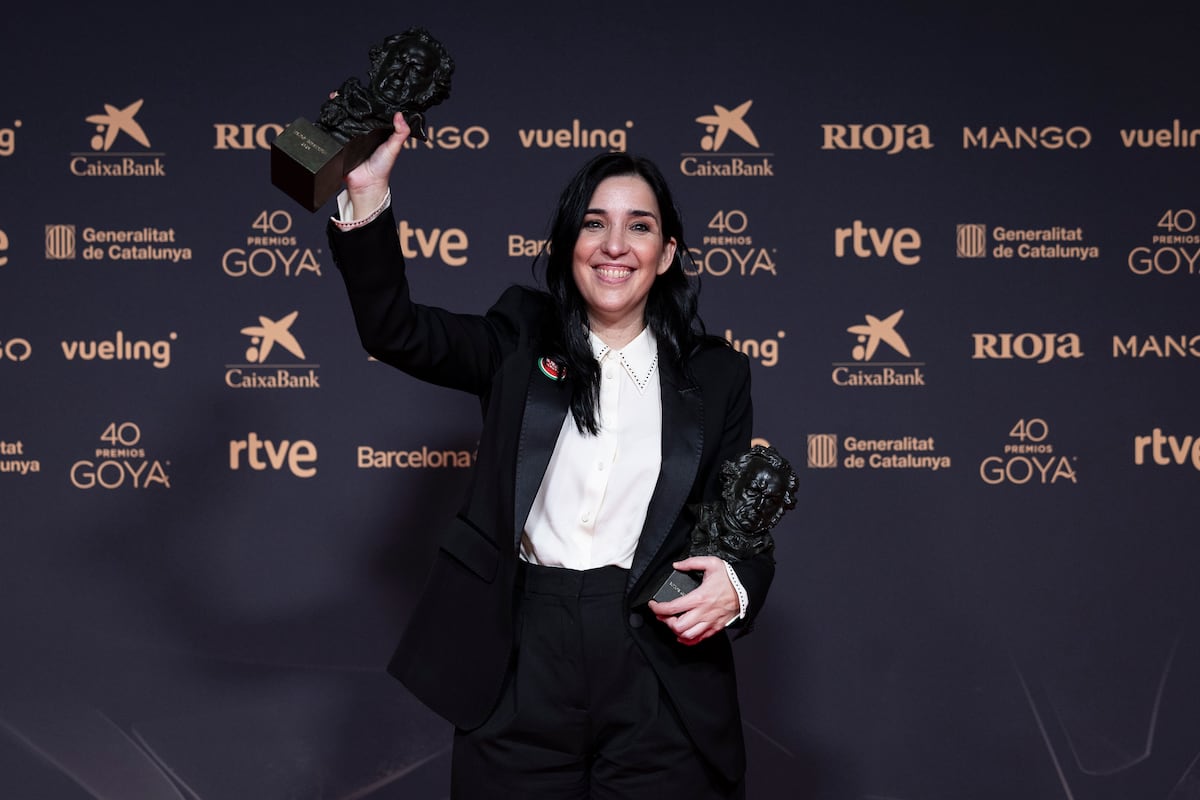
The concept of “intimacy” resonated throughout the 40th Goya Awards, as producers of the Best Picture winner, Los domingos, and the recipient of the Best Documentary award, Tardes de soledad, both touched on its significance. Sandra Hermida, a producer for Los domingos, spoke of “the intimate as political” although accepting the award for Best Picture this past weekend, echoing a sentiment previously expressed by Albert Serra upon receiving the Goya for Best Documentary.
Serra won his first Goya for the acclaimed Tardes de soledad, stating, “Today, many political themes are discussed, and this film, modestly, addresses how the political and ideological clash with intimacy…[Tardes de soledad] speaks to how a controversial topic—one not everyone likes—is experienced from a personal perspective.” Without explicitly naming it, Serra was referencing the ritual of bullfighting. Similarly, the creators of Los domingos alluded to another national tradition, that of the Catholic faith, without directly stating it.
This exploration of intimacy in Tardes de soledad clarifies the film’s perspective, but raises questions regarding Alauda Ruiz de Azúa’s vision in Los domingos, which centers on a teenager who decides to become a cloistered nun. The distinction between the intimate—always secret and enigmatic—and the personal or private—closer to the domestic and familial—is key. Both films, winners at consecutive years at the San Sebastián International Film Festival, revolve around religious concepts, and rituals. While Serra masterfully draws us into the antagonistic and brutal mystery of bullfighting—that of the animal and the bullfighter—Los domingos feels narratively confusing and problematic with the spiritual enigma surrounding its protagonist. This is the main weakness of the night’s big winner—taking home awards for Best Picture, Director, Original Screenplay, Supporting Actress Patricia López Arnaiz, and Nagore Aramburu—which largely mirrored predictions that favored Los domingos over its main competitor, Sirât, by Oliver Laxe.
Held on March 1, 2026, the gala served as a platform for various social and political causes, coinciding with the United States’ escalation of conflict in the Middle East. However, the film that best represents and confronts this turbulent present, Sirât, didn’t receive any of the major awards. Sirât did win six Goyas—for Best Sound, Editing, Original Music, Production Direction, Cinematography, and Art Direction—but despite its international success and selection as Spain’s entry for the upcoming Oscars, the film’s director and co-writer, Oliver Laxe, was overlooked by the Academy’s 3,000 members. This contradiction isn’t modern, but Sirât was still recognized. Its award recipients used the words “journey” and “adventure” to describe the experience of making the film, and its musician, Kangding Ray, dedicated his award to all the ravers of the world: “because we danced together and resisted together.”
The 2025 Spanish film harvest, like the international scene, deserves applause. Films like La buena letra, by Celia Rico, or Romería, by Carla Simón, were left out despite deserving more recognition, but there was plenty to choose from. It’s difficult to argue with the recognition given to the delicate debut, Sorda, which received three Goyas: Best Supporting Actor for Álvaro Cervantes, Best New Actress for Miriam Garlo, and Best New Director for Eva Libertad. The moving Maspalomas rightfully earned its lead actor, Jose Ramon Soroiz, a Goya. Its cast works like a well-oiled machine. Both Sorda and Maspalomas bring visibility to previously unseen realities.
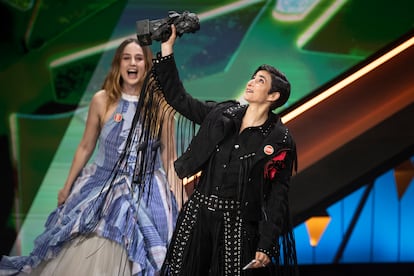
Manuel Gómez Pereira and Joaquín Oristrell won the Goya for Best Adapted Screenplay for the fun La Cena, and they highlighted another type of invisibility—that of comedy. Alba Flores and Sílvia Pérez Cruz won the award for Best Original Song for Flores para Antonio, and their speech was a standout moment of the night. Through Pérez Cruz’s guidance, the daughter of Antonio Flores has discovered her own voice, confronting the grief of her father’s death, her orphanhood, and even the powerful figure of her grandmother—another icon of Spanish culture—from a place of intimate truth.
The Goya Awards celebrated works centered around core Spanish identities—bullfighting, the church, and even the Flores family—but the place of Spanish cinema within our culture remains a question. Academy President Fernando Méndez-Leite accepted with resignation that people now talk more about “movies” than “films” as he stepped down from his role. And the honorary award recipient, Gonzalo Suárez, defended the continued relevance of cinema despite the passage of time: “Cinema is the last refuge for daydreaming. And that reminds me of the first bison that our ancestors painted in the caves. I am proud that cinema has survived the internet and the caves, even if now the bison is me.”
