
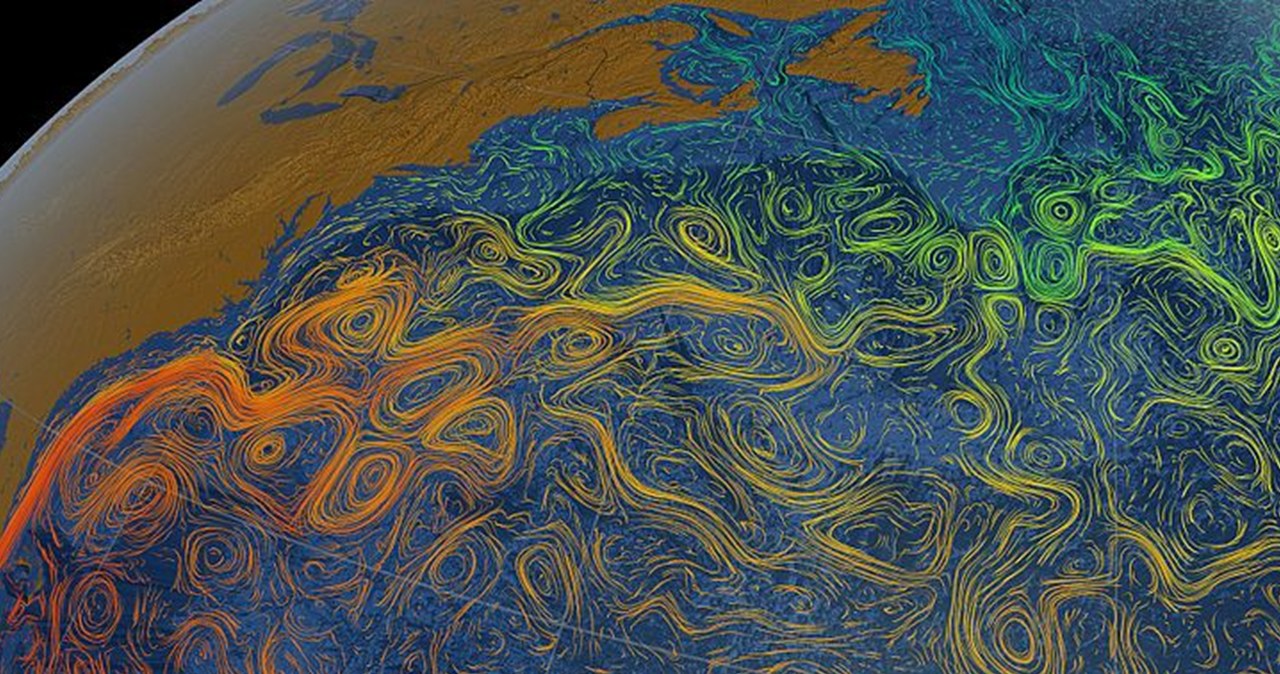
Ocean currents are often perceived as stable and slow-moving – vast rivers of water flowing through the oceans for millennia. However, latest research suggests that one of the most important elements of this system may be behaving far more erratically than previously thought. Scientists are warning that a shift in the Gulf Stream’s path could be an early warning sign of a collapse of the massive Atlantic Ocean circulation system.
Oceanic “Conveyor Belt” Transporting Heat
The Gulf Stream is part of a much larger mechanism – the Atlantic Meridional Overturning Circulation (AMOC). This system functions like a giant conveyor belt, transporting warm water from the tropics northward into the Atlantic, influencing the climate of Europe and North America. A shutdown of the AMOC could have dramatic consequences, particularly in Europe, where temperatures could plummet.
Researchers at Utrecht University used computer simulations to model the potential impacts of such a collapse. Their findings, published in Communications Earth & Environment, utilized a high-resolution ocean model and gradually added freshwater to the North Atlantic – mirroring the real-world effects of melting glaciers. Diluting the salty water slows down the oceanic “conveyor belt.”
The simulations revealed a critical and surprising moment. As the AMOC weakens, the Gulf Stream abruptly shifts its position, moving as much as 219 kilometers (136 miles) northward within just two years. This shift occurred approximately 25 years before a complete circulation collapse in the model.
Perhaps even more concerning, similar signals are appearing in real-world data. Analysis of satellite measurements from the last three decades, along with depth records dating back to 1965, indicates the current is already beginning to move away from the coast near Cape Hatteras.
Early Warning Signal
Researchers also observed other troubling signs. In regions where the current is shifting, waters are warming more rapidly than before, and the deep boundary current flowing beneath the Gulf Stream is also demonstrably weakening.
“These results provide indirect evidence of a contemporary weakening of the AMOC and show that abrupt changes in the Gulf Stream path may act as an early warning signal of the system reaching a critical transition,” the study authors conclude.
While a collapse isn’t yet inevitable, the research suggests the oceanic mechanism regulating the Northern Hemisphere’s climate may be approaching a stability threshold faster than scientists previously believed.
Source: René M. Van Westen et al, Abrupt Gulf Stream path changes are a precursor to a collapse of the Atlantic Meridional Overturning Circulation, Communications Earth & Environment (2026). DOI: 10.1038/s43247-026-03309-1
