
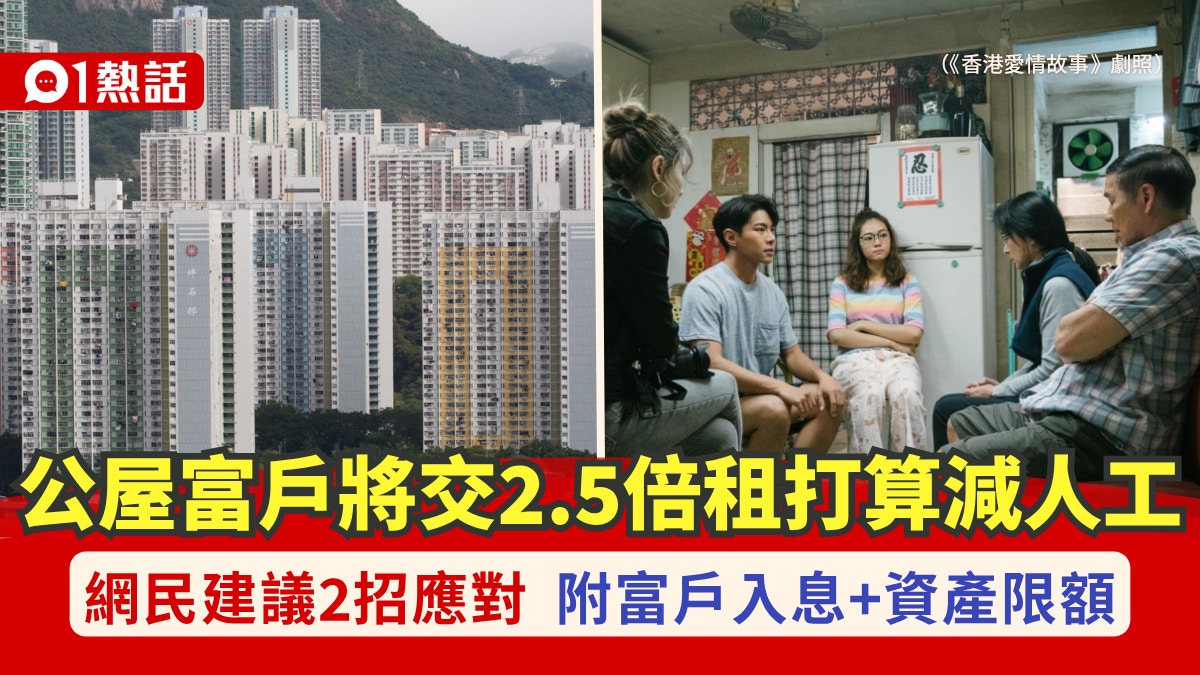
The Hong Kong Housing Authority has implemented updated income and asset limits for public rental housing tenants, effective April 1, 2025. The revised policy aims to optimize the allocation of public housing resources by identifying “wealthy tenants” who possess the financial means to transition to private housing.
Defining the “Wealthy Tenant” Threshold
Under the 2025-2026 guidelines, the Housing Authority classifies residents as “wealthy tenants” if they meet any of the following criteria: owning residential property within Hong Kong, having a total family income that exceeds five times the current public housing income limit, or possessing total net assets that exceed 100 times the income limit.
For a family of four, the net asset threshold for this classification is set at $3,100,000. This specific limit also applies to small families of one to three people where all members are over the age of 55. This tightening of eligibility underscores the government’s focus on ensuring subsidized housing remains available for those in the most acute need.
2025-2026 Monthly Income and Asset Limits
The updated financial ceilings vary based on household size. According to the latest policy data, the monthly income and net asset limits are as follows:

- 1 Person: Monthly Income $13,090 | Net Assets $291,000
- 2 People: Monthly Income $20,230 | Net Assets $394,000
- 3 People: Monthly Income $25,100 | Net Assets $514,000
- 4 People: Monthly Income $31,000 | Net Assets $600,000
- 5 People: Monthly Income $38,650 | Net Assets $666,000
- 6 People: Monthly Income $45,440 | Net Assets $721,000
- 7 People: Monthly Income $49,930 | Net Assets $770,000
- 8 People: Monthly Income $55,830 | Net Assets $805,000
- 9 People: Monthly Income $61,570 | Net Assets $892,000
- 10+ People: Monthly Income $67,180 | Net Assets $961,000
These benchmarks serve as the primary metrics for determining rent adjustments and continued eligibility for public housing subsidies.
Eviction Criteria and Compliance
The Housing Authority has established strict mandates for tenants whose financial status improves beyond certain limits. Residents are required to vacate their units if they meet the “wealthy tenant” criteria mentioned above. A specific rule applies to those whose income falls between four and five times the limit: if a household’s total income exceeds the limit by four times—but not more than five times—for two consecutive reporting cycles (a total of four years), they must move out of their public housing unit.
To maintain transparency and compliance, the reporting framework requires tenants who have resided in public housing for 10 years or more to submit an income and asset declaration every two years. Regardless of their length of residency, any tenant who obtained their lease through the “New Lease Policy” or the “Public Housing Lease Management Policy” must also adhere to this biennial reporting schedule.
The implementation of these measures reflects a broader economic strategy to increase turnover in the public housing sector, encouraging those with higher disposable income to enter the private market and freeing up units for lower-income applicants.
