
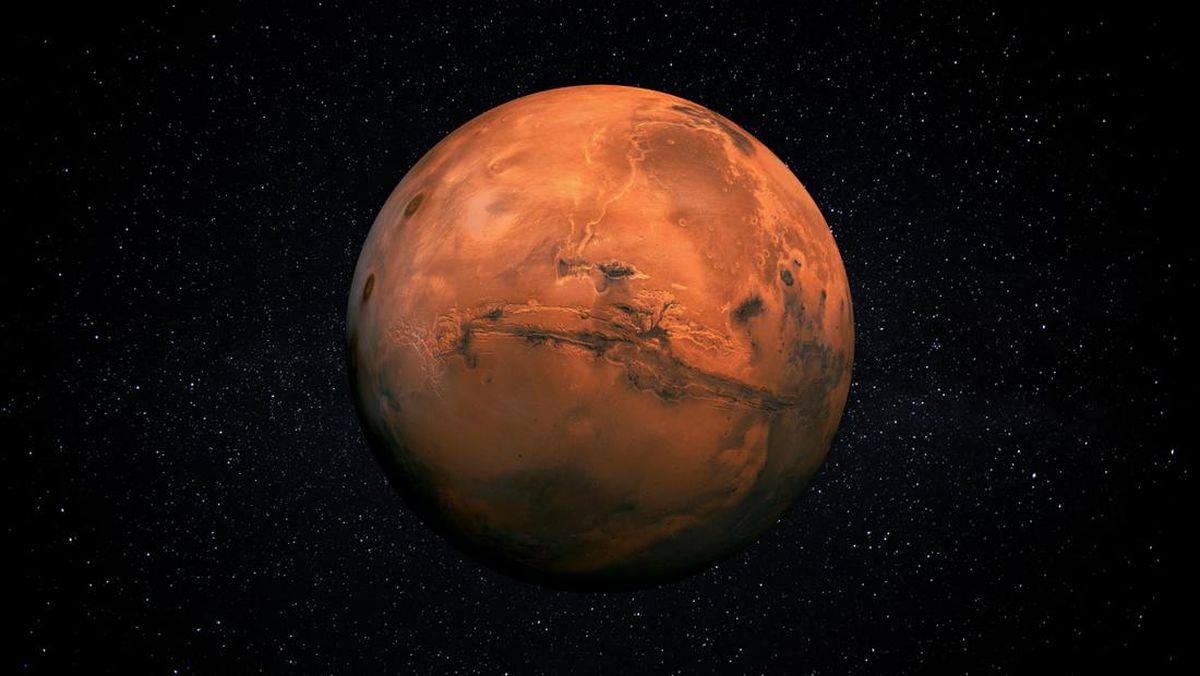
The planet Mars has long captivated scientists and space enthusiasts alike, and a key question surrounding potential exploration is the sheer scale of the planet and how much of it astronauts could realistically cover on foot. NASA, which is planning to send humans to Mars for the first time, has begun to address this logistical challenge.
According to NASA, any astronaut walking on the Martian surface would likely only be able to explore a limited area of the planet.
ADVERTISEMENT
SCROLL TO CONTINUE WITH CONTENT
“Fundamentally, we need two parameters,” explained Erdal Yigit, a Professor of Physics and Astronomy at George Mason University, citing Space. “These are the astronaut’s speed – both velocity and direction – and the distance they intend to travel.”
Yigit calculated the time it would take to circumnavigate Mars along its equatorial path.
The circumference of Mars is approximately 13,300 miles (21,400 kilometers). Walking at a pace of 3.1 mph (5 km/h), it would take roughly 4,290 hours – equivalent to about 668.6 sols (Martian days), or roughly a quarter of a Martian year – to complete the journey without rest.
While Mars’ gravity is about 40% less than Earth’s, walking speed is unlikely to differ significantly. The challenges of Martian exploration extend beyond just locomotion, however. Like explorers on Earth, astronauts would need to carry substantial supplies – including oxygen, water, and food – as well as the weight of a protective spacesuit to shield against harmful radiation. Rest and sleep are also essential considerations.
Assuming eight hours of sleep each night, this would add approximately 56 sols to the total time. Factoring in time for meals, breaks, changing clothes, hygiene, and establishing temporary campsites would likely add another 30-35 sols, depending on the length of each stop.
Yigit noted that these factors would realistically increase the time needed to circumnavigate Mars, without even accounting for potential unforeseen obstacles. “a realistic estimate would likely be at least 265 sols, or around 40 percent of a Martian year. This calculation doesn’t account for potential challenges, such as challenging terrain,” he added.
Mars is characterized by numerous mountains – some taller than those on Earth – as well as valleys, craters, and other geological features. This makes a complete walk around the planet highly improbable in the near future. However, Yigit argues that sending astronauts to Mars still offers significant advantages over robotic exploration.
“Even though it’s highly unlikely that humans will walk around the entire Red Planet, sending astronauts to the surface still has many benefits compared to rovers,” Yigit stated.
|
Baju Astronaut untuk Misi Luar Angkasa (Photo: CNNIndonesia/Basith Subastian)
|
