
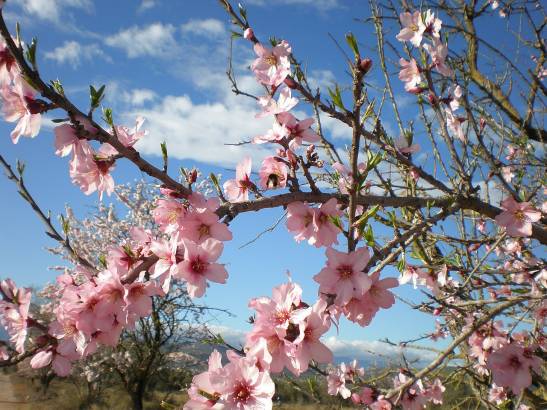
Each year, the return of spring after the dormancy of winter is a remarkable phenomenon, often taken for granted. As insects re-emerge after months of cold, and vegetation bursts forth with new leaves and blossoms, the signs of seasonal change are clear. These changes are driven by two key factors: light and warmth. But how do plants actually detect these shifts, and how is the ongoing climate crisis impacting this annual renewal?
Plants perceive the arrival of spring through increasing daylight hours and rising temperatures
Like humans, plants recognize the arrival of spring by sensing the lengthening days and warmer temperatures. However, lacking eyes or heat-sensitive skin, plants rely on different mechanisms to perceive these changes.
To detect light, plants utilize proteins called photoreceptors, specifically phytochromes, which react to red light and measure the photoperiod – the changing length of day and night throughout the seasons. This serves as an internal clock.
As nights shorten, phytochromes become activated, promoting the buildup of other proteins that then trigger genes responsible for initiating flowering. The products of these genes, known as florigens, are hormones produced in the leaves and transported to the growing tips of stems, effectively switching off vegetative growth and initiating flower production for plant reproduction.
Light and Heat
While much is known, the molecular machinery of plant photoperiodism – the ability to measure the relative length of light and darkness – remains an area of ongoing study. A team at Yale University, led by Joshua Gendron, found that certain genes, particularly one called PP2-A13, are activated when days shorten and alter how the plant allocates resources for survival during the winter. Although these genes don’t directly trigger flowering, “plants ‘turn on’ these mechanisms during the short days of winter and ‘turn them off’ as days lengthen and spring approaches,” Gendron explained.
Phytochromes too act as temperature sensors, as heat is invisible infrared light
Alongside photoperiodism, temperature also plays a role as an additional stimulus, though, according to botanist Paul Ashton of Edge Hill University in the United Kingdom, “the precise mechanism is still unknown.”
Recent research has revealed that phytochromes also function as sensors for temperature, since heat is invisible infrared light. Ashton explained that phytochromes release hormones that convert starch into sugars to provide nourishment to the plant’s growing areas.
Temperature also impacts the hormones themselves. Forest ecologist Gregory Moore, from the University of Melbourne in Australia, explained that in many species, the phytochrome acts as a seasonal switch, stimulating the production of the hormone abscisic acid (ABA). “ABA is produced in autumn and is a general inhibitor, but it is cold-sensitive and degrades throughout the winter.” The loss of ABA can be enough to induce flowering, but in spring, the phytochrome shifts to producing gibberellic acid, which stimulates the spring response.
Complementary Signals
Which signal – light or temperature – is more critical for triggering flowering? According to Ashton, “generally, temperature plays a more significant role.” If plants relied solely on light, he reasoned, they would risk beginning to flower while frosts could still damage the process. Conversely, they could miss opportunities if temperatures are favorable early in the spring.
Light sets the general guidelines, while temperature handles the fine-tuning
For Moore, light is more important: “Temperature is an unreliable indicator of the season due to its fluctuations, making the photoperiod a much more reliable trigger for seasonal responses.” In fact, light determines whether some species flower when days get longer, in spring and summer, while others flower when days shorten, in autumn. Both signals complement each other: light sets the general guidelines, while temperature handles the fine-tuning.
Regardless, Moore emphasized, “depending on the species, the triggers for spring responses are well-known or poorly understood.” The ecologist added, “We know a lot about certain economically relevant species that provide us with food, fiber, or wood, and also about orchids because they have many enthusiasts, but we know little about many ornamental species.”

Earlier Flowering
The question of which is the primary trigger, light or temperature, is particularly relevant in the context of climate change, which doesn’t impact both equally. “It is much more likely to affect aspects of metabolism sensitive to temperature than those controlled by the photoperiod,” Moore summarized. Climate change disrupts the plant calendar not only by altering temperature but also humidity, according to recent research. Many plants require a cold winter chill for the spring program to initiate correctly, a process called vernalization. If this doesn’t occur, flowering may fail.
In Doñana, flowering arrives about 20 days earlier than 35 years ago, with extreme cases like rosemary, which has advanced 92 days
Any casual observer will notice something that scientific data confirms: plants are entering spring mode earlier, with flowering and growth occurring sooner. This shift has implications for ecosystems and agriculture, highlighting the interconnectedness of natural processes.
In one of the largest and most cited studies, scientists at the University of Cambridge gathered data from more than 400,000 plants in the United Kingdom, concluding that flowering, on average, has advanced by a month since the 1980s, particularly in herbaceous species.
In Spain, studies from the University of Seville show that around Doñana National Park, flowering arrives about 20 days earlier than it did 35 years ago, with extreme cases like rosemary advancing 92 days. According to co-author of these studies, Daniel Pareja-Bonilla, general flowering is advancing almost one day every two years, “a extremely accelerated rate, especially compared to other regions of the world.” Other observations indicate that in Catalonia, almond trees are blossoming 10 days earlier than they did 40 years ago.

Flowering is advancing at a very accelerated rate, especially compared to other regions of the world
Daniel Pareja-Bonilla, University of Seville

The Climate Changes, the Machine Fails
Even in tropical regions, where there might be less disruption due to the absence of winter cold, a 2026 study reveals that flowering has shifted by an average of two days per decade over the last 200 years. In some species, the effect is opposite, a delay in flower budding of up to almost three months since the mid-20th century.
These anomalies are far from simple curiosities. The first impact is on the plants’ own survival: as Gendron points out, the gene systems controlled by the photoperiod are predictive mechanisms that allow plants and other organisms to prepare their metabolism to anticipate conditions during seasonal changes; “when the climate changes, they are unable to correctly predict temperature and water availability throughout the year,” he says.
When the climate changes, plants are unable to predict correctly the temperature and the availability of water throughout the year
Joshua Gendron, Yale University
But beyond that, a second, far-reaching impact affects the entire ecosystem, a machine with countless interconnected parts. “For plants pollinated by insects, the synchronization with relevant pollinators can be broken,” Ashton points out. If flowers and insects don’t coincide in time, the former won’t get the pollination essential for their reproduction, and the latter will lose the food from the flowers. Without insects, birds can’t feed their young, and so on; the entire choreography of nature collapses, including our crops.
