
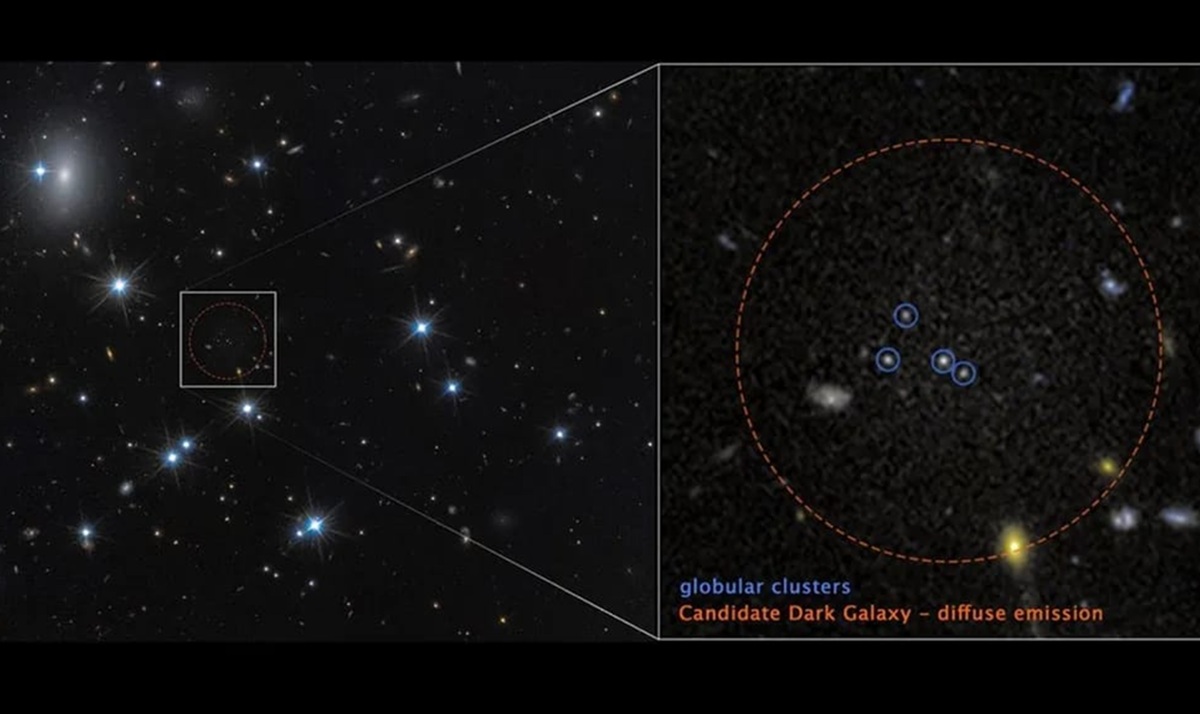
Astronomers have discovered a rare galaxy almost entirely composed of dark matter. The finding, made using observations from the Hubble Space Telescope and the Euclid Space Telescope, reveals the existence of an extremely faint galaxy named CDG-2.
Generally, all galaxies in the universe are dominated by dark matter, a mysterious substance that cannot be directly observed but possesses significant mass. In typical galaxies, dark matter usually accounts for about five times more mass than ordinary matter, which forms stars, planets, and cosmic gas.
Though, in galaxy CDG-2, the dominance of dark matter is far more extreme. Researchers found that approximately 99% of the galaxy’s mass consists of dark matter, making it one of the most “dark” galaxies ever discovered. This discovery offers a unique opportunity to study the nature and distribution of dark matter in the universe.
A Nearly Invisible Galaxy
Located approximately 245 million light-years from Earth, galaxy CDG-2 is unlike most galaxies, which appear bright from cosmic distances. This galaxy is exceptionally faint and difficult to detect due to its sparse number of stars.
Because of its lack of visible light, CDG-2 is often referred to as a “ghost galaxy.” The light it emits is so weak that it is almost undetectable by conventional telescopes.
Dark matter cannot be observed directly because it does not interact with electromagnetic radiation or light. Unlike particles of ordinary matter, such as protons, neutrons, and electrons, dark matter does not emit, absorb, or reflect light.
However, scientists can detect its presence through gravitational effects. The presence of dark matter can be inferred from its influence on the movement of gas, stars, and the bending of light around it.
Discovered Through Globular Clusters
The discovery of CDG-2 began when astronomers studied dense collections of stars known as Globular Clusters. These structures often hint at the presence of hidden, faint galaxies.
The research team identified ten faint, low-surface-brightness galaxies and two candidate dark galaxies. To confirm the existence of one of these candidates, researchers utilized several large telescopes, including the Hubble Space Telescope, the Euclid Space Telescope, and the Subaru Telescope in Hawaii.
Hubble data revealed four closely-packed globular clusters within the Perseus Cluster, a galaxy cluster approximately 300 million light-years from Earth.
Further observations then uncovered faint light surrounding these globular clusters. This dim glow provided evidence of a hidden galaxy, almost invisible to the naked eye, which was subsequently identified as CDG-2.
Significant Clues About Galaxy Evolution
David Li of the University of Toronto, the lead researcher on the project, explained that this galaxy represents a unique case. According to Li, CDG-2 is the first galaxy detected solely through its population of globular star clusters.
Based on the team’s analysis, the galaxy has a brightness equivalent to about 6 million sun-like stars. Approximately 16% of that light originates from the globular clusters surrounding it.
Scientists hypothesize that the galaxy once contained more stars in the past. However, most of those stars likely became unbound due to gravitational interactions with other galaxies in the vicinity.
Unlike ordinary stars, globular clusters have a very high star density, allowing them to withstand these gravitational disturbances. Globular clusters are the only remaining markers of the now-shadowy galaxy CDG-2.
This discovery provides new insights into how galaxies can evolve and the crucial role dark matter plays in cosmic structure. (Space/Z-2)
