
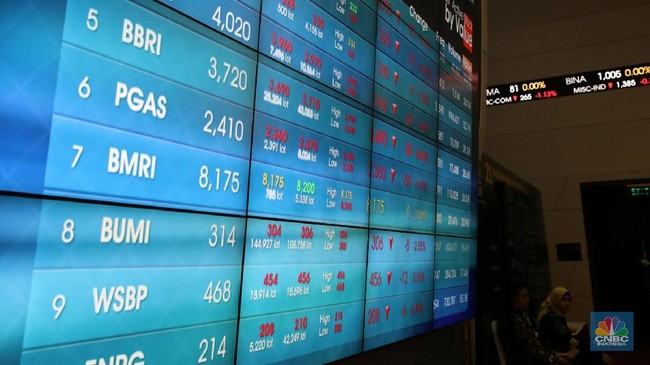
Jakarta, Indonesian shares experienced a significant downturn on Monday, falling as much as 5.2% to reach a low of 7,156. A total of 449 stocks declined, while 57 rose and 158 remained unchanged, with trading volume reaching Rp 1.5 trillion.
The decline in the Indonesian stock market is attributed to negative sentiment stemming from escalating tensions between the United States and Iran, prompting global investors to reduce risk exposure and seek safe-haven assets, according to Senior Technical Analyst Nafan Aji Gusta of Mirae Asset Sekuritas.
“Technically, the IHSG is in a bearish consolidation phase following the formation of a downward bar. The Stochastics K_D indicator is signaling negatively, though volume is decreasing and the RSI is oversold,” Gusta stated on Monday, March 9, 2026.
Adding to investor concerns, Fitch Ratings recently downgraded Indonesia’s credit outlook from “stable” to “negative,” raising questions about the government’s fiscal policies and macroeconomic stability.
Gusta recommends investors focus on fundamentally sound stocks trading at attractive valuations.
Associate Director Maximilianus Nicodemus of Pilarmas Investindo Sekuritas echoed this sentiment, noting that Fitch Ratings’ revision of Indonesia’s debt rating outlook also contributed to investor apprehension.
“This outlook change reflects increasing risks to future fiscal prospects and economic policies, particularly amid uncertainty surrounding policy direction and potential budget deficit expansion,” Nicodemus explained.
Fitch highlighted the increased financing needs to support government priorities, including a universal free nutritious meal program, which could place pressure on fiscal position if not offset by increased state revenue.
The ratings agency also noted that while the government’s debt ratio remains manageable, it has the potential to increase, along with relatively high interest payments compared to similarly rated countries.
“We assess that weakening fiscal discipline or a faster-than-expected increase in the debt ratio could raise downgrade risks. This move by Fitch follows a similar decision by Moody’s to lower Indonesia’s outlook to negative, further drawing global investor attention to the credibility of Indonesia’s fiscal policies going forward,” he added.
Over the past week, the IHSG has fallen nearly 8%, marking its worst weekly performance since the MSCI Crash in late January. Several factors have contributed to the sharp decline in the Indonesian stock market.
In recent times, the IHSG has been influenced not only by domestic factors but also by external pressures and shifting perceptions among global investors regarding Indonesia as an investment destination.
Escalating geopolitical tensions, particularly in the Middle East, have prompted global investors to adopt a more defensive stance. In such uncertain conditions, financial markets typically experience a shift in sentiment towards risk aversion, where investors reduce exposure to assets considered riskier.
Emerging markets, including Indonesia, are often among the most affected as inflows of foreign capital can quickly reverse. This phenomenon, known as geopolitical contagion, sees the impact of conflicts or tensions in one region spread to global financial markets. International investors tend to move their funds to safer instruments, such as government bonds of developed countries or dollar-based assets.
stock markets in emerging markets face pressure from capital outflows. For Indonesia, this can lead to market volatility and hinder potential gains in the IHSG in the short to medium term.
Secondly, growing concerns regarding Indonesia’s position in global stock indices are also weighing on the market. Investors are paying attention to the possibility of a change in Indonesia’s classification within indices compiled by Morgan Stanley Capital Index (MSCI).
Currently, Indonesia’s weight in the MSCI Emerging Markets Index is trending downward and is approaching around 1%. This decline reflects the decreasing proportion of the Indonesian stock market in global portfolios that track the index.
A risk increasingly discussed among market participants is the potential for Indonesia to be downgraded from emerging market to frontier market status.
While this scenario is not necessarily imminent, even the discussion of it is enough to influence investor sentiment. Many global investment funds, particularly passive funds and ETFs, automatically adjust their portfolios based on the composition of the MSCI indices.
If a country’s classification changes, the funds following those indices will also adjust accordingly. In an extreme scenario, this change could trigger significant capital outflows from the domestic stock market.
Thirdly, increasing attention is being paid to the country’s credit risk. In addition to external pressures and index classification issues, investors are also monitoring developments on the macroeconomic front, particularly perceptions of government debt risk.
Several international rating agencies, including Fitch Ratings, Moody’s Investors Service, and S&P Global Ratings, have signaled caution through changes to Indonesia’s outlook.
These outlook changes do not necessarily mean a credit rating downgrade will occur in the near future, but they indicate that rating agencies are beginning to see risks that need to be monitored, particularly regarding fiscal conditions, government debt dynamics, and potential pressure on the budget deficit in the future.
For global investors, changes in perceptions of a country’s credit risk can have far-reaching consequences, affecting the cost of funding for both the government and the corporate sector. If risk is perceived to increase, investors typically demand higher returns to hold assets in that country.
In the context of the stock market, increased concerns about sovereign credit can also put pressure on market sentiment.
Investors tend to develop into more selective in allocating funds to domestic assets, potentially limiting the movement of the IHSG.
In addition to these factors, escalating tensions between Iran and Israel, and the United States, have driven up global oil prices, increasing the risk of significant inflation in nearly all countries.
the Indonesian rupiah has continued to weaken against the US dollar, breaching the psychological level of Rp17,000 per dollar. The lack of positive sentiment suggests that pressure on the IHSG is likely to intensify in the future.
Add as a preferred
source on Google (ayh/ayh)
