
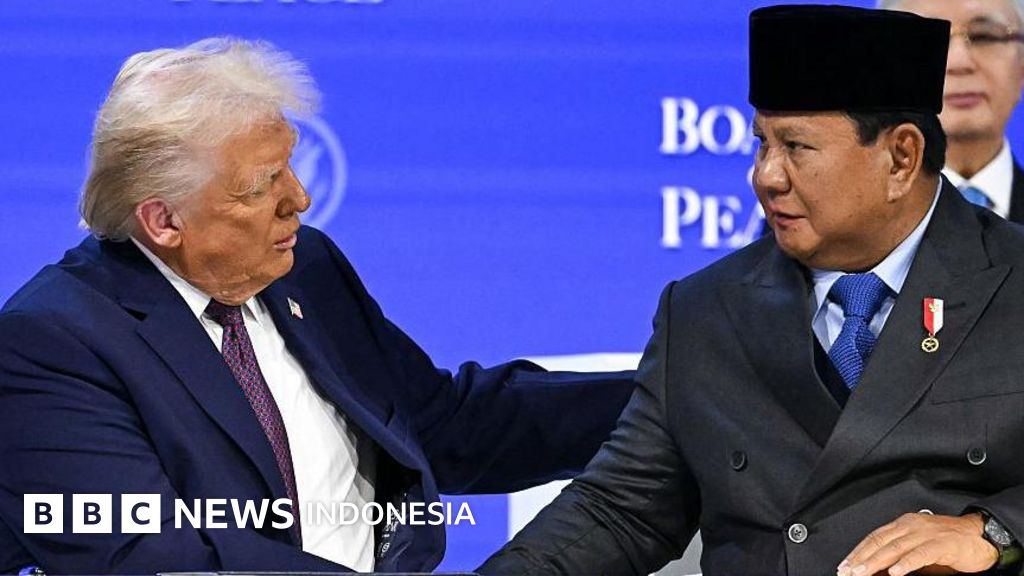
Sumber gambar, AFP via Getty Images
Waktu membaca: 10 menit
Indonesia and the United States have reached an agreement to lower tariffs on goods originating from Indonesia to 19%, while Indonesia will eliminate 99% of tariff barriers for U.S. Products.
The agreement was signed Friday, February 20, by Indonesian Coordinating Minister for Economic Affairs Airlangga Hartarto and U.S. Trade Representative Jamieson Greer, following months of negotiations.
“This agreement will be effective 90 days after the legal processes are completed by both sides,” Hartarto said during a press conference streamed live by the Presidential Secretariat via YouTube on Friday, February 20.
Hartarto added that the agreement will be consulted with the Indonesian House of Representatives.
Details of the agreement were not included in Hartarto’s statement or by other officials.
Under the agreement, exports from Indonesia to the U.S. Will be subject to reciprocal tariffs of 19%, with certain products receiving reciprocal tariffs of 0%.
The 19% tariff rate is the result of months of negotiation, after the U.S. Initially imposed a 32% tariff on Indonesian goods.
Key commodities such as palm oil, coffee, and cocoa will be exempt from tariffs when entering the U.S. Market.
Conversely, Indonesia will eliminate import duties on U.S. Products as part of the agreement.
According to the agreement, Indonesia will remove tariff barriers on more than 99% of U.S. Products exported to Indonesia across all sectors.
This includes agricultural products, health products, seafood, information and communications technology, automotive products, and chemicals.
The White House stated in a written release that the 19% tariff reduction is accompanied by commitments from the Indonesian government:
- To purchase $15 billion worth of U.S. Energy commodities
- To purchase $13.5 billion worth of aviation-related goods and services from Boeing
- To purchase $4.5 billion worth of U.S. Agricultural products
The Indonesian government also signed 11 memoranda of understanding (MoUs) as follow-up to the reciprocal trade cooperation in several sectors on Wednesday, February 18.
The total value of the MoUs is approximately $38.4 billion, or Rp648.19 trillion, covering sectors such as agriculture, energy, and technology.
One such MoU was with Freeport-McMoran to extend mining permits and expand operations at Grasberg, Papua.
What did Coordinating Minister for Economic Affairs Airlangga Hartarto say in the press briefing?
Hartarto further stated that the agreement is mutually beneficial for the people of Indonesia and the U.S.
“The philosophy of this agreement is that it must be a win-win. Beneficial for the people of Indonesia and the people of the U.S. We want to achieve a golden age for both countries, not just one country,” Hartarto said.
He explained that the agreement was the result of a negotiation process since the announcement of the U.S. Reciprocal tariff policy in April 2025.
Indonesia, he said, had sent four official letters in 2025 and approximately 90% of Indonesia’s proposals were approved by the U.S.
Hartarto claimed his team made seven visits to Washington and more than 19 technical meetings with the USTR.
“This agreement differs from other country’s trade agreements because the U.S. Agreed to revoke non-economic clauses such as nuclear reactor cooperation, defense, and security, making the agreement purely focused on trade,” Hartarto revealed.
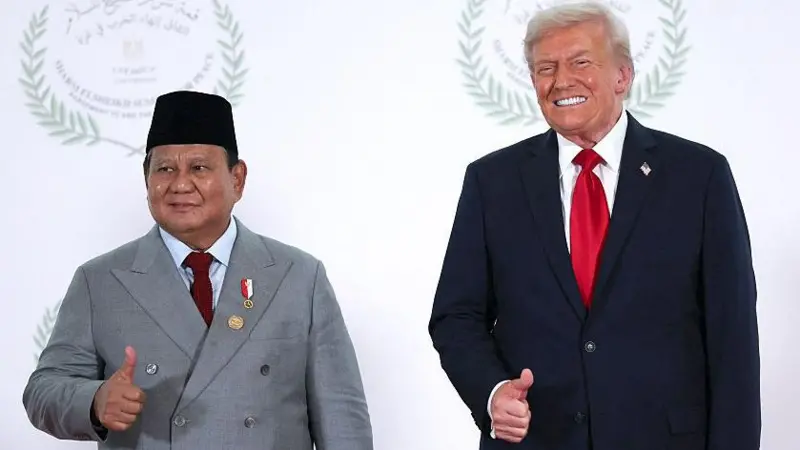
Sumber gambar, Suzanne Plunkett – Pool / Getty Images
He said approximately 1,819 tariff lines for Indonesian products receive facilities under the agreement.
This includes sectors such as agriculture and industry, including palm oil, coffee and cocoa, spices, electronics and semiconductors, and aircraft equipment.
These products receive tariffs of up to 0% in the U.S. Market.
The apparel and textile sectors also receive 0% tariffs through a tariff-rate quota (TRQ) mechanism.
The agreement has the potential to build a more stable and integrated supply chain with the U.S. Market, potentially increasing export value-added and boosting the competitiveness of the national industry.
However, according to Shinta, various opportunities within this agreement depend on domestic preparedness.
Now that the agreement has been finalized with the signing on Thursday, February 19, Shinta emphasized several crucial points that the government needs to address to ensure the agreement has a positive impact on the national industry:
First, a balance between opening the market and protecting domestic industries. Labor-intensive strategic industries in Indonesia currently absorb millions of workers, so trade policy must continue to consider the sustainability of domestic industries.
Second, careful regulation of technical aspects of trade, including tariff structures, rules of origin, and non-tariff policies. These technical details are crucial in determining Indonesia’s competitiveness compared to rival countries such as Vietnam, Bangladesh, and India.
Third, improving the ease of doing business domestically. In addition to tariffs, increased exports and purchases of materials from the U.S. Also depend on simplifying regulations and permits, reducing labor costs, harmonizing customs, and easing access to financing for machine modernization and strengthening upstream industries.
Separately, Chairman of the Indonesian Employers Association (Apindo), Shinta Kamdani, and Executive Director of the Indonesian Footwear Association (Aprisindo), Yoseph Billie, requested time to review the results of the agreement and its impact on their industries.
What is the impact of this trade tariff agreement?
Economists view the agreement as a continuation of the situation from July 2025, when the U.S. Decided to reduce Indonesia’s reciprocal tariffs from 32% to 19%.
“This agreement is locked in. So, we really need to grab advantage of the opportunities that exist. For example, we can optimize the 0% tariff on labor-intensive products and ensure that the investment promises are fulfilled,” said University of Indonesia economist Telisa Falianty.

Sumber gambar, ANTARA FOTO/Hafidz Mubarak A
She also emphasized the importance of continuing negotiations at the business-to-business (B2B) level. According to her, U.S. Businesses still need some raw materials that originate from Indonesia, which can be leveraged through negotiations regarding burden sharing.
Telisa said that diplomatic skills in the business field are highly critical.
However, there are things to consider after the agreement comes into effect following the signing on February 19. “Before it is signed and the market has not fully adopted it, our trade balance is still in surplus. It is important to maintain that so that it does not become a deficit,” said Telisa.
Maintaining a trade surplus, she explained, is one source of foreign exchange. She noted that foreign exchange weakened during the previous semester due to stagnant prices for mainstay commodities such as palm oil.
“If the trade balance then becomes a deficit, the rupiah will depreciate again. The weakening of the rupiah will set pressure on the state budget,” Telisa said.
Fluctuations in the stock market related to MSCI also could increase debt interest rates in 2026 due to rising yields. Economic growth will also be affected by these import-export issues.
Telisa then highlighted the issue of Domestic Component Level (DKLN) which was excluded for imported goods from the U.S. Under this trade agreement. Although limited in sector and product, she believes it could prompt other countries to request similar agreements.
“If that happens, imports could become more free. This could also put more pressure on our industry. It will affect employment,” Telisa said.
CORE Executive Director Muhammad Faisal also mentioned the DKLN. “Here’s something the United States once complained about and did not want to comply with. Then, it was abolished for them. This could be a bad precedent,” said Faisal.
“In international trade systems, investment should not have different treatment. With domestic products alone, there should not be different treatment.”
According to Faisal, the DKLN is intended to encourage industrialization, which is a national priority agenda. If there are exceptions regarding this, it means that the agreement reached is not in line with the government’s priority agenda.
The DKLN comes from Minister of Industry Regulation Number 35 of 2025, which requires high local content, including nickel batteries and electronic modules for incentives. Under the regulation, manufacturers building facilities in Indonesia and employing local labor receive a DKLN recognition of at least 25%.
exemptions from tariffs in the trade agreement largely target raw materials, such as palm oil, coffee, and cocoa.
“It’s not bad, but let’s compare it to Vietnam. The exemptions Vietnam received were for high value-added products, such as electronic products, so when it became effective last August, Vietnam actually saw a surge,” said Faisal.
Speaking about raw material commodities, Indonesia has been under pressure for a long time. He cited cocoa as an example, with limited production and a focus on exports because the value is higher when sold abroad than domestically.
“If there are no tariffs, it will be easier to export these raw materials and more demanding to encourage the downstreaming of plantations, which is a priority agenda for the government. There are many contradictions with the government’s own agenda,” said Faisal.
This shows the difference in negotiation about prioritized products. Especially when looking at Vietnam, which managed to negotiate about products related to trade tariffs.
“Don’t be surprised if the difference in export performance with Vietnam widens.”
‘Impact of limited diplomatic process’
International relations practitioner and lecturer Dinna Prapto Raharja argued that the locked-in tariffs show a lack of diplomatic process carried out by diplomatic elements and the absence of involvement of experts when it came to the negotiating table.
“Currently, foreign affairs are centered in the hands of the head of government and head of state. Everything happens quickly with the mindset: Indonesia must be seen, Indonesia is highly respected, Indonesia must get a deal,” said Dinna.
This “deal-breaking” perspective, Dinna continued, is what distances Indonesia from the diplomatic process. In diplomacy, everything that has been agreed upon will be reviewed first so that any offers from partners can be screened and a middle ground found if it conflicts with Indonesia’s priorities and interests.
In the diplomatic process, there are negotiations and bargaining that are opened to the public, especially those that cause budgetary burdens for the state and the business world.
“Instead, what we are witnessing is that since foreign affairs have been centralized in the hands of the head of state, this bargaining does not happen. Even if it does, there is no transparency as to why the head of state accepts demands from the U.S.”
This story will be updated periodically.
