
“Inverted” World
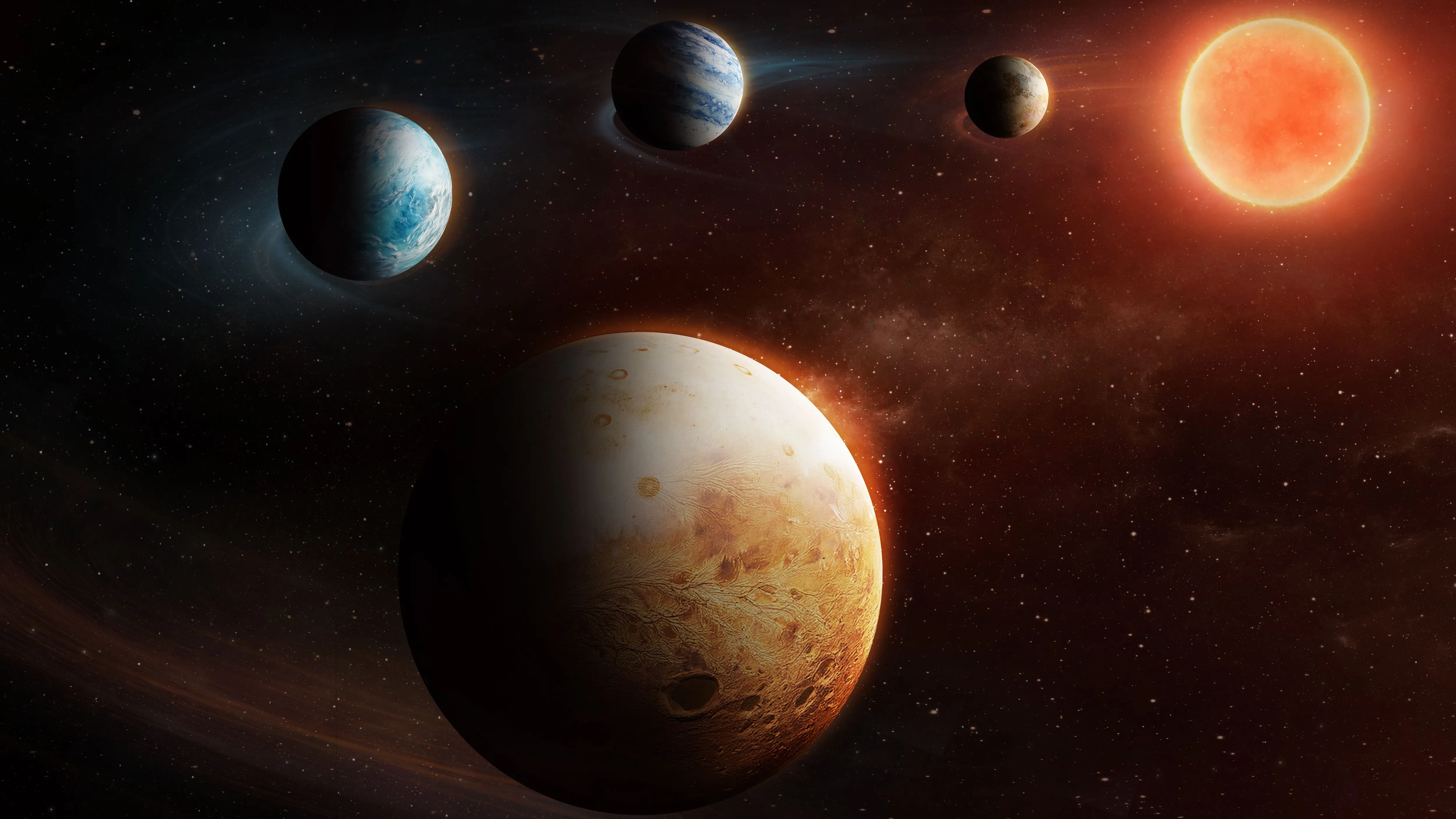
The system around the star LHS 1903 exhibits an unusual arrangement.
Image: picture alliance / Cover Images
Astronomers have discovered a planetary system 116 light-years from Earth that challenges current understanding of how planets form.
Key Takeaways
-
Astronomers have identified a planetary system that contradicts prevailing theories.
-
The arrangement of planets around the star LHS 1903 deviates from the norm.
-
Researchers suggest the findings point to alternative planet formation histories.
Traditionally, planetary systems are thought to form with rocky planets close to their star and gas giants further out. This pattern is observed in our own solar system, with Venus, Mercury, Mars and Earth orbiting near the Sun, followed by Neptune, Saturn, Uranus, and Jupiter. However, a newly discovered system is upending that established model.
LHS 1903 System Defies Conventional Models
A team led by astrophysicist Thomas Wilson of the University of Warwick identified the red dwarf star LHS 1903, located 116 light-years away. The star is cooler and less luminous than our Sun. What sets this system apart isn’t the star itself, but the unexpected arrangement and composition of its orbiting planets. Close to LHS 1903 is a rocky planet, followed by two larger gas planets, and then, surprisingly, another rocky planet further out.
Current models of planet formation – like those describing our solar system – predict rocky planets forming near the star and gas giants further away. The structure around LHS 1903 strongly contradicts this pattern; a rocky planet outside of gas giants shouldn’t exist according to standard models. This discovery has implications for how we understand planetary system development and the potential for habitable worlds.
Rethinking Planet Formation Histories
Researchers believe the system suggests alternative histories for planet formation, as detailed in the journal Science. One theory proposes the planets didn’t form simultaneously, but sequentially from the inside out. It’s hypothesized that the outermost planet formed when little gas remained, preventing it from developing an atmosphere.
Another possibility is that the planet migrated into the gas-poor zone. For astronomy, the discovery around LHS 1903 means planet formation is likely more complex than previously thought. “The more different exoplanetary systems we find, the more we begin to rethink these theories,” said Isabel Rebollido, a researcher at the European Space Agency (ESA), in a statement.
Sources:
Science: Gas-depleted planet formation occurred in the four-planet system around the red dwarf LHS 1903
Berliner Zeitung: Entstehung der Welten: “Verkehrtes” Planetensystem stellt Wissenschaft auf den Kopf
t3n.de: Verkehrte Welt im All: Warum das System LHS 1903 nicht existieren dürfte
