
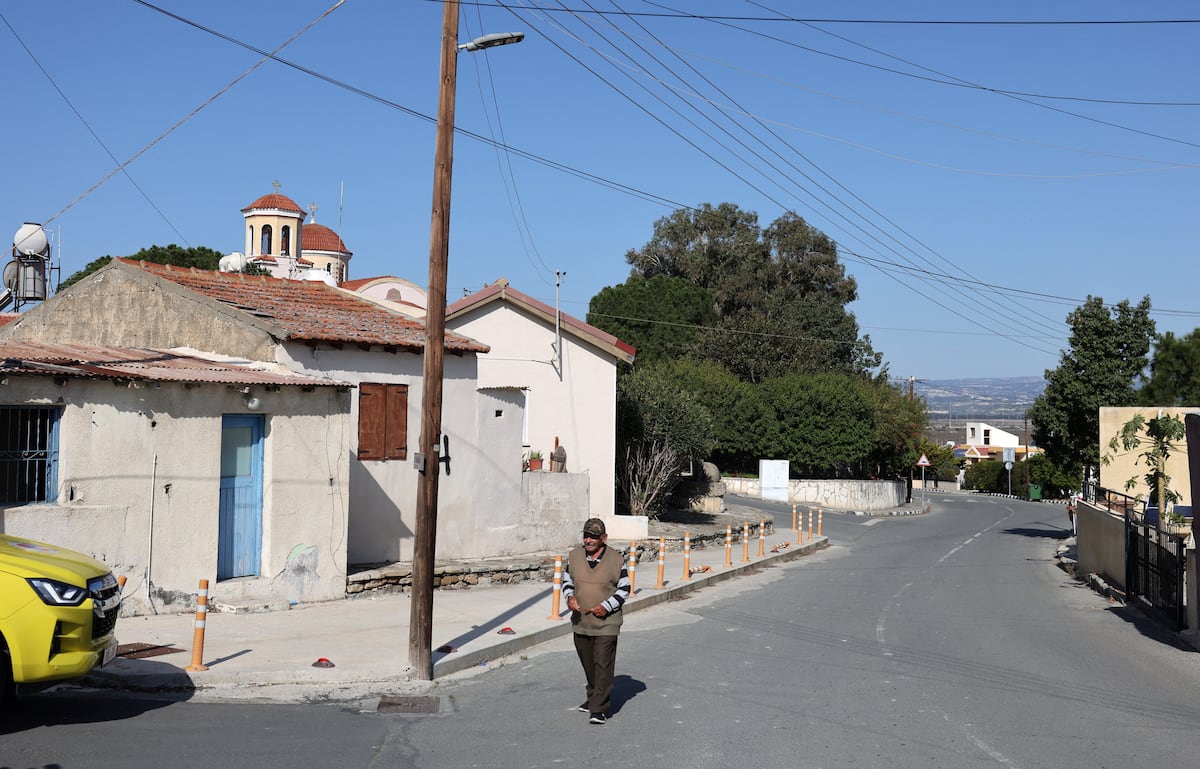
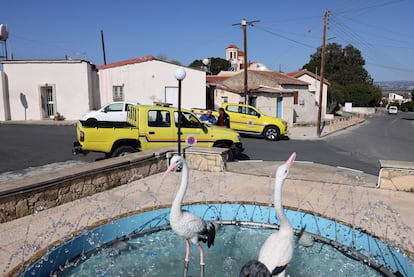
The Cypriot town of Akrotiri was largely deserted Tuesday, as tables remained set in a tavern near the entrance to the Royal Air Force (RAF) base, ready for patrons who did not arrive. The scene reflected the impact of a drone attack on the base Monday, prompting a heightened state of alert in the region. Nearby, a pizzeria, an Indian restaurant, and several pubs that typically cater to British soldiers remained closed, creating a ghostly atmosphere.
“Most people have left,” explained the owner of a café, which reopened Tuesday afternoon after a hasty evacuation the previous day. Only a few journalists remained. Andreas, a butcher, was one of the few residents defying instructions to leave town. “Am I going to travel to a hotel for two days? No way! Whatever happens, will happen,” he said from his empty shop.
The incident has prompted a bolstering of defenses in the region, with Greece, France, and the United Kingdom mobilizing or planning to send reinforcements to Cyprus, a European Union member state. Iran launched drones that attacked one of the two military bases maintained by London in the Mediterranean country, which have played a key role in previous British military operations in the Middle East. Athens has dispatched five aircraft and affirmed its commitment to “contribute with any means at its disposal to the defense of the Republic of Cyprus.”
Early Monday, a Shahed drone of Iranian manufacture – reportedly launched from Lebanon, according to the Cypriot government – impacted a runway at the Akrotiri base in southern Cyprus. The strike caused minor damage but no casualties. Two additional drones heading in the same direction were intercepted Monday, and another was spotted over the civilian airport in Paphos, leading to a temporary closure.
Several villages near the airport were temporarily evacuated, and residents of Akrotiri, adjacent to the British air base, were instructed to leave and were relocated to nearby hotels. The evacuation order, the Interior Ministry said, remains in effect until Friday, when the situation will be reassessed.
The Akrotiri base encompasses not only military installations but also territory. Together with the Dhekelia base in eastern Cyprus, it occupies nearly 3% of the island’s surface area, and both are considered by London to be “British Overseas Territories,” although the Republic of Cyprus disputes this sovereignty. “Look: at the end of the street is the United Kingdom and on the street above it too; here is Cyprus. Half the town is British and the other half is from Cyprus, although here we are all Cypriots, that is, Europeans,” explained Tasos, a farmer, describing the quirks of the territorial demarcation – a legacy of decolonization – in his town, Trachoni. His two grandchildren play at his feet. “Although this town has not been evacuated, classes have been suspended. People, This proves true, are afraid.” Constantina, who runs a café, confirmed this: “Some neighbors have left. There is some fear, but Here’s a thing between the Americans and the Iranians; it shouldn’t affect us.”
The Cypriot Interior Ministry published Tuesday a guide on the demand to prepare an emergency backpack with basic supplies “that can be easily transported to a shelter,” if necessary. And the Ministry of Education has sent circulars to schools with protocols for acting in case of “incidents,” something that several local media outlets have criticized as an attitude that generates panic among the population.
Although Tuesday passed without further incidents, there is a palpable tension. Early in the morning, air raid sirens sounded again in Akrotiri, but it was later announced that it was a false alarm. Throughout the day, there was a normal flow of vehicles, but no fighter jets took off. However, an A-400 Atlas military transport aircraft landed at the RAF base and later departed. In the evening, the roar of F-35 and Eurofighter Typhoon fighters taking off from Akrotiri was heard, according to the Cypriot press, to intercept Iranian drones launched against Jordan.
The government of Keir Starmer also announced the deployment of the HMS Dragon destroyer, along with two helicopters equipped with missiles designed to intercept drones, to protect Akrotiri. However, the prime minister emphasized that the base is not being used by the United States in its attacks on Iran.
The Iranian embassy in Nicosia has neither confirmed nor denied its country’s role in the drone attack, but issued a statement Tuesday underlining that its relations with Cyprus “have historically been cordial and constructive” and that there have been “no changes” in that status. It also asserted that its country “does not undertake offensive actions,” but that its actions are limited to “the inherent right to self-defense.”
Greece and France have mobilized in support of Cyprus, with France announcing the deployment of its nuclear-powered aircraft carrier Charles De Gaulle. Athens dispatched four fighter jets and a transport plane to the Andreas Papandreu air base, near Paphos airport, where Greek Defense Minister Nikos Dendias flew Tuesday to review the situation with his Cypriot counterpart, Vasilis Palmas. “Cyprus is not [a country] far away,” the Greek minister stressed. “These are hard times for our region. But Greece wants to make it clear, categorically, its intention to provide any assistance it can to Cyprus.”
Cypriot President Nikos Christodoulides explained that he has also requested assistance from the governments of France, Germany, and Italy, and Paris has pledged to send a frigate and anti-missile and anti-drone systems. Two Greek frigates are scheduled to arrive Wednesday off the Cypriot coast, equipped with the Centauro system for neutralizing drones, which has already been tested in the Red Sea against drones used by the Houthis, allies of Tehran. Notably, one of the Greek frigates is named after Cimon, a 5th-century BC Athenian general whom Pericles sent to Cyprus to fight the Persians. The recent events highlight the increasing volatility in the Middle East and the potential for wider regional conflict.
