
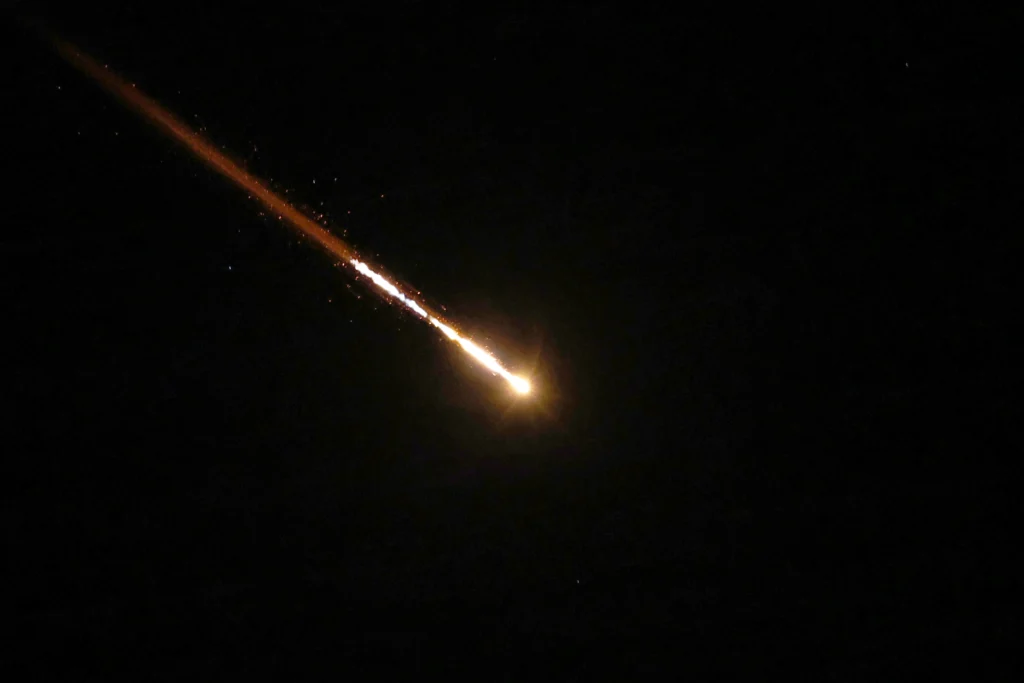
Iran’s Islamic Revolutionary Guard Corps (IRGC) has launched a new wave of missile attacks targeting both Israel and U.S. Military assets in the region, escalating tensions in the Middle East. The attacks, announced Monday, mark the 33rd phase of what the IRGC calls “Operation True Promise 4.”
The military body reaffirmed its stance of resistance and continuity in operations, stating: “We will not let them rest.” Photo: EFE
Under the operational slogan “At Your Service, Oh Jamenei,” the IRGC announced the launch, targeting strategic military installations belonging to the United States and Israel. This latest phase involved the deployment of Khyber Shikan solid-fuel missiles, described as high-tech projectiles equipped with one-ton warheads.
According to the IRGC, the missiles precisely hit their intended targets in occupied territories and regional command centers. The development underscores growing regional tensions and raises concerns about a wider conflict.
READ ALSO:
Iran launches attacks against strategic bases of the United States and Israel in the Middle East
The IRGC report highlighted that the attacks were not solely focused on Israel, but also impacted U.S. Military assets, specifically citing a strike against the U.S. Navy’s Fifth Fleet.
The city of Tel Aviv reportedly came under fire from more than ten missiles. The Iranian military command emphasized that this action fulfilled prior warnings about the vulnerability of air defense systems in the area, stating that emergency sirens sounded continuously.
#WATCH | Circulating footage of an Iranian missile evading three Israeli interceptor missiles. pic.twitter.com/LWdXqO2DGD
— Al Mayadeen English (@MayadeenEnglish) March 9, 2026
Despite strict information censorship imposed by Israeli defense forces to minimize reports of damage, visuals purportedly showing missiles passing through the Iron Dome system and explosions at key communication centers have begun circulating on social media.
The IRGC stressed that this new phase of the operation is a firm response to prior aggressions and a demonstration of the technological capabilities of its long-range weaponry, designed to bypass missile defense shields deployed in the region.
Destruction of strategic centers and neutralization of threats
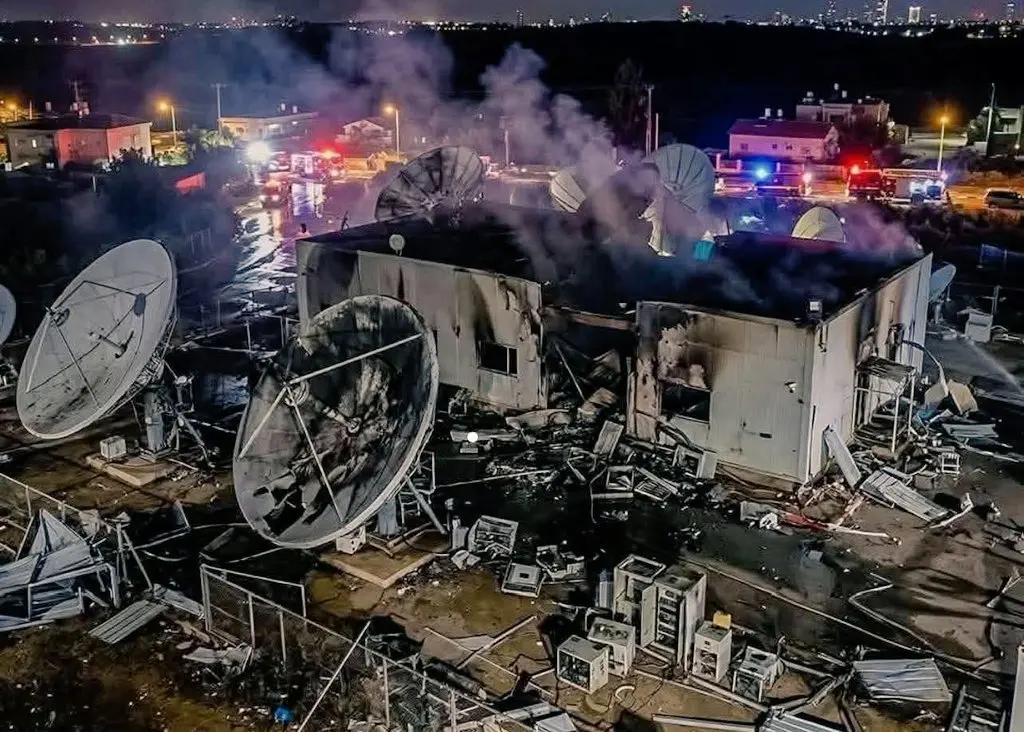
The IRGC’s Aerospace Force confirmed the destruction of the Sdot Micha satellite communications center, located south of Tel Aviv. According to Iranian high command, the facility served as a critical coordination hub linking Israeli air bases with its military aircraft fleets, and its destruction represents a significant blow to the occupation’s operational logistics.
Simultaneously, defense units of the Ruhollah Corps demonstrated their interception capabilities by downing a cruise missile over central Iran. The IRGC also claimed responsibility for neutralizing an Orbiter-4 reconnaissance drone belonging to Israeli forces, which was destroyed while operating over the Isfahan region.
In a statement, the military body reaffirmed its stance of resistance and continuity in operations, stating: “We will not let them rest.”
Chronology of the offensive
Prior to this latest deployment, the IRGC detailed the scope of the 32nd operational wave, which was executed under the same slogan of loyalty to Iranian leadership. In this phase, attacks focused on strategic points in the occupied north and center, employing long-range missiles of the Qadr and Khorramshahr models.
The operation also targeted Ben Gurion International Airport. The IRGC noted that scenes of personnel and settlers fleeing the facilities expose “the reality of the miserable and tragic conditions in which this entity lives.” The statement concluded with a direct warning to the Israeli regime: “The rope will tighten around your neck moment by moment.”
These actions were preceded by the 31st stage of Operation ‘True Promise 4’, dedicated to Sayyed Mojtaba Jamenei, following his recent election as the third Leader of the Islamic Republic by the Assembly of Experts. The massive deployment directly responded to ongoing aggressions against Iranian territory and the bombing of civilian areas by the Washington and Tel Aviv-led coalition.
The coordinated operation between the IRGC’s ground, air, and naval forces impacted strategic installations deep within occupied territory, activating alert sirens in key locations such as Tel Aviv, Haifa, Rishon LeZion, and Holon. According to official statements, the attacks also hit U.S. Military assets in the region, including radar base 512 and support units at Al-Udairi and Arifjan camps in Kuwait, using drones and long-range missiles to breach enemy air defense systems.
During the 28th phase, the use of cluster missiles that fragmented over Tel Aviv was reported, dispersing submunitions in 16 strategic points in the area and prompting the deployment of emergency teams in Bat Yam. Kheibar missiles of a new generation, equipped with high-power warheads, hit Bir al-Sabe’ and infrastructure linked to the Al-Azraq airbase, a center of operations for U.S. Aircraft involved in the aggression against Iran.
Subsequent phases, waves 29 and 30, marked the beginning of operations under the command of the new Leader of the Revolution during the 19th night of Ramadan. These incursions directed high-tech projectiles toward the Negev desert, Tel Aviv, and various U.S. Air bases in the region. According to reports from local media in occupied Palestine, the impacts resulted in the deaths of two settlers and several injuries, while alerts extended from Haifa and the occupied Golan to settlements on the outskirts of Gaza.
Tehran has emphasized that its targets are strictly foreign military bases and installations used to attack Iranian sovereignty. The IRGC reiterated that neighboring countries are not considered adversaries, clarifying that the U.S. And Israeli military platforms operating from those points are the sole targets of its defensive fire.
This defensive deployment by the Islamic Republic comes in direct response to the large-scale military aggression initiated by the United States and Israel on February 28, in which Ayatollah Ali Jamenei was killed. That foreign incursion, which flagrantly violated international law by bombing civilian areas and strategic points on Iranian soil, marked a breaking point that forced Tehran to activate its most advanced defense protocols to safeguard the integrity of its people.
In the face of what the Iranian government describes as a “de facto declaration of war” by the U.S.-Israeli coalition, the IRGC has acted in strict exercise of its national sovereignty. These operations do not represent an act of aggression, but a legitimate and proportional response aimed at dismantling the military platforms from which attacks against the Persian nation are orchestrated, making it clear that any violation of its territory will have direct consequences on the command centers of the aggressors.
Author: teleSUR: mr – JB
Source: Al Mayadeen
