
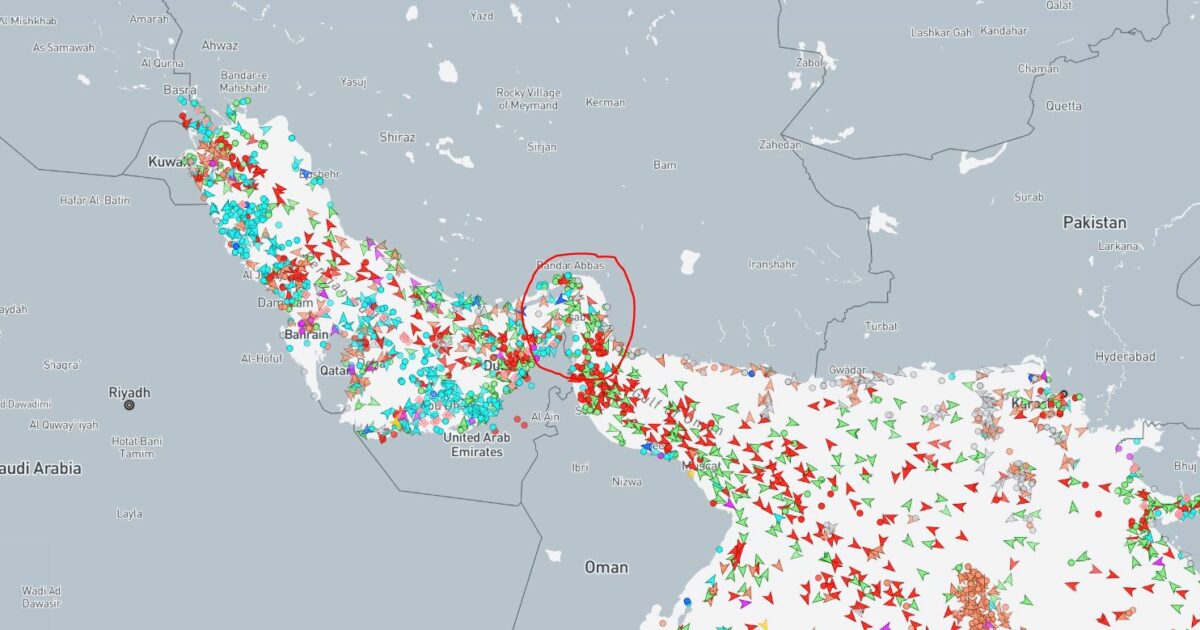
At least 150 tankers are currently stalled in open waters in the Gulf region, marking the first concrete evidence of the impact from the decision announced Saturday evening by the Iranian Revolutionary Guard Corps following joint attacks by the United States and Israel: the closure of the Strait of Hormuz. Market reactions are expected when trading opens Monday morning, with Bloomberg reporting a potential “nightmare scenario” for global markets.
The closure of the Strait of Hormuz, announced by Iran after the joint attacks by the United States and Israel, is unprecedented and could trigger a domino effect that, starting in the energy sector, would overwhelm household purchasing power and reignite inflation. This could have consequences for the U.S. Midterm elections in November, where the topic of price trends is a major concern. Importing countries would face heavy pressure on their public finances and economic growth.
Why it’s so crucial
The narrow waterway between Iran and Oman is the world’s primary energy chokepoint. It connects the Gulf of Persia to the Indian Ocean, and through it pass oil and gas shipments from major Gulf producers – including Saudi Arabia, the United Arab Emirates, and Iraq, as well as Iran itself – destined for markets in Asia, Europe, and North America. According to the U.S. Energy Information Administration, at least 20 million barrels of crude oil per day transit Hormuz, representing about a fifth of the global total, along with the same proportion of global liquefied natural gas trade, much of which originates in Qatar.
More than 80% of these flows are headed to Asia.
What happens after the closure
The Revolutionary Guard announced the closure to maritime traffic on Saturday, stating it was no longer safe. Several tankers had already been warned to change course. On Sunday, Iranian state television reported that a tanker that had crossed it “illegally” was hit and “sinking.”” The UK Maritime Trade Operations (Ukmto) agency reported that two ships were hit by projectiles but not seriously damaged. Logistics giant Maersk has decided to halt passage of its ships through the strait. It’s important to note that completely sealing the strait isn’t necessary to paralyze it. In the past, seizures of tankers or electronic interference with navigation systems (also reported during last June’s 12-day conflict) have been enough to make the route too dangerous, causing insurance premiums to surge.
The immediate impact of the closure is a reduction in oil supply, potentially driving up prices. Historically, oil prices have risen by approximately 4% for every 1% decrease in global supply. Prior to the U.S. And Israeli raids, Brent crude was trading at just under $73 a barrel, compared to $60 at the end of December; even the anticipation of an attack had already caused a noticeable increase. Investment banks and research institutions predict a jump to over $120-130 a barrel in the event of a prolonged Hormuz blockade.
The OPEC+ decision and doubts about its effects
Algeria, Saudi Arabia, Iraq, the United Arab Emirates, Kuwait, Kazakhstan, Oman, and Russia – the major producers gathered in OPEC+ – decided at a meeting on Sunday to increase production by 206,000 barrels per day in April. But, the effectiveness of this measure is questionable, and not only because the increase is limited compared to a total of over 42 million barrels of oil per day. The key issue is that this oil needs to be transported. With the strait closed, much of the Gulf’s exports would remain trapped, and additional supply would take time to reach markets.
Some countries have built infrastructure over the years to bypass the strait, such as the Saudi pipeline that crosses the kingdom to the Red Sea and the Emirati oil pipeline leading to the Fujairah terminal on the Indian Ocean. However, U.S. Calculations estimate the total capacity of alternative routes at only 2.6 million barrels per day.
Who will suffer the consequences and why it’s costly for Tehran too
The consequences could be particularly severe for Asia, the primary destination for these supplies. Paradoxically, China, an ally of Iran and its main trading partner – and the largest purchaser of Iranian crude (about 3.3 million barrels per day) despite U.S. Sanctions – could be among the most affected. Approximately 90% of Iranian energy exports are directed to Beijing and largely transit through Hormuz. A prolonged blockade would disrupt important flows for the Chinese economy and have a boomerang effect on Tehran, virtually eliminating its oil revenues.
The impact on the European Union appears less direct at first glance, as it purchases less crude oil from the Gulf than in the past (now more reliant on the United States, Norway, and Africa). However, the EU is one of the largest global importers of liquefied natural gas. While most of it comes from the U.S., Qatar is a close second, and its LNG carried on methane tankers passes through Hormuz. For Italy, the emirate is even the primary supplier, providing 45% of its seaborne imports. A surge in oil and gas prices would mean higher fuel costs, increased energy bills, and potentially a new wave of inflation, with effects on growth and public finances.
The impact on the U.S. Economy ahead of the Midterm
The United States has grow the world’s leading oil producer and a major exporter of gas and LNG in recent years. However, it is not immune to the effects on global prices: a sharp increase in the price of a barrel would quickly translate into more expensive gasoline, a major concern for the administration ahead of the Midterm elections. Inflation would also make it more difficult for Donald Trump to obtain the repeated calls for new interest rate cuts from the Federal Reserve. A prolonged conflict that destabilizes energy prices, notes the Financial Times, would represent a further shock to market confidence, already strained by the risks associated with the boom in artificial intelligence and, in particular, the possible collapse of private credit, which is heavily exposed to the software sector.
However, the White House does not appear concerned at this time: a Department of Energy official told the Ft that it is not considering releasing oil from the strategic reserve, created to cope with potential emergencies or to stabilize prices.
