
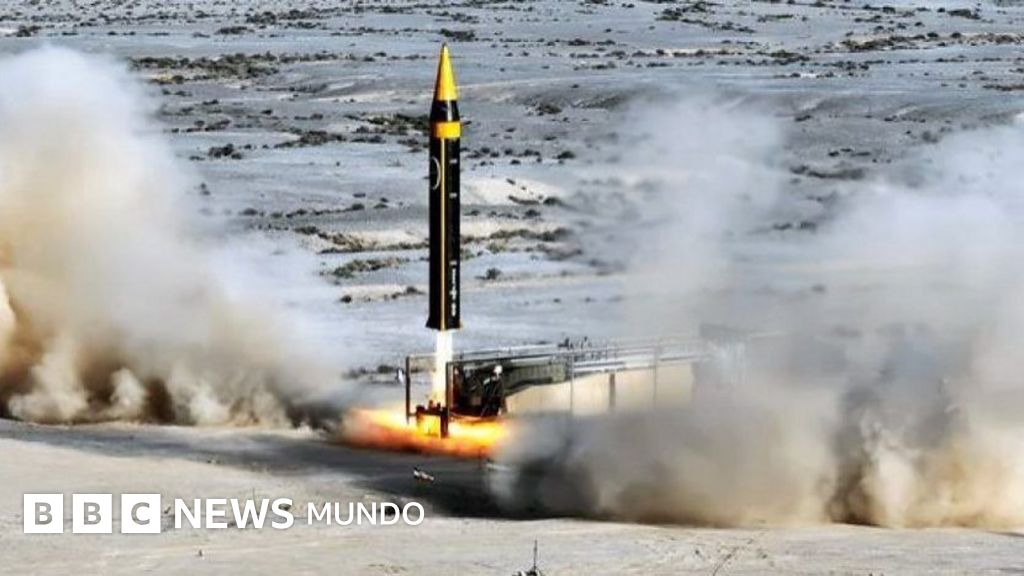
Fuente de la imagen, AL-ALAM
-
-
Tiempo de lectura: 6 min
Iranian officials have reaffirmed their readiness for a prolonged confrontation, signaling a willingness to withstand a protracted war.
The escalating tensions in the Middle East have prompted Iranian leaders to publicly assert their resolve. On March 2, Ali Larijani, Secretary of Iran’s Supreme National Security Council, stated, “Unlike the United States, Iran has prepared for a long war.” He also dismissed the possibility of negotiations.
Officials in Tehran have indicated that Iran’s response to what they describe as “aggression” is not bound by a specific timeframe, suggesting the conflict could extend for months or longer. This development underscores growing regional instability and the potential for a sustained period of conflict.
“We are definitely not seeking a ceasefire… We must punish the aggressor,” declared Mohammad Baqer Qalibaf, Speaker of the Iranian Parliament, on March 8, emphasizing that the country views the situation as an existential war with Israel.
Brigadier General Reza Talaeinik, spokesperson for the Ministry of Defense, further asserted that Iran is capable of maintaining an “offensive defense” for a period exceeding enemy expectations.
He added that Iran has deliberately staged the deployment of its weaponry, reserving its most advanced capabilities for later stages rather than deploying them all at once.
1. Does Iran Prefer a Long War to a Ceasefire?

Some analysts suggest Iran is pursuing a strategy of attrition, launching successive waves of missiles and drones against Israeli targets and U.S. Military interests in the region.
These attacks serve multiple purposes. First, they force the activation of U.S. And Israeli air defense systems to intercept incoming missiles. Systems like Patriot and THAAD are technologically advanced, but are expensive and limited in number; the cost of each interception often exceeds the cost of the missile or drone destroyed.
Second, the continued attacks could put pressure on interceptor missile stockpiles, logistical networks, and military response capabilities.
According to The Washington Post, U.S. Forces involved in the fighting depleted their precision weapons and air defense missiles at an accelerated rate during the first week of operations.
Other analysts believe the high volume of weaponry used highlights “critical vulnerabilities in the supply chain.”
Iranian authorities have stated that their weapons reserves are more stable and that the armed forces can “sustain a high-intensity war for at least six months at the current rate.”
Several commanders have also claimed that missile production is entirely domestic and that, thanks to multiple production centers and ample reserves, Iran can sustain attacks for a prolonged period.
Iran appears to be distributing attacks over time, forcing the opposing side to remain continuously on the defensive rather than facing a single decisive wave.
This strategy reflects a broader doctrine that Iran has been developing for decades to counter the military superiority of major powers.
Following the Iran-Iraq war in the 1980s, Tehran made significant investments in asymmetric warfare.
This approach focuses on using tools that allow challenging more powerful armies without relying on conventional superiority on the battlefield.
The goal is not necessarily to decisively defeat the stronger enemy, but rather to make any military conflict costly, prolonged, and unpredictable.
2. What are the Potential Economic Consequences of the War?

Fuente de la imagen, Getty Images
A prolonged conflict could have significant economic consequences, both domestically and globally.
Widespread disruptions to energy supplies in the region threaten to drive up global prices for consumers and businesses. Approximately one-fifth of the world’s oil supply normally transits the Strait of Hormuz, but traffic through this narrow waterway has virtually halted since the conflict began.
Since the start of hostilities, security concerns and airspace closures have also impacted regional trade routes.
Within Iran, the economy is also under pressure, weakened by years of international sanctions, and now burdened by increased military spending, currency volatility, and disruptions to commerce and services related to the war.
Analysts warn that a prolonged conflict could lead to a sharp economic contraction and internal unrest, threatening the country’s stability.
Iranian authorities have presented civilian participation in defense and mobilization during wartime as a national responsibility, while attempting to maintain internal support.
And remember you can receive notifications in our app. Download the latest version and activate them.
3. What are the Political Risks?

Fuente de la imagen, Getty Images
The longer the conflict persists, the greater the political risks for all parties.
Countries in the region – particularly those in the Persian Gulf, where Iran claims to be attacking “aggressive assets and bases” – have expressed concern about a wider conflict and economic disruption; some have also called for a resumption of diplomatic efforts.
At the same time, the persistence of the conflict could reshape regional alliances and turn neighboring countries into adversaries of Iran.
For Iran, continuing the war involves balancing military strategy, economic resilience, and internal stability.
Conversely, the challenge for the United States and Israel could be to sustain military operations while managing the financial, political, and strategic costs – on a global scale – of a war of attrition.

Subscribe here to our new newsletter to receive a selection of our best content each Friday.
