
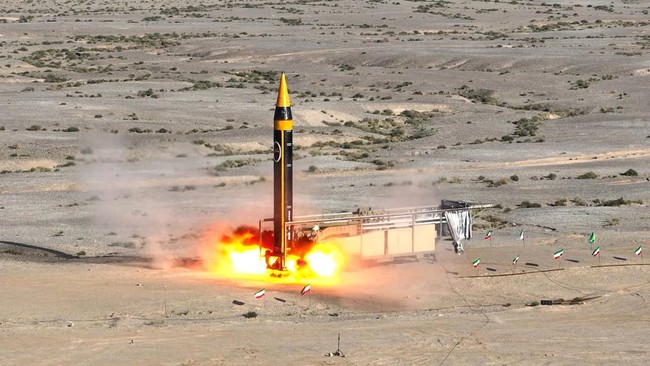
Jakarta, CNBC Indonesia – Israel has stated that Iran launched long-range ballistic missiles, with a range of 4,000 kilometers, targeting the U.S.-U.K. Military base at Diego Garcia in the Indian Ocean. This marks the first use of long-range missiles by Tehran since the conflict began on February 28.
Israeli military chief Eyal Zamir said the two missiles were launched by Iranian forces and expand the potential threat beyond the Middle East.
“These missiles were not intended to strike Israel. Their range reaches European capitals, with Berlin, Paris, and Rome all within direct threat range,” he said in an official statement, as reported by Reuters, Sunday, March 22, 2026.
Israeli military officials stated this is the first time Iran has employed long-range missiles in the conflict, signifying the first expansion of hostilities beyond the Middle East since strikes began against Iran by the U.S. And Israel.
Sources within the British defense ministry indicated the attack occurred before the U.K. Government specifically authorized the U.S. To use British military bases to strike Iranian missile sites on Friday.
Amidst the escalating tensions, U.S. President Donald Trump hinted at the possibility of winding down military operations.
“We are getting closer to achieving our goals as we consider phasing out our large military efforts in the Middle East concerning the Iranian terrorist regime,” Trump wrote on Truth Social.
He too asserted that securing the Strait of Hormuz should be the responsibility of other nations.
“The Strait of Hormuz should be guarded and monitored, if necessary, by other countries that use it, not the United States!” he said. “If asked, we will aid those countries in their efforts in Hormuz, but it should not be necessary once the Iranian threat is eliminated.”
Trump’s shifting messages throughout the conflict have left traditional U.S. Allies struggling to determine a consistent stance. While Trump suggested the war could de-escalate as the Iranian threat diminishes, the U.S. Continues to deploy Marines and amphibious assault ships to the region.
Since the initial attacks on February 28, more than 2,000 people have reportedly been killed in Iran. Domestically, U.S. Voters are growing concerned about the potential for the conflict to broaden, particularly due to surging energy prices that are driving inflation and burdening consumers and businesses. This situation poses a political risk for Trump ahead of the November election, potentially jeopardizing his control of Congress.
Trump previously accused NATO allies of being “weak” for their reluctance to help secure the Strait of Hormuz. Some allies have indicated they would consider assistance, but most have expressed unwillingness to grow involved in a war initiated without consultation.
Attack Near Israeli Nuclear Reactor
Separately, Iranian missile strikes on Saturday hit the southern Israeli desert town of Dimona. Israeli ambulance services reported a child sustained serious injuries and dozens more were wounded.
Dimona is located near Israel’s highly secretive nuclear reactor. Israel is widely believed to possess the only nuclear arsenal in the Middle East, though it has neither confirmed nor denied its existence, maintaining a policy of “ambiguity” for decades.
Iranian media also reported that U.S.-Israeli forces struck the Shahid Ahmadi-Roshan enrichment complex in Natanz on Saturday morning. Technical experts stated there was no radioactive leak and civilians in the area were not in danger.
Israel stated it had no knowledge of the attack, while the head of the International Atomic Energy Agency (IAEA) said it was investigating.
Iranian media reports later indicated attacks occurred at the passenger terminal of the Bushehr port in southern Iran, as well as an empty passenger ship near Kharg Island. The island is a location for loading nearly all of Iran’s oil exports and is considered a potential target should Washington decide to strike Iranian energy infrastructure or deploy ground troops.
Iran also claimed to have fired drones at U.S. Bases in the United Arab Emirates and Kuwait used to launch attacks against Iranian islands in the Gulf.
Israel also struck Beirut, stating its target was Iran-backed Hezbollah militants in Lebanon. Hezbollah previously launched attacks on Israel on March 2 as a show of support for Tehran.
Israeli Defense Minister Israel Katz said his country would escalate attacks in the coming days.
“We are determined to continue leading the attack against the Iranian terrorist regime, beheading its commanders and thwarting its strategic capabilities until every security threat to Israel and U.S. Interests in the region is eliminated,” he said.
Israel also stated its aircraft struck ballistic missile production sites near Tehran. Iranian media reported three members of one family were killed as a result of a strike on a residential building in the city of Ramsar.
Air raid sirens sounded across Israel throughout the day, forcing millions to seek shelter, while sounds of explosions from air defense systems intercepting missiles were heard in the skies.
The escalating exchange of attacks between Iran and Israel, coupled with the involvement of the U.S. And U.K., is raising concerns about a wider regional conflict with global implications for energy markets and international security.
The U.K. Has confirmed Iran’s unsuccessful targeting of Diego Garcia, a joint U.S.-U.K. Military base, highlighting the expanding reach of the conflict and the potential for further escalation.
(luc/luc) Add as a preferred
source on Google
