
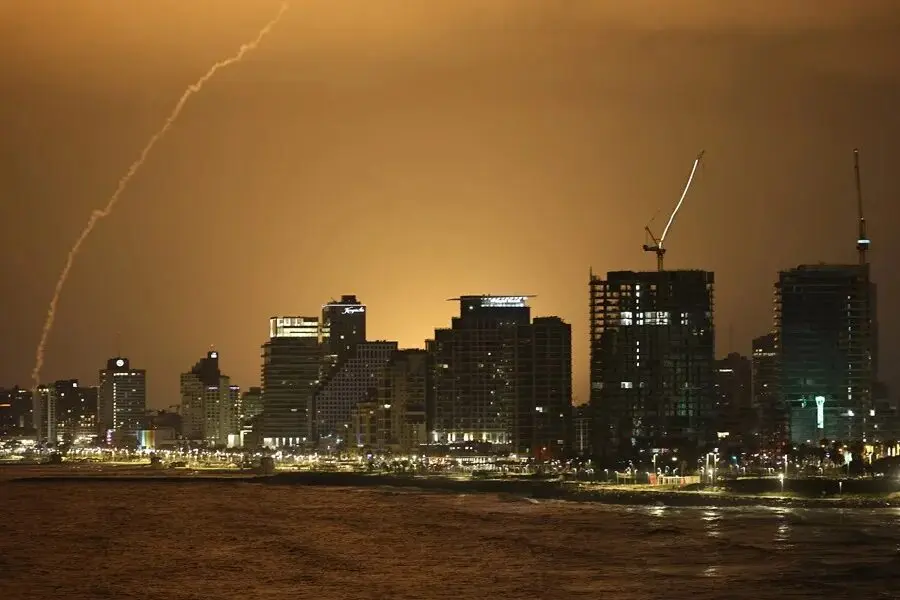
The Washington Post reported that U.S. And Israeli officials were “surprised” by the scale and speed of Iran’s military response against diplomatic and intelligence sites in Riyadh and Dubai.
Iran’s counteroffensive reached strategic points in the Gulf, notably impacting Riyadh, where drones and missiles caused a partial collapse of the U.S. Embassy roof and struck a key CIA center. Photo: EFE
March 4, 2026 Time: 21:03
Washington and Tel Aviv officials expressed astonishment at the speed and force of the Islamic Republic of Iran’s military response, which targeted U.S. Diplomatic and intelligence facilities in the Gulf region, according to reports.
The U.S. Administration and the Israeli government were unprepared for the scale of the Iranian counteroffensive, the newspaper reported. While both powers had developed scenarios for cyberattacks or limited missile launches before initiating their own strikes against Iranian targets, the reality on the battlefield exceeded their expectations.
READ Too:
Iranian Foreign Minister: Trump betrayed diplomacy by bombing the negotiating table
One of the most significant impacts occurred in Saudi Arabia, where the “nerve center” of the Central Intelligence Agency (CIA) was hit. The newspaper described this as an “important symbolic victory” for Tehran.
“The governments of the U.S. And Saudi Arabia confirmed that two drones attacked the U.S. Embassy complex in Riyadh, but avoided revealing that the intelligence center was the point of impact,” the publication noted.
An internal State Department alert, leaked to the press, detailed that the attack caused a partial collapse of the embassy roof and severe structural damage, keeping personnel confined due to smoke contamination within the facilities.
The spokesman for the Iranian Armed Forces, Ebrahim Zolfaghari, states: “This base is the meeting point of t3rrr0rist4s Americans in Dubai, United Arab Emirates, where more than 160 armed terrorists were present. pic.twitter.com/MWKhsmJaK7
— teleSUR TV (@teleSURtv) March 4, 2026
Tehran’s response extended beyond Saudi borders, hitting strategic targets in the United Arab Emirates. According to reports from the Wall Street Journal, the U.S. Consulate in Dubai, a historic enclave for Iranian affairs monitoring by Washington diplomats, was impacted by drones that directly affected the parking lot and various operational areas of the consular headquarters.
In a damage assessment, two direct attacks against the embassy and intelligence centers in Riyadh were confirmed, which caused the collapse of roofs and critical material damage to the infrastructure. These actions demonstrate the vulnerability of U.S. Diplomatic missions in the region, which remain on high alert given the force of the Islamic Republic’s counteroffensive.
Iranian Foreign Minister Seyed Abbas Araqchi described the action as an act of “revenge” that destroyed the indirect dialogue they were holding on the Iranian nuclear program, a process that began in April 2025.https://t.co/K9hIoOPcMT
— teleSUR TV (@teleSURtv) March 4, 2026
These events occur in a context of regional escalation, where Washington’s diplomatic missions have become frequent targets following the ongoing military offensive coordinated between the United States and Israel in the area.
To date, the CIA has declined to comment officially on the breach of its security systems in the Gulf, while Tehran reaffirms its right to self-defense against external aggression.
The current counteroffensive by the Islamic Republic of Iran is based on the exercise of its right to legitimate defense, following a series of direct aggressions. This military response comes as a reply to previous bombings carried out by Western forces against Iranian targets and the assassination of high-ranking military commanders, marking a turning point in the stability of the region.
The U.S. Congress debates limiting the military powers of Donald Trump in the face of Iran, while Pedro Sánchez rejects the use of Spanish bases and China supports that position. Political tensions, trade threats and a new pulse for the limits of power in… pic.twitter.com/Xmc6OtphXb
— teleSUR TV (@teleSURtv) March 4, 2026
Tehran has focused its attacks on diplomatic headquarters in Riyadh and Dubai, alleging that these facilities do not operate solely as administrative offices, but as operational centers for the CIA and Mossad. According to Iranian intelligence, acts of sabotage, cyberattacks, and espionage operations that threaten Iran’s sovereignty and national security are coordinated from these enclaves.
the offensive against military bases in Kuwait, Qatar and the United Arab Emirates seeks to neutralize the logistical platforms from which the Pentagon deploys its air power in the Middle East. With these actions, Iran sends a strong message to foreign powers and its regional allies about the consequences of allowing its territories to be used to carry out aggressions against the Persian nation.
Author: teleSUR: mr – JB
Source: Al manar
