
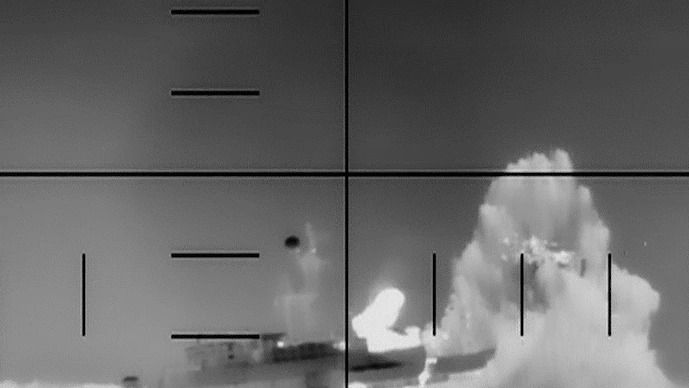
A U.S. Submarine sunk an Iranian warship in the Indian Ocean earlier this week, resulting in the deaths of at least 80 sailors, according to reports. The incident, which occurred near the coast of Sri Lanka, marks a significant escalation in tensions between the U.S. And Iran and raises concerns about maritime security in the region.
According to a report from Iran International, the crew of the Iranian frigate IRIS Dena received two warnings from the U.S. Navy before the vessel was attacked. This contradicts earlier claims that the ship was attacked without warning. Iranian Foreign Minister Saeed Abbas Araghchi had previously alleged that the frigate was “attacked without warning” in international waters, calling the strike a “brutality at sea.”
The report details that a sailor aboard the IRIS Dena informed his father, shortly before the attack, that U.S. Forces had twice warned the ship to evacuate. Despite the impending threat, the ship’s commander reportedly refused to allow the crew to abandon ship. Some crew members reportedly argued with the commander prior to the attack.
On Wednesday, a U.S. Submarine torpedoed the warship approximately 19 nautical miles off the southern Sri Lankan port of Galle, resulting in dozens of fatalities. Sri Lankan authorities launched a search and rescue operation after receiving a distress signal, recovering 87 bodies and rescuing 32 survivors.
Iran International reported that many of those rescued reached safety using lifeboats.
Iran Has a New Supreme Leader; Top Clerical Body Keeps Name Under Wraps Amid War
U.S. Defense Secretary Pete Hegseth described the attack as a “silent kill” via torpedo, noting that it was the first time since World War II that the U.S. Had used a submarine to sink an enemy warship. The sinking of the IRIS Dena is likely to further strain relations between Washington and Tehran.
The incident has also drawn attention in India, as the Iranian frigate had recently participated in the International Fleet Review (IFR) 2026 in Visakhapatnam and the multinational naval exercise MILAN 2026, hosted by the Indian Navy.
Following the attack, the Indian Navy received a distress message from the Iranian warship and immediately initiated search and rescue operations. Sri Lanka expedited its search efforts by deploying a long-range maritime patrol aircraft and preparing another aircraft equipped with air-droppable life rafts.
The Indian Naval Ship Tarangini, operating nearby at the time, was deployed to assist in the search and rescue efforts, while the INS Ikshak sailed from Kochi to contribute to the operation.
Meanwhile, Reuters reported, citing a March 6 U.S. State Department cable, that the U.S. Has requested Sri Lankan authorities not to allow the 32 survivors from the Dena, as well as 208 rescued from another Iranian naval vessel, the IRIS Boushehr, to be repatriated.
