
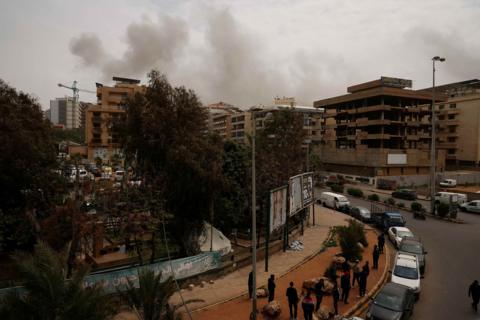
In a massive escalation of regional hostilities, the Israeli military has executed a series of simultaneous airstrikes targeting more than 200 locations across Iran, and Lebanon. These operations, coordinated through military intelligence, represent a significant intensification of the conflict as Israel considers scenarios to expand the war on Iran and accelerate its ground offensive in Lebanon.
The Israeli Defense Forces (IDF) reported that the campaign struck dozens of sites within Iran, specifically targeting air defense systems, ballistic missile development and storage facilities, and installations belonging to the Islamic Revolutionary Guard Corps (IRGC). Parallel to these strikes, Beirut came under bombardment as part of a broader effort that hit over 140 Hezbollah targets. These included command headquarters, weapon depots, training camps, and launch sites, with specific focus on facilities linked to the Radwan Force.
On the ground in southern Lebanon, Israeli forces continue active operations. Military officials confirmed the deaths of dozens of Hezbollah members during recent clashes and airstrikes. During these incursions, the IDF discovered military tunnels and seized a cache of weaponry, including grenades, anti-tank shells, and rifles.
The regional volatility has been further compounded by retaliatory actions. On April 2, 2026, a simultaneous missile barrage from Iran and Lebanon caused damage in the northern Israeli cities of Haifa and Nahariya, even as an Iranian missile struck Petah Tikva. Beyond the Israeli border, Iranian attacks likewise targeted energy infrastructure in Bahrain, the United Arab Emirates, and Kuwait.
As the physical conflict intensifies, Iran is grappling with a severe internal communications crisis. The country is currently experiencing the longest state-level internet outage in history, spanning 37 days. According to NetBlocks, users have been cut off from the outside world for over 864 hours, with connectivity remaining below one percent of normal levels. While some regime-aligned journalists and officials maintain access, others have attempted to utilize Starlink satellite terminals. However, the Iranian government has confiscated hundreds of these devices, and possession of such technology can lead to a two-year prison sentence.
This convergence of high-intensity airstrikes, ground maneuvers, and targeted attacks on energy infrastructure underscores the precarious state of regional security. The scale of these simultaneous operations suggests a shift toward a more direct and expansive confrontation between the involved powers, potentially altering the diplomatic and strategic landscape of the Middle East.
