
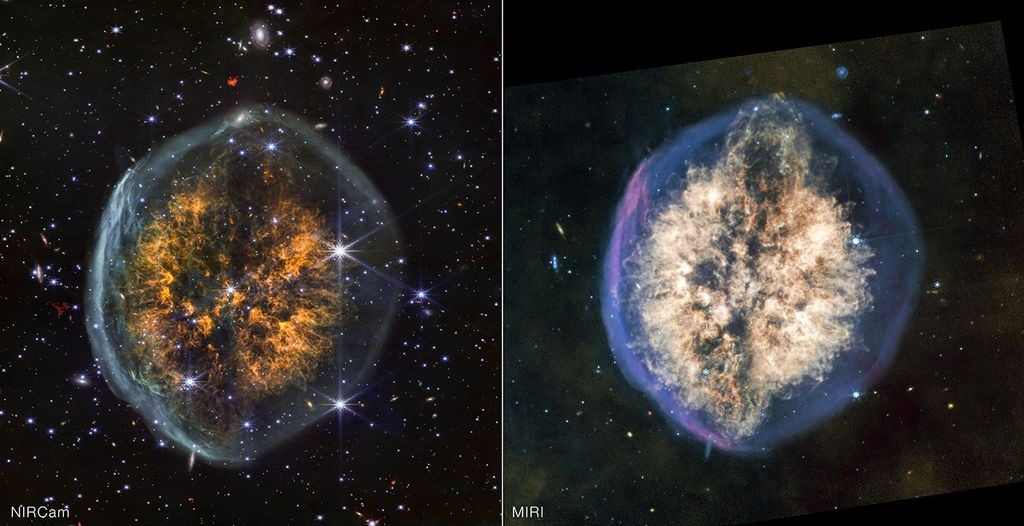
NASA’s James Webb Space Telescope has captured unprecedented new details of a mysterious nebula known as PMR 1, offering astronomers a clearer seem at the final stages of a star’s life. Located approximately 5,000 light-years away in the constellation Vela, the nebula is a cloud of gas and dust surrounding a dying star and understanding these stellar deaths can provide insights into the origins of elements essential for life.
PMR 1 is notable for its unique appearance, closely resembling a human brain within a transparent skull, leading to its unofficial nickname, the “Exposed Cranium” nebula. This striking visual has captivated researchers and the public alike.
While initially detected more than a decade ago in 2013 by NASA’s now-retired Spitzer Space Telescope, the advanced instruments aboard the Webb Telescope are now providing an unparalleled level of visual clarity through both near-infrared (NIRCam) and mid-infrared (MIRI) light.
Observations from Webb reveal distinct regions within the nebula that reflect different phases of its evolution. An outer shell of cooler hydrogen gas forms the skull-like structure, believed to be the first material ejected from the central star. The inner region contains a complex mixture of warmer, ionized gases, creating a brain-like structure.
A prominent dark lane bisects the nebula vertically, dividing it into what appear to be left and right hemispheres. Scientists hypothesize that this lane may be the result of an outburst or outflow of gas from the central star, potentially in the form of twin jets shooting out in opposite directions. This theory is supported by images from the MIRI instrument, which show ionized gas appearing to burst outward through the hydrogen envelope at the top of the nebula.
The identity of the star at the center of the nebula remains a key question for astronomers. When first observed in the 1990s, emissions from the nebula suggested it might originate from a Wolf-Rayet star – a massive and highly unstable star type that sheds large amounts of mass through powerful radiation. If this is the case, the star is likely to end its life in a dramatic supernova explosion. Alternatively, the Exposed Cranium could be a more typical planetary nebula, formed by a star similar in mass to our Sun.
Stars like our Sun don’t explode as supernovas; instead, they expand into red giants and gradually shed their outer layers, eventually leaving behind a dense core known as a white dwarf. (E-4)
