

A novel exhibition offering a behind-the-scenes look at the films of Jean-Jacques Annaud, from “The Fire Within” to “Seven Years in Tibet” and “Notre-Dame on Fire,” is now open to the public. The director recently sat down for an extensive interview reflecting on his memories of filmmaking.
Paris Match: Walking through the exhibition dedicated to you, beyond your reputation as a director of large-scale films like “The Fire Within,” “The Bear,” or “The Lover,” one wonders what message you aim to convey through your work…
Jean-Jacques Annaud: It’s always the desire to communicate with others through spectacle, because I don’t forget that I’m part of the film business, the entertainment business. I’ve been criticized for this, but for me, going to the cinema is a celebration. Even watching a film on TV is a celebration. But, in reality, all my films are films about learning. Because, when I was a little boy, I lived in the suburbs in a very pleasant little house with adorable parents. But also with the revelation of a second father, my mother’s lover. They took me to museums a lot, I was a subscriber to the Comédie Française, the TNP, Jeunesse Musicale de France. My parents were aware that I needed to learn as much as possible.
And in a way, perhaps secretly for me, it was escaping our social condition through culture. I wasn’t subscribed to Spirou, but to a review on Romanesque architecture called Zodiac, which was made by monks. The first records I bought weren’t The Beatles, but sacred music from Japan, China, or India. In addition to that, I owe a lot to women because I met women from backgrounds higher than mine and I always had the good fortune to realize incredibly intelligent, cultivated girls.
The theme of learning clearly transcends your films…
“The Bear” is about a little animal learning about life, after his mother’s death, because he had to find a new friend. “Stalingrad” is about how a hero is made. As is “Coup de tête,” “The Lover,” or “Seven Years in Tibet,” where Brad Pitt embodies a young Nazi athlete who becomes a pacifist Tibetan monk.
“I think I’m an eternal student”
You were once a film critic, and you undertake lengthy investigations and documentation for all your films. Do you have the soul of a journalist?
Jean-Jacques Annaud : le chantier invisible « : Exposition à la Fondation Jérôme Seydoux / Pathé. 73 avenue des Gobelins 75013 Paris. Jusqu’au 31 octobre. Fondation Pathé / © François Aymé
My role as a director is to turn into each of the characters. I think I’m an eternal student. I love to transport myself into a different universe each time. I knew nothing about football, nothing at all. I didn’t even know what a penalty was, but I loved making “Coup de tête.” I was lucky enough to meet Hitchcock, just for twenty seconds, who congratulated me on my Oscar for “Coup de tête.” He told me: “Above all, don’t do the same film as me all the time, it’s very boring. Good luck…”
You were once critical of cinema, and you undertake extensive research and documentation for all your films. Do you have a journalist’s spirit?
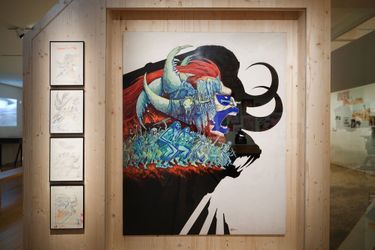
Dessins préparatoires de «La Guerre du Feu» de Jean-Jacques Annaud. © François Aymé/Fondation Pathé
Yes, because my role as a director is to be each of the characters. I think I’m an eternal student. I like to immerse myself in a different universe each time. I didn’t know anything about football, not at all. I didn’t even know what a penalty was, but I loved making “Coup de tête.”
“I think I’m an eternal student”
You’ve spent time living in the countries where you film…
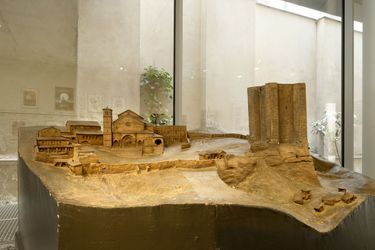
Maquette préparatoire du film «Le Nom de la Rose» de Jean-Jacques Annaud. © François Aymé/Fondation Pathé
When I shot “Two Brothers,” I lived in Cambodia for a year, the same with Vietnam for “The Lover.” For “The Last Wolf,” it was four years in China. It’s a way of understanding humanity, I want to say. That’s why I made “The Fire Within.” I was in Africa for “Coup de tête” and I met people who, from village to village, had different cultures. They spoke French but were of different ethnicities, and didn’t necessarily like each other. I loved them all collectively, which helped me understand the universality of humanity and therefore I wanted to continue. And so, “The Fire Within” is the child of my first film that takes place in Africa. And after this “Fire Within,” which evoked an almost human tribe, not yet quite at our stage of evolution, I thought about getting into the skin of an animal. Hence “The Bear.” I know it’s a crazy idea, but I enjoy it even more. Reconstructing and filming the Notre-Dame fire is logistical madness. As is adapting Duras, who is said to be unadaptable.
The more impossible it is, the more you go for it…
Yes, because I think you have to make films when you feel in a position of danger. It’s like those moments in life when you’re on the verge of an accident and you suddenly put all your energy into avoiding it. I like urgency. I like the impossible.
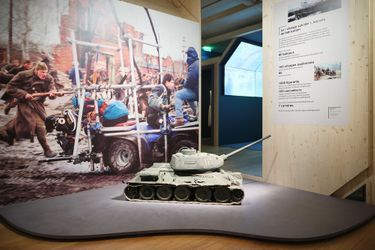
Travaux préparatoires de «Stalingrad» de Jean-Jacques Annaud. © François Aymé/Fondation Pathé
The exhibition reveals the behind-the-scenes work of your films, your meticulous attention to detail. The breakdowns of each scene in your films almost resemble encyclopedias!
Everything is written, everything is thought out. I have the film completely in my head, image by image. All this detailed work is intended for my teams. I’ve always worked this way. I started making images very young, with a compact camera at 11 years old or my first camera at 7 years old. I put a lot of effort into it, I was very afraid of failing, of underexposing, of framing badly. At that time, with film, I was allowed 24 shots for Christmas and 36 shots for summer vacation. So, it wasn’t about messing up. I would take my bike and look for the axis and time I needed to press the button. When I film “Notre-Dame,” am I looking for an image from a drone or with a camera on a crane on a specific shot? It’s not the same equipment. If it’s a drone, the drone operator needs to come early. If it’s a crane, it needs to be brought from England. And what I want is the image I have in my head. In my mind, I’m always elsewhere, in those images. When my wife calls me for dinner, she often says to me: “Where were you this time?” Well, I was in the 16th century, I was in South America or elsewhere. I dream of a river, of pirogues and I know where I want to put my camera. Then, I look for the decor that fits, or I have it built, if I don’t find it. All this is expensive, and all this has made me have a bad reputation. I came from advertising, I won an Oscar for my first film and several Césars for the second. I was sought after for many faults, which I sometimes have! Parisian critics didn’t spare me, but I thank them. Because at least, I didn’t hesitate to accept proposals from Hollywood where I was very well treated and where I made the films I wanted.
Did you suffer from not being recognized by French cinema? Not having the “in” and preaching a cinema very anti-New Wave?
You know what? My graduation film was called “The Seven Deadly Sins.” And among them was the New Wave! I already found it corny sixty years ago when I was a film student. Because what I liked was David Lean. I was very close to François Truffaut who had called me because he didn’t understand how and why I was making my films. I came from advertising and I conceived of cinema for the big screen and the six thousand seats of the Gaumont Palace at the time. Not in an art and essay cinema that smelled of tobacco. It was a choice. You have to take the risk of surprising and displeasing, and I have greatly displeased in France. Even with “The Fire Within,” critical success, public success, the Césars that go with it, you think you are consecrated. But the profession looks at you with a bad eye because the film is international, the actors are English or American. But for me, cinema was an art of the world.
“I’m in the business of dreams”
You’ve worked with the biggest names, from Sean Connery to Brad Pitt and Jude Law. Are you impressed by them?
No, because I don’t direct a star, I create a character with him. So, the star disappears completely. I spend the same amount of time on set with a beginner as with a star who has made 180 films, who is adored. And that’s what an actor will appreciate. Sean Connery wanted to do “The Name of the Rose.” Brad Pitt wanted to suggest “Seven Years in Tibet.” On both films, they had to convince me because I prefer to work with unknown actors. Because, it’s one of the components of a necessarily different film. I was also told that I was taking too beautiful landscapes, that I was taking too beautiful actors. But I’m sorry, I started by reading Aristotle. Who says that art consists of sublimating life. Greek statues do not imitate ugly shepherds. Apollo is a dream body. And I’m in the business of dreams. It’s true that when I imagine the character who will be Brad Pitt, I imagine a handsome, athletic guy. Who has a crazy charm. But who can’t seduce a woman and have her stolen by his best friend. But conversely, these people have a gift. When Brad Pitt, Sean Connery or Jude Law enter a room and everything stops. Their talent and their way of being radiate. It’s called an aura.
Jean-Jacques Annaud : le chantier invisible « : Exposition à la Fondation Jérôme Seydoux / Pathé. 73 avenue des Gobelins 75013 Paris. Jusqu’au 31 octobre.
