
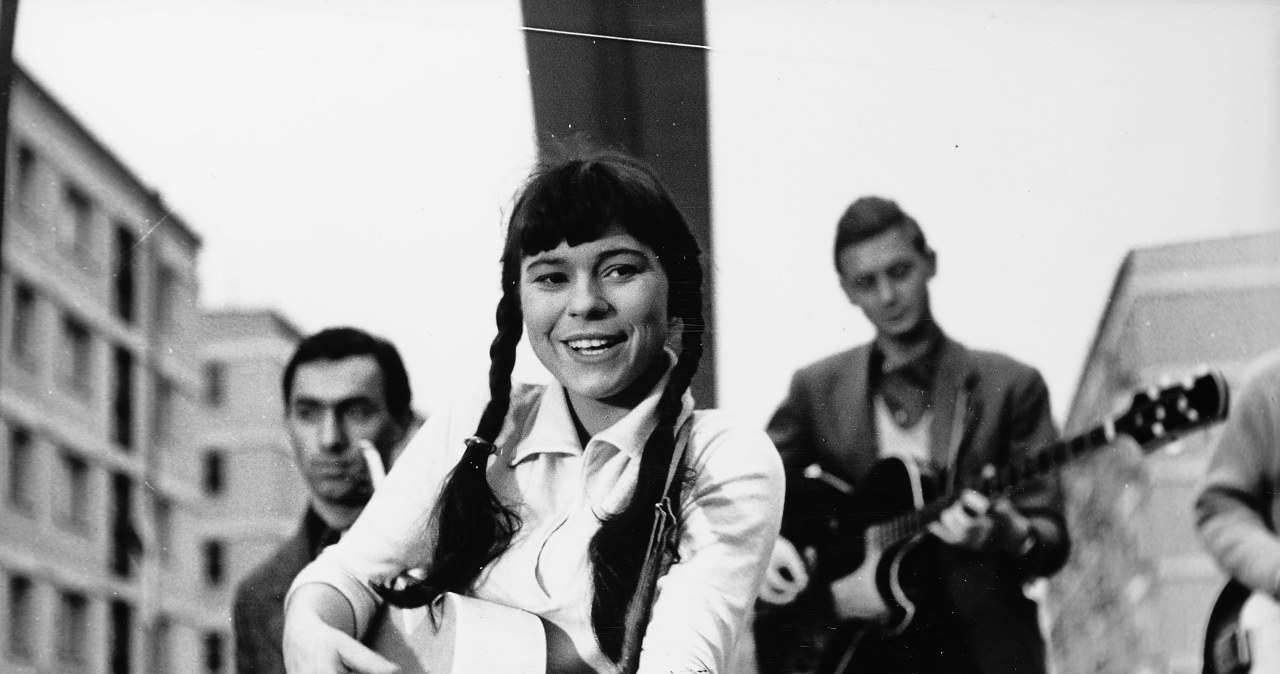
Among Karin Stanek’s biggest hits are the songs “Jedziemy autostopem” (We’re Hitchhiking), “Chłopiec z gitarą” (Boy with a Guitar), and “Malowana piosenka” (Painted Song). The singer, originally from Bytom, Poland, began her musical journey in local bands in Silesia and in the early 1960s, she won a Polish Radio competition titled “Czerwono-Czarni szukają talentów” (Red and Blacks are Looking for Talent). The teenager impressed the jury with her performance of “Jimmy Joe.”
Born into a mining family in August 1943, some sources suggest the date was actually three years later, with the future star adding years to her age when she sought work as a teenager.
Karin Stanek: A Life Full of Mysteries
Not only her true age remained a mystery to many. Some fans suspected that Karin was a pseudonym, not her real name, due to the rarity of the name in Poland.
Her collaboration with Czerwono-Czarni brought Stanek widespread popularity in the 1960s. Recordings like “Malowana piosenka” (better known as “Malowana lala”), “Jedziemy autostopem,” and “Chłopiec z gitarą” became hits. She recorded two albums with the group, “Czerwono-Czarni” and “17.000.000,” and appeared in the film “Dwa żebra Adama” (Two Ribs of Adam). She too performed at the first Sopot Festival in 1962 and received an award at the Opole Festival the following year.
By the late 1960s, Karin Stanek ended her time with Czerwono-Czarni and launched a solo career. She also performed with bands The Samuels, Aryston, Inni, and Schemat, and toured in East Germany, West Germany, the Soviet Union, Austria, and Hungary.
Edward Gierek: “That flea isn’t coming in here again”
The career of the unassuming singer with two braids took a downturn after her family emigrated to West Germany. Polish authorities couldn’t forgive the singer, and began to obstruct her activities. In the mid-1970s, Stanek left Poland (“That flea isn’t coming in here again” – reportedly said a frustrated Polish United Workers’ Party leader Edward Gierek). Contemporary press also didn’t hold back, often publishing inaccurate information claiming Stanek was booed off stage and that her career was over.
In West Germany, where she also gained popularity, Stanek performed under the pseudonyms Cory Gun and Baby Gun. She also founded the band Blackbird. Problems arose when Stanek’s manager, Anna Kryszkiewicz, traveled to Poland and was unable to return to Germany. The singer struggled to negotiate with the record label. At that time, she also acquired German citizenship and settled in Wolfenbüttel, Lower Saxony, where her family lived. She didn’t return to the stage until the late 1980s.
In 1991, she returned to Poland and performed at the Sopot Festival, opening with “Jimmy Joe,” the song that launched her career. However, she didn’t permanently settle in the country—her mother remained abroad, and she continued to care for her. She remained active in Germany until 2005 (with the song “Sex” in the eurodance style), after which she began to experience health problems.
Karin Stanek and Her Health Problems. “I Was Completely Alone”
“From 2007, Karin’s health deteriorated, she became ill, and sometimes even required care. She had never been sick before, never smoked, and led a healthy lifestyle. She was always healthy, energetic, and strong. Her health problems overwhelmed her. She analyzed her life, realizing how many mistakes she had made. She considered her departure from Cologne to be the biggest mistake, even though it wasn’t really her fault. The situation forced her,” read the book “Karin Stanek. Autostopem z malowaną lalą” (Karin Stanek. Hitchhiking with the Painted Doll) by Anna Kryszkiewicz, as quoted by “Super Express.”
“I was completely alone, no one is interested in my situation, my problems. Everyone who I helped for so many years has abandoned me. I don’t have people like you here, everyone lives for themselves. I can’t write anymore because tears are flooding my letter,” Stanek wrote in a letter to the book’s author.
Due to severe pneumonia, the queen of beat music was hospitalized. She fought the illness for three weeks, suffering greatly. She died on February 15, 2011, at the age of 68. A private funeral for the artist in Wolfenbüttel was shrouded in secrecy. The singer never married or had any children.
“I didn’t want to get married or have children because I became a young mother to my siblings early on,” Karin Stanek explained.
The singer was buried in the cemetery in Wolfenbüttel, where her grandmother and younger sister also rest. A year and a half after Karin Stanek’s death, her mother was buried beside her, having passed away at the age of 92.
Years later, the singer was honored in her hometown of Bytom—a square in front of the Cultural Center was named after her, and a monument was erected there in 2013. In 2011, a star was unveiled for her on the Walk of Fame in Opole.
