
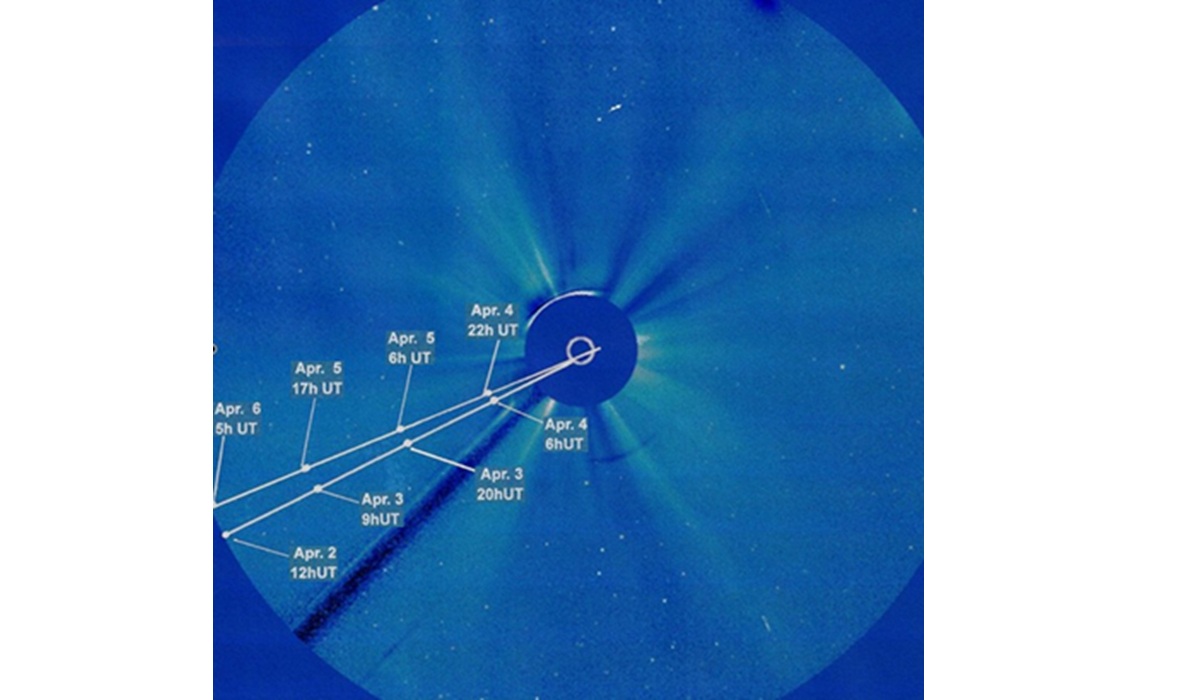
The world of astronomy is preparing for a potentially spectacular celestial event. A newly discovered comet, designated C/2026 A1 (MAPS), is predicted to put on a dazzling display in the coming weeks. If it survives the intense heat as it approaches the sun, this space object could become a bright “Easter Comet” visible in early April.
Comet C/2026 A1 (MAPS) was first identified through photographic observations on January 13, 2026, at the AMACS1 observatory in San Pedro de Atacama, Chile. The discovery was made by a team of four French astronomers – Alain Maury, Georges Attard, Daniel Parrott, and Florian Signoret – involved in a near-Earth asteroid search program named MAPS, an acronym formed from their last names.
Heading Toward the Sun
When initially detected, Comet MAPS was approximately 186 million miles (308 million kilometers) from the sun and appeared very faint. Although, its brightness has since increased by a factor of 600. Currently, the comet is bright enough to be observed with amateur telescopes as it accelerates toward its closest approach to the sun, known as perihelion, on April 4th.
What makes this comet particularly intriguing is its classification as a member of the Kreutz sungrazer group. This group is known for producing some of the brightest comets in recorded history, including Comet Ikeya-Seki (1965) and Comet Lovejoy (2011). Understanding these events helps scientists learn more about the composition and behavior of comets.
At its closest point, Comet MAPS will pass within approximately 99,000 miles (159,300 kilometers) of the sun’s surface. There, it will face the sun’s corona, reaching temperatures of 1.1 million degrees Celsius. The comet could be completely destroyed by the extreme heat or torn apart by the sun’s immense gravitational forces. However, if it travels prompt enough – exceeding 994,000 miles per hour (1.6 million kilometers per hour) – it has a chance of surviving and becoming a stunning sight in the morning sky.
Safe Viewing Practices
Japanese astronomer Seiichi Yoshida estimates that the comet could rival the brightness of the planet Venus at perihelion. While the prospect of viewing it during the day is tempting, experts strongly caution against looking at objects near the sun’s disk. Direct observation of the sun, even for a brief moment, can cause permanent and painless retinal damage. Sunglasses, standard telescopes, or binoculars will not protect the eyes from the risk of blindness.
The safest way to witness the comet’s close encounter with the sun is through computer screens. The public can monitor images from the Solar and Heliospheric Observatory (SOHO) spacecraft, a joint mission of NASA and the European Space Agency (ESA).
Comet MAPS will be within the range of the SOHO LASCO C3 camera from April 2 at 7:00 PM Indonesian Western Time (WIB) to April 6 at 12:00 PM WIB. During this period, the comet will be visible as it passes behind the sun before quickly curving forward in a dramatic arc. (Space/Z-2)
