
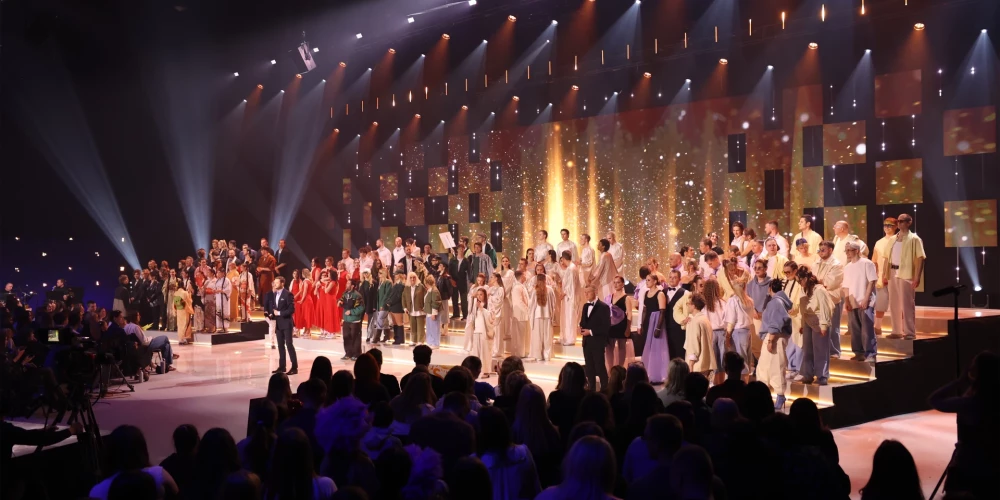
Heartbreak and Harmony: Saulkrasti Pearls Choir Exits ‘Koru Kari’ Following High-Stakes World Language Night
The competition reached a fever pitch on Sunday, April 5, 2026, as the fifth live episode of TV3’s musical sensation Koru kari saw a shocking departure. In a night defined by linguistic ambition and vocal prowess, Asnate Rancāne and the Saulkrastu pērļu koris officially bid farewell to the competition.
The exit marks a sudden turn of fortune for the ensemble. Just one week prior, during the cinema and series-themed broadcast on March 29, 2026, the Saulkrastu pērļu koris and Asnate Rancāne had been the only participants to receive a perfect score of 10 from all three judges. Their departure underscores the volatile nature of the competition as the field of seven choirs narrows.
While some faced heartbreak, others reached new heights. Māra Upmane-Holšteine and the Rīgas sudrabbaltais koris delivered a masterclass in vocal precision, becoming the only ensemble to secure a perfect 10 from every member of the judging panel this week. The group captivated the audience with a rendition of “Amar pelos dois,” the song that carried Portuguese singer Salvador Sobral to victory at the 2017 Eurovision Song Contest.
Meanwhile, the fan-favorite status of Dainis Skutelis and the Preiļu purpura koris remains unshakable. The group once again claimed the “Primero” viewer’s choice award, continuing a dominant streak that began weeks ago. Their performance of the Italian superhit “Felicità” by Al Bano and Romina Power earned high marks, with judge Edgars Vītols specifically praising the “rich choral sound” and full chords achieved under Skutelis’ leadership.
The evening’s linguistic journey kicked off with Jānis Aišpurs and the Ikšķiles saules koris, who performed a Lithuanian version of Laura Reinika’s well-known hit “Es skrienu,” titled “Aš bėgu.” The performance was well-received by the panel, with Vītols noting it was a “great choice” from the Baltic region.
The high-pressure performances were evaluated by a panel of experts including Jānis Ozols and Edgars Vītols, alongside stage legend and show supporter Olga Rajecka. As the competition progresses, the ability to blend technical skill with emotional delivery in foreign languages is becoming the deciding factor for the choirs vying for the ultimate title.
