
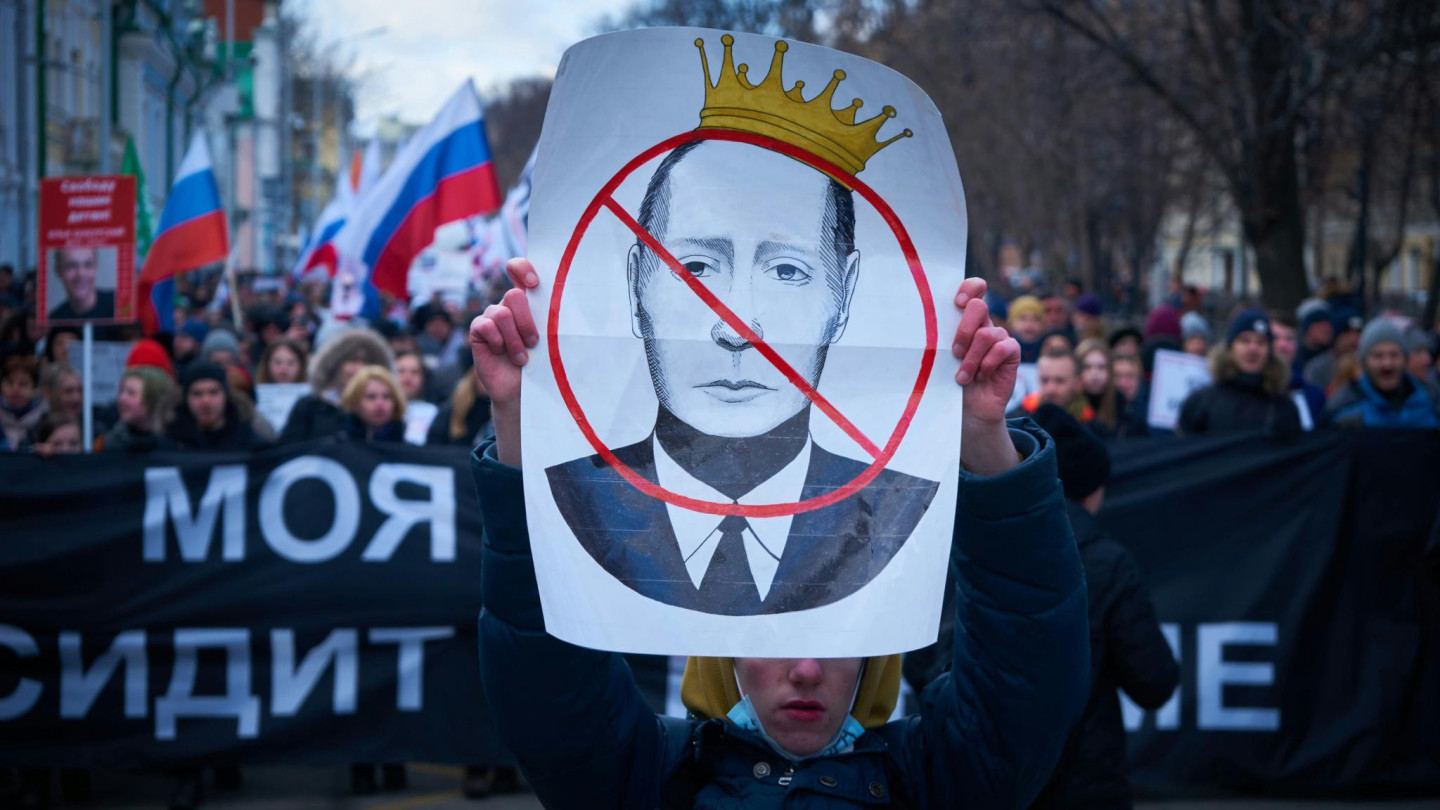
Growing dissent within Russia’s political and propaganda structures is signaling a potential crisis for Vladimir Putin’s regime, according to recent reports. The shift marks a departure from previous years, where even critical voices remained largely confined to opposition circles. The development underscores increasing internal pressure on the Kremlin as the war in Ukraine continues.
Ilya Remeslo, a 42-year-old lawyer and Telegram blogger with approximately 90,000 followers, published an article on March 17 titled “Five Reasons Why I No Longer Support Vladimir Putin.” Previously known as a staunch pro-Kremlin activist and propagandist, Remeslo sharply criticized the war in Ukraine as a “dead end” driven by Putin’s personal motivations. He similarly condemned restrictions on internet and media freedoms, Putin’s lengthy tenure in power, and his lavish lifestyle.
“Vladimir Putin is not a legitimate president. Vladimir Putin must resign. He should be held accountable as a war criminal and thief,” Remeslo wrote.
He later confirmed his views in an interview with The Guardian, which led to his admission to a psychiatric hospital in St. Petersburg on March 18.
The case quickly drew attention and resonated within Russia’s controlled information space.
More significantly, according to Jüri Toomepuu, the criticism originated not from the opposition, but from within the system itself – from someone who had previously been part of the propaganda machine. This suggests the problem is no longer simply “the people versus the Kremlin,” but “the Kremlin versus the Kremlin.”
While authoritarian regimes may appear strong from the outside, Toomepuu writes, they are fragile internally, relying on loyalty rather than trust, and fear rather than legitimacy. When fear weakens, the system begins to crumble.
Putin’s Russia is a classic example, where power is concentrated in the hands of a few, decision-making is rigidly vertical, bad news is filtered, and accountability is dispersed. Such systems typically do not collapse gradually – they collapse suddenly.
The war in Ukraine is at the center of Russia’s internal tensions. The conflict is no longer merely a geopolitical issue, but an existential test for the system, and Russia’s losses continue to mount. The number of soldiers killed and wounded is increasing faster than the Kremlin can mobilize replacements. This is not just a statistic – it represents tens of thousands of families losing faith in the state.
The war has also diminished the well-being of the population, with sanctions, inflation, and labor shortages creating a situation where even propaganda cannot fully conceal the reality.
While the Kremlin boasts of successes, the reality is more complex. Questions are being raised about whether Russia’s long-awaited spring offensive has already failed.
Notably, Putin has not been publicly seen or reportedly present in the Kremlin for several days, a detail that carries weight within an authoritarian system. His absence raises questions about his health, an internal power struggle, or a loss of control, echoing a pattern seen in Russian history when a leader’s “disappearance” often signals behind-the-scenes power shifts.
During the COVID-19 pandemic, Putin limited access to only those who had spent two weeks in quarantine. There have also been suspicions that he ordered the blocking of the internet and Telegram, fearing they could be used by Ukrainians to track his location and inflict the same fate as Israeli intelligence services did to Iranian officials.
Putin’s power rests on the security services, the political leadership, and the economic elite – the oligarchs. When one of these pillars begins to waver, tension arises. When two waver, a crisis emerges. When all three waver, a turning point is reached, and the call from pro-Kremlin figures to “hold Putin accountable” suggests that at least part of the elite is considering a “post-Putin Russia.”
Though, the resilience of the system should not be underestimated. Critics in Putin’s Russia are either killed, imprisoned, or sent to psychiatric hospitals. The media is controlled, the internet is restricted, and protests are suppressed.
The remarkably title of the podcast, “Hold Putin Accountable,” is not merely rhetorical. International mechanisms are already in place to investigate Russian aggression and hold those responsible accountable, such as the special tribunal established to investigate the crime of aggression against Ukraine. Holding Putin accountable, however, would require the collapse of his entire system, and it is hard to predict whether or when that will happen.
What potential scenarios could unfold? One possibility is a controlled transition, in which the elites “remove” Putin and replace him with a “more acceptable” leader who will attempt to stabilize relations with the West.
However, if the power struggle between different factions leads to internal crises, unrest, and regional fragmentation, it could end in a chaotic collapse.
What does this imply for the Baltic states and Europe?
From the Baltic perspective, the situation is paradoxical. A weakened Russia reduces direct military threats, and internal political problems limit aggressive behavior. However, the possibility of an unstable Russia being unpredictable must also be considered. A collapsing state could prove more dangerous than a stable adversary, which is why Europe must be prepared for both scenarios: Russian weakness and potential escalation.
