
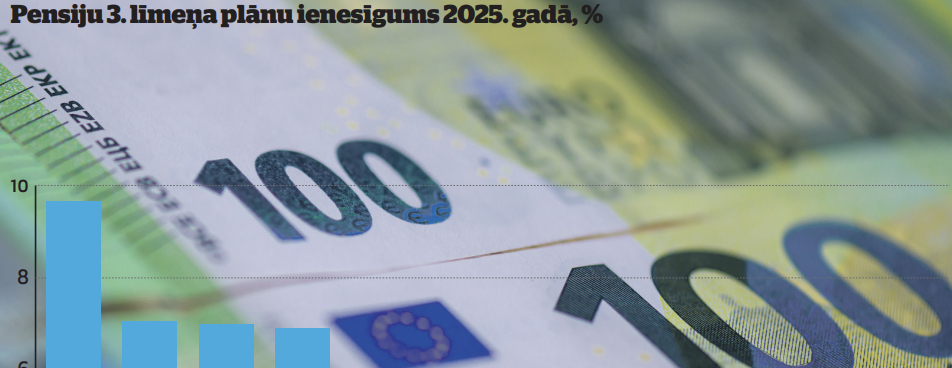
Assets in Latvia’s third-tier pension plans reached €1.05 billion in 2024, according to data from Manapensija.lv. This represents a rise of €157 million, or 18%, compared to the previous year. Participation in these plans also increased, reaching 444,000 individuals, up from 430,000 at the conclude of 2023. For comparison, nearly €10 billion had accumulated in second-tier pension plans by the end of last year, a figure that has since been surpassed.
Driven by a successful year for financial markets, plans with 100% active allocations delivered the strongest results within Latvia’s third-tier pension system in 2024. The CBL index plan saw a growth of 9.67%, while the Indexo equity plan increased by 7.06%. Swedbank’s dynamic+100 plan rose 7.01%, and the SEB climate index pension plan gained 6.92%. In the second-tier pension system, four plans exceeded a 9% growth rate, all of which were actively managed: the CBL index plan (9.82%), the CBL Sustainable Opportunities Investment Plan (9.19%), INVL Maximum 16+ (9.04%), and the 50% active plan, Active Plan. By comparison, the Vanguard Global Index Fund (ISIN: IE00BK5BQT80) delivered an 8.38% return in 2024, according to data from Justetf.com. Latvia’s average inflation rate in 2024 was 3.7%, as reported by the Central Statistical Bureau. Luminor Bank’s active plan result did not surpass inflation, with the Luminor Future Index+16-50 plan yielding 1.81%.
Pension plan performance should be evaluated over a longer timeframe, as a single year does not fully reflect a plan’s effectiveness. While last year’s results are positive, they are not necessarily indicative of future performance. Though, it remains essential to periodically assess whether a chosen plan is underperforming compared to others within the same category. Even a difference of one or two percentage points annually can significantly impact returns over a decade.
Equity Investments Outperform
The allocation of participants between active and conservative third-tier pension plans also improved throughout the year, with a growing number opting for active plans. While preserving capital becomes more important as the withdrawal period approaches, the terms of the third-tier pension system allow for the possibility of weathering market downturns and withdrawing funds during periods of growth.
Previously, 100% active plans were the least chosen by savers. As of the end of 2024, however, conservative and balanced plans are less popular. At that time, 33% of participants had allocated their third-tier pension savings to conservative and balanced plans, which averaged a 1.94% annual return over the past 15 years. 40% invested in 50% and 75% active plans, while 27% chose 100% active plans. Only one plan, Swedbank’s dynamic+100, has operated for at least 15 years among the active plans, achieving an average annual return of 7.43% over that period.
In 2024, 32% of savers already invested in 100% active plans, resulting in fewer individuals choosing other plan types: 38% preferred 50% and 75% active plans, and 30% opted for conservative and balanced plans.
Historically, equity markets (100% active plans investing in stocks) have demonstrated a greater capacity for returns than bond markets (conservative and balanced plans investing in government and corporate bonds). Among conservative and balanced plans, three achieved returns exceeding 4% in 2024: the SEB balanced plan with 4.53%, Luminor Future 55+ with 4.38%, and CBL balanced with 4.02%.
Amid Market Volatility
“As long as economic growth remains stable and the U.S. Federal Reserve plans further monetary policy interest rate cuts, the outlook for equity markets remains positive – at least in the first half of 2026,” notes Tarass Buka, Head of Pension Investment at Luminor. “Unfortunately, the recent U.S. And Israeli conflict with Iran, which began in February, immediately triggered market volatility: major country stock prices fell by 1–3%, while gas and oil prices rose by 5–10%. This situation serves as a reminder that market fluctuations are inevitable and that investing is a long-term process.”
Līva Zorgenfreija, Swedbank’s chief economist in Latvia, adds that initial market expectations were for a relatively short conflict in the Middle East, but the situation has turn into more concerning over time. Recent statements by former U.S. President Donald Trump have somewhat calmed the markets, suggesting hopes for a swift resolution. Overall uncertainty remains high, and further price fluctuations are likely, with the possibility of overreactions.
It’s worth noting that at the beginning of the year, most analysts surveyed by Bloomberg were optimistic about stocks, predicting a roughly 9% increase in the U.S. S&P 500 index. Global equity returns were forecast at 6–7%, while bond yields were expected to be in the 3–5% range.
