
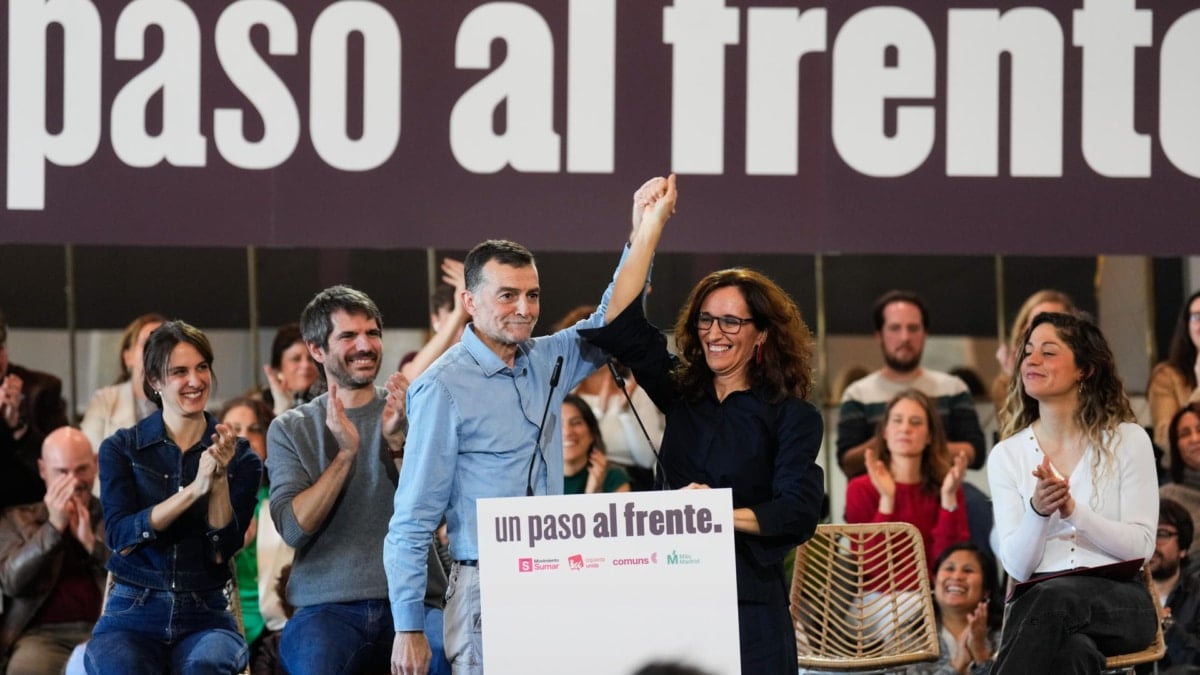
Spanish left-wing parties are exploring potential alliances ahead of upcoming elections, seeking to consolidate support and counter the rise of right-wing factions. The discussions come as various polls offer differing predictions on the impact of a unified left-wing front excluding the Socialist Workers’ Party (PSOE). The possibility of a broader coalition aims to strengthen the left’s position in both national and regional contexts.
Gabriel Rufián, a spokesperson for the Republican Left of Catalonia (ERC), initially proposed the idea of presenting the strongest possible brand, a concept that had been circulating among parties like Más Madrid and Compromís. This strategy is particularly appealing to those parties given the lack of significant competition within their respective regions.
Rufián later clarified that the goal isn’t to exclude any parties, but rather to encourage those with a realistic chance of success. He directly addressed ERC and Catalunya en Comú, after weeks of promoting a left-wing alliance extending beyond his own party. Rufián believes that three lists – including the PSOE – shouldn’t hinder the general elections.
PUBLICIDAD
On Saturday, February 21, 2026, parties within the Sumar coalition – including United Left (IU), Sumar Movement, Más Madrid, and the Commons – reaffirmed their commitment to forming a broad left-wing alliance, leaving the door open “wide open” to nationalist parties, Podemos, and any other group wishing to join the project. They criticized the idea of limiting the discussion to electoral sociology, as suggested by Rufián. Despite differing positions, there is a shared understanding within the progressive space that unity strengthens their position, even if it doesn’t always guarantee improved results.
The lack of provincial-level data complicates accurate predictions of seat allocation. However, based on recent polls, such as one conducted by Sigmados in early February, a complete left-wing bloc contesting all constituencies could secure 39 seats in Congress, down from the current 45. All parties would benefit except Sumar and Podemos, which could see their representation fall to a maximum of 19 deputies.
Polls and Potential Outcomes
Other polls, like one from 40dB, present a less favorable outlook for the left and boost the right, particularly Vox. That poll shows the People’s Party (PP) maintaining 31.2% support, Vox rising to 18%, the PSOE falling to 27.7%, and the division within Sumar resulting in 6.4% for the magentas and 3.7% for Podemos.
While specific results for nationalist parties are not detailed, the overall trend across polls remains consistent. ERC is estimated at 1.8% nationally (approximately 13% regionally), the Galician Nationalist Bloc (BNG) at 0.8% (10%), and EH Bildu at 1.2% (around 30% in their autonomous community). There is a general consensus on these figures across most polls.
An alliance of the left would only allow growth alongside the independence movements in Catalonia, the Basque Country, and Galicia. The alliance with Podemos is crucial to maintaining seats.
Based on the 40dB data, three scenarios are being considered. The first involves Sumar, Podemos, and the nationalists running separately. The second envisions a coalition between Sumar, Podemos, and their allies, such as Más Madrid and Compromís, similar to the arrangement in 2023. The third is a virtual scenario: a coalition encompassing all of the left, excluding the PSOE. The first scenario would keep the PP strong, losing only two seats, while significantly reducing the PSOE’s representation by 14 and doubling Vox’s seats to 33. Sumar would fall to 9 seats and Podemos to 4, while the nationalists would maintain or even gain one seat each.
In the second scenario, Sumar and Podemos would achieve 10.1% of the vote, a decrease of 2.23 percentage points from the last general election, allowing them to contest seats and losing only two, ending with 29. The growth of Vox as the third party comes from gains made at the expense of the PP and PSOE, particularly in provinces like Castile and León, Castile-La Mancha, and traditional strongholds.
Finally, the third scenario would allow the left to salvage its position and gain two additional seats in Congress. However, this coalition would not extend beyond Catalonia, the Basque Country, and Galicia, with a unified left-wing list adding one seat in each of those regions.
Recent Election Results Offer Clues
Several elections since 2023 provide a closer look at the current political landscape. The 2024 European elections serve as a key reference point. Extrapolating the votes from the single constituency to a national parliament yields two scenarios. In the first, with parties running separately, the major parties benefit, with the PP at 152 seats, the PSOE at 132, Vox at 22, and Sumar at 4 and Podemos at 2. ERC (8), EH Bildu (7), and BNG (2) also see gains, as does Junts with 11.
It’s important to note that European elections often see lower turnout and different voting patterns. The PP and Se Acabó la Fiesta (5) are overrepresented, as are the PSOE relative to Sumar and its partners.
Under this framework, a unified left would reverse the trend, bringing the PP down to 148, the PSOE to 124, and Vox to 21, while increasing the left’s representation to 38. Junts would remain at 11 and SALF at 4.
In addition to the European elections, Aragón can offer a perspective, being considered the “Ohio of Spain”, although political and sociological changes are blurring that comparison. Considering the results of Chunta Aragonesista and adding the percentages of Sumar and Podemos in early February, they would exceed 12.3 points in the general election. This would bring a left-wing alliance in the region to 13.6%. With Vox at 18%, the PSOE at almost 25%, and the PP above 34 points, the results would be 119 seats for the PP; 88 for the PSOE; 63 for Vox and 48 for the left-wing alliance without nationalists. In Aragón, concentrating the left-wing vote would only yield 8 seats compared to 6 for Chunta and 1 for IU-Sumar.
In this exercise of estimations, considering the same data from the general election, with Vox now 5 points higher and the left at its lowest, the change would benefit the left. Sánchez would lose three seats, falling to 118. Of the 45 total seats for the plural left, it would rise to 50. But it wouldn’t harm the national right. It would come at the expense of one PSOE seat in Barcelona, Navarra, and Pontevedra, and one from Junts in Girona and the PNV in Vizcaya. Although a majority could be achieved with the PNV, CC, and Junts, it would still be 179 deputies, the same as the investiture.
As in this scenario, the previous poll simulation demonstrates that while the right could be weakened by a left-wing front, the potential decline of the PP is offset by the rise of Vox. Rufián’s concerns about avoiding a boost for Vox don’t appear to be fully supported by the data.
PP and Vox together would exceed 188 in the worst-case scenario, even with a united left. The potential decline of the PSOE prevents them from assembling a majority. With Junts (5), PNV (5), and Coalición Canaria (1), only 161 seats would be reached, both with and without the nationalists. In a hypothetical scenario where the PSOE were to unite that space, it wouldn’t exceed 160 seats and wouldn’t have options.
A Simulation from Scratch
In a scenario starting with the 2023 results but adjusting for a 18% share for Vox – impacting both the PP and PSOE – and assuming Sumar reunites across the territory and aligns with the left-wing independence movements in Catalonia, the Basque Country, and Galicia, the alliance could secure 46 seats, one less than predicted in the first simulation. Sumar would lose a seat in Andalusia due to the increase in far-right support, and the seat in Chunta would be at risk. ERC would rise from 7 to 15, the Commons from 6 to 16, gaining two extra seats. One additional seat would be added in the Basque Country and another in Galicia, all at the expense of the PSOE, Junts, and the PNV.
In that scenario, the PP would remain at 130 seats, the PSOE would fall to 110, Vox would rise to 52, the alliance would reach 46, the PNV would have 4, Junts would have 6, and CC and UPN would have two seats. If a scenario is considered where Vox and Sumar improve equally at the expense of the PP and PSOE, with both reaching a 15% national share, more seats would be contested.
The magentas would gain two in Andalusia, another in the Balearic Islands, the Canary Islands, the Valencian Community, and Madrid. The seat in Navarra would be lost in conjunction with EH Bildu, but they would aspire to 3 extra with ERC in Catalonia, 2 with BNG in Galicia, and the same added in the Basque Country, reaching 55 representatives. Vox would improve its share of the 33 to 45, but would remain third.
Regardless of the estimation model used, the left does not achieve an absolute majority in any case. In all scenarios, PP and Vox exceed the 176-seat threshold. In the latter case, they reach exactly that number with UPN. Faced with these numbers and a sense of pessimism, the parties within the Sumar coalition convened on Saturday at the Círculo de Bellas Artes. They believe the worst course of action is to concede defeat and abandon the possibility of renewing the coalition government a year before the next elections.
They hope the project will once again inspire and mobilize voters who have stayed home in recent years. This goal is complicated by the distance from Podemos, the lack of latest leaders, and the challenge of mobilizing a pessimistic electorate from within the government itself.
Methodology. For the preparation of these simulations, the D’Hondt method was used to approximate seat distribution. The lack of province-by-province data complicates the task and reduces precision, especially considering that most of the left-wing bloc’s candidacies are not national but are presented in specific areas. The analysis is based on previous results or the same proportionality as the whole. Recent polls, especially 40dB and Sigmados, the results of the European elections and Aragón, and the 2023 general election were considered to apply that same method then and now with a similar capacity.
