
as Quebec heads into an election year,Premier François Legault has downplayed the possibility of another sovereignty referendum,despite recent polling indicating a potential resurgence in separatist sentiment. In a year-end interview, Legault expressed confidence that a majority of Quebecers do not currently support independence, even while acknowledging the Parti Québécois is gaining traction [[1]]. The premier also addressed the recent, and at times contentious, negotiations with Quebec doctors, and the legislation designed too overhaul thier compensation model.
Quebec Premier François Legault doesn’t believe his province is currently interested in another referendum on sovereignty, a key factor as he looks ahead to the 2026 general election. The statement comes as recent polling suggests a shift in public opinion and a potential resurgence of separatist sentiment.
In a year-end interview, Legault acknowledged the possibility of a renewed push for independence but expressed confidence that a majority of Quebecers would ultimately vote against it. He downplayed recent polls showing his government facing headwinds and the Parti Québécois (PQ), led by Paul St-Pierre Plamondon, gaining traction.
“Quebecers haven’t even begun to ask themselves, ‘Do I want a referendum on Quebec sovereignty?’” Legault said. “And the answer to that question, in my opinion, is clear: I am convinced that a large majority of Quebecers will not vote ‘yes’ in a referendum.”
Legault predicted that the PQ’s current momentum in the polls won’t last. “People will understand that ‘Paul St-Pierre Plamondon’ equals ‘a referendum that we don’t want,’” he stated.
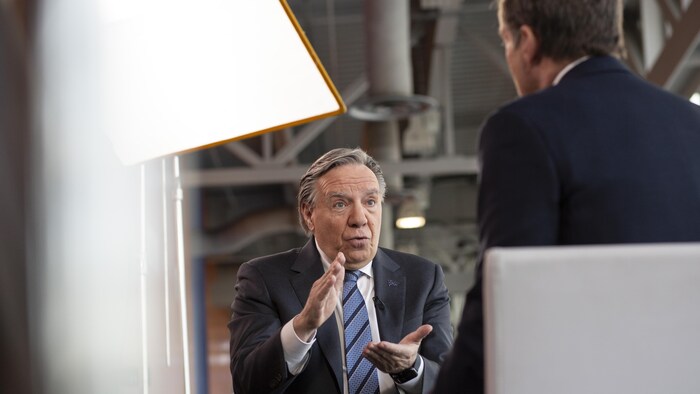
François Legault a accordé une entrevue de fin d’année au chef d’antenne Patrice Roy.
Photo : Radio-Canada / Denis Wong
Despite his skepticism about a renewed push for sovereignty, Legault conceded that a referendum campaign could have some benefits. “A referendum would be good for the French language,” he admitted. “I’ll admit that.”
However, he quickly added a cautionary note, stating, “It would be bad for the economy,” predicting “four years of uncertainty that would hurt” if the PQ were to win.
I don’t want there to be a referendum. Yes, it would be good for French. But it would be bad for the economy. And anyway, we would lose it!
Legault, a former minister in the PQ government, declined to say whether he would campaign against independence if a referendum were called. “I don’t answer hypothetical questions,” he said. “We know that the majority will vote against it.”
Legault Pleased With Progress in Doctor Negotiations
The premier has spent recent months locked in a contentious dispute with Quebec doctors, ultimately imposing legislation that sought to overhaul their compensation model. The law was passed despite significant opposition.
A tentative agreement reached last week with family physicians led to significant revisions of the controversial legislation. The outcome of the negotiations raises questions about the cost of the concessions made to end the standoff.
Legault expressed no regrets about the hardline approach, arguing it was necessary to reach a deal. “I wouldn’t say I regret it,” he said. “I would venture to say that if we hadn’t passed Bill 2, we wouldn’t have an agreement today.”
“If we hadn’t forced the issue, we would be in the same place as previous governments. We would have backed down… and we wouldn’t have changed the compensation system, as has been the case for 25 years.”
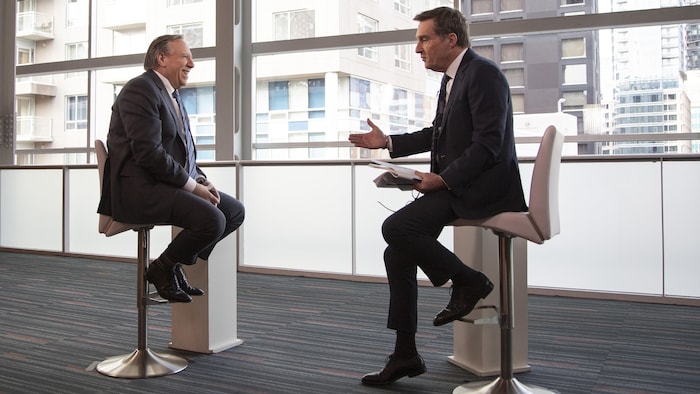
François Legault a accordé une entrevue de fin d’année au chef d’antenne Patrice Roy.
Photo : Radio-Canada / Denis Wong
“In life, when you want to negotiate, you have to ask for more to get less. That’s how it works.”
Legault believes the outcome justifies the difficult negotiations. “The results will be there. I ask Quebecers to be patient. By next summer, not in ten years, hundreds of thousands of Quebecers will have access to a family doctor.”
“Finally, we have convinced doctors to accept that 50% of their salary is for patients they take care of,” Legault said. “This is a completely new approach.”
“I am convinced, and Quebecers will judge us in the fall, that we will finally see a radical change in the way family doctors operate by summer, in the coming months,” he said.
Legault also defended his Health Minister, Christian Dubé, whose role in the negotiations came under scrutiny. He insisted Dubé is “at ease” with the agreement. Dubé’s involvement in resolving the conflict should not be seen as a rebuke, he added. “It’s normal, at the end, for the premier to make the final decision. That’s how it works in all major negotiations.”

![[[1]]]((https://images.radio-canada.ca/q_auto,w_700/v1/ici-info/16x9/francois-legault-entrevue-patrice-roy-plateau.jpg))