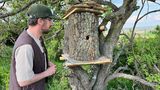
Winemakers in the South Moravian region of the Czech Republic last year raised concerns about a lack of mature trees, a situation impacting local bird populations. The decline in suitable habitats has prompted some to install artificial nesting boxes for species like the hoopoe.
“I understand the well-intentioned efforts of all landowners and nature lovers to create artificial nesting conditions, not just for hoopoes,” said Jiří Kmet, head of the Department of the Pálava Protected Landscape Area Administration. “But this method is not a panacea. We must primarily plant trees and leave the old ones in the landscape.”
Historically, a traditional forestry practice known as “pařezění” – or pollarding – helped maintain trees with cavities suitable for nesting. This involved cutting trees to encourage new growth from the stump, which would then be harvested for fuel although allowing the stump to regenerate. “If you come to such a forest after ten years, the shoots will have grown together again, and they will be used for heating, which is technologically much simpler than felling large trees, and the stump continues to regenerate in this way,” explained Pavel Dedek, an entomologist with the Pálava Protected Landscape Area. “The pruning accelerates the formation of cavities, similar to those found in weeping willows depicted in the paintings of Josef Lada.”
This practice resulted in trees with numerous cavities at ground level. However, modern forestry practices have shifted away from this approach. “Today, forests are denser, trees are straight, they do not create cavities, but they provide higher quality wood. However, they are not as suitable for biodiversity,” Dedek said. The Pálava region still retains some of these older trees. “They are long-lived organisms and still bear the traces of past management practices. That is why Pálava is an area where there is currently no shortage of nesting trees in the forests,” he added.

Photo: Pavel Dedek, CHKO Pálava
A sprouting stump in Pálava
The Pálava region is unique in that the practice of pollarding ended after World War II, later than in many other areas where it was abandoned in the mid-19th century.
Maintaining trees with cavities is a challenge for organizations, municipalities, landowners, and farmers. “It also involves road maintenance workers and those responsible for maintaining public green spaces,” Kmet said. “I understand that those responsible for the operational safety of trees in built-up areas are afraid of old trees, but it can be solved by thinning and lowering the center of gravity. And even if such a tree is not aesthetically valuable, it still plays a huge role in maintaining the species diversity of the area. It hosts not only large vertebrates and cavity nesters, such as the hoopoe, but also many species of wood-decaying insects or bats. It simply makes sense.”
Pálava is setting an example for conservation efforts. “If we glance at aerial photographs from 1938, we can see small fields and trees on their borders. There were many more trees in the landscape than there are today. That is why we are planting avenues and trying to divide large soil blocks with field paths. But the main thing is to motivate owners to start planting trees on their land. Even if it’s a long-term effort,” Kmet concluded.