
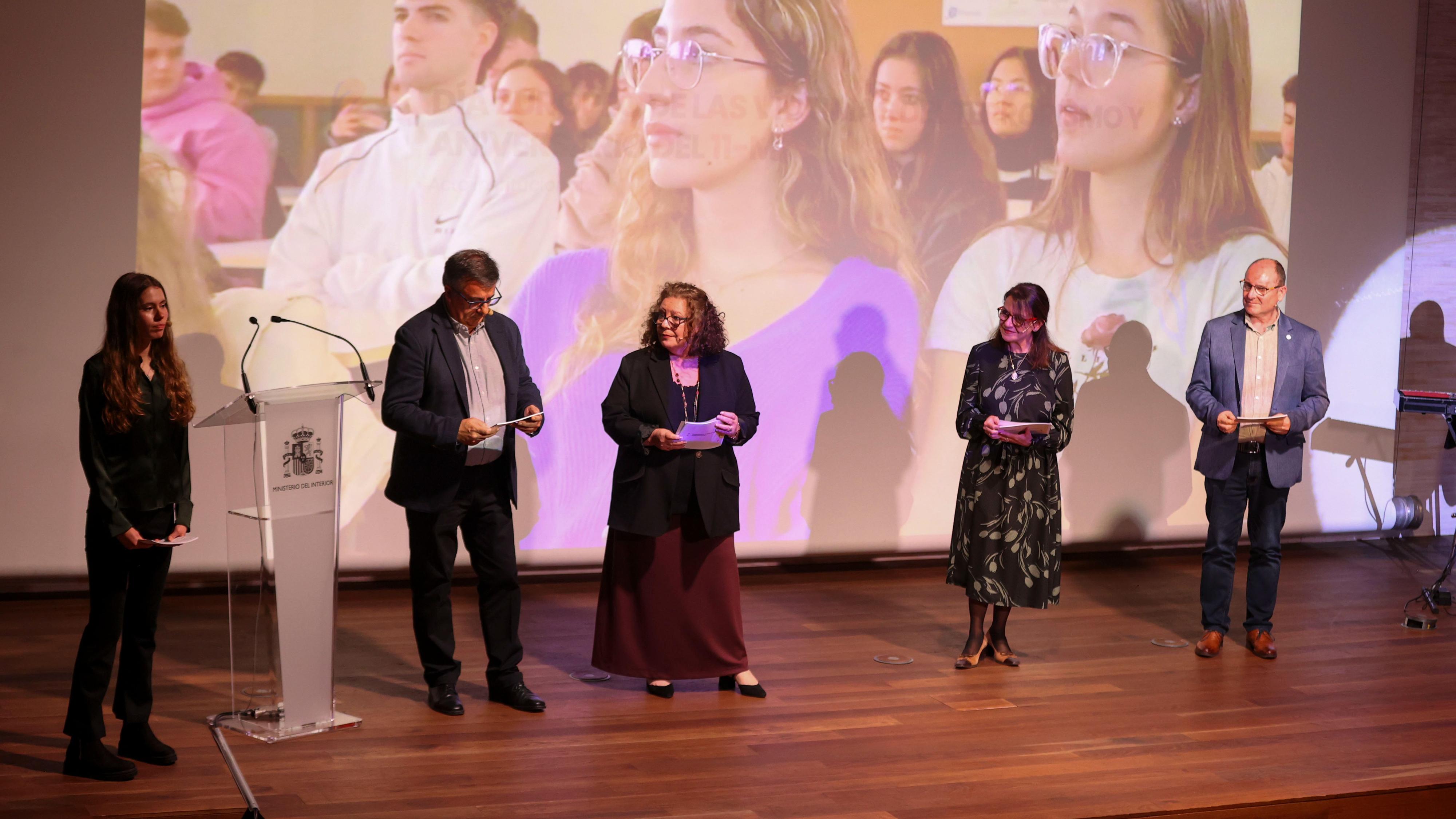
Madrid marked the European Day of Remembrance for Victims of Terrorism on Monday with a call for vigilance against the rhetoric that can lead to violence. Officials and victims’ advocates warned that radicalization often begins not with violent acts, but with the dehumanization of others through simplified, exclusionary, and justifying narratives.
“Radicalization does not begin with a violent act, it begins with the dehumanization of the other, with discourses that simplify, that point fingers, that exclude, with stories that justify violence as an ideological shortcut,” said Juan Benito Valenciano, president of the Victims of Terrorism Foundation, at a commemoration held at the Francisco Giner de los Ríos Foundation in Madrid.
The event, presided over by Interior Minister Fernando Grande-Marlaska, included a musical performance by Sofía Comas and a moment of silence to honor all victims of terrorism. The commemoration annually remembers the 2004 Madrid train bombings, the deadliest terrorist attack in European history, which claimed 192 lives.
Valenciano emphasized that “memory, justice, and education” are the key responses to terrorism, lessons learned from those who have suffered its consequences. He recalled the March 11, 2004, attacks as “a wound in the collective memory” of Spain, stating that the terror struck “trains full of everyday life—students, workers, mothers, fathers, dreams heading towards any destination.” He underscored that terrorism attacks not only infrastructure, but also coexistence, freedom, and human dignity.
Marlaska calls for “collective” defense of democracy
Minister Grande-Marlaska thanked victims of terrorism for sharing their experiences as a preventative measure against violent radicalization and to counter terrorist narratives. He highlighted the importance of the “Memory and Prevention of Terrorism” educational project, through which victims share their “painful personal experiences” with younger generations.
“You, the victims of terrorism, are the ethical reference of our democratic system and values,” Marlaska said, adding that their resilience demands a “collective fight in defense of democracy” and a commitment to peaceful coexistence.
Prior to the speeches, a video presentation showcased the “Memory and Prevention of Terrorism” educational project, promoted for nearly a decade by the Ministries of Interior and Education, and the Victims of Terrorism Foundation. The project aims to raise awareness about the consequences of terrorism and promote rejection of violence and respect for victims.
FEMP calls for a minute of silence
The Spanish Federation of Municipalities and Provinces (FEMP) has called for a minute of silence on Wednesday, March 11, at noon, in memory of the victims of the 2004 jihadist attack on the Madrid railway network.
Mayors, provincial councils, and island governments across Spain have been invited by FEMP President María José García-Pelayo to join the minute of silence on the 22nd anniversary of the “terrible attacks” that left 193 people dead and more than 2,000 injured.
García-Pelayo issued a communication to all municipalities, inviting them to hold these silent gatherings at the doors of local government buildings throughout the country.
