
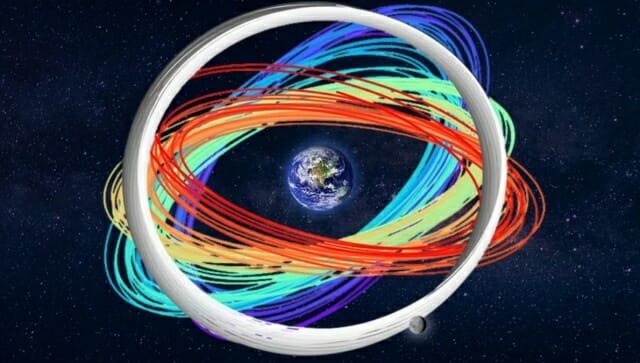
美 LLNL 연구진 연구 결과, 6년 생존 9.7%
6년간 안정적 궤도 유지한 경우 9.7%뿐
LEO보다 훨씬 큰 불확실성…지구 자전도 영향
A new study from the Lawrence Livermore National Laboratory (LLNL) suggests that fewer than 10% of a million satellites deployed in the space between Earth and the Moon would remain operational long-term. The findings highlight the challenges of expanding infrastructure beyond low Earth orbit (LEO) as companies and nations look to capitalize on cislunar space.
Researchers at LLNL used supercomputers to simulate the orbits of a massive constellation of one million satellites in the cislunar region. The simulation, which required approximately 1.6 million CPU hours – a task estimated to take 182 years on a standard computer – was completed in just three days.
The increasing number of satellites orbiting Earth, exemplified by projects like SpaceX’s Starlink and China’s reportedly thousand-satellite network, has prompted concerns about orbital congestion and the potential for cascading collisions known as the Kessler syndrome. As LEO becomes increasingly crowded, attention is turning to cislunar space as a potential alternative.
Cislunar space, the region between Earth and the Moon, could supplement Earth-based communication infrastructure and provide services like internet access to future lunar bases or settlements. However, predicting satellite orbits in this region is significantly more complex than in LEO.
The LLNL study found that approximately 54% of the simulated orbits remained stable for at least one year, but only 9.7% remained stable for six years. The results, published on the pre-print server arXiv, demonstrate the substantial uncertainties inherent in cislunar orbit prediction.
Unlike LEO simulations, which exhibit relatively stable and repetitive patterns, the Earth-Moon system presents a far more unpredictable environment. This is due to the complex gravitational interactions between Earth, the Moon, and the Sun, as well as the lack of protection from Earth’s magnetic field, exposing satellites to increased radiation.
Researchers identified Earth’s rotation as a key factor influencing orbital stability. Subtle variations in gravity caused by Earth’s spin can have a cumulative effect on satellite trajectories over extended periods.
Despite the low long-term survival rate, the simulation identified approximately 97,000 potentially stable orbits within the cislunar region, offering possibilities for future exploration and infrastructure development. The findings suggest that careful orbit selection and ongoing monitoring will be crucial for successful long-duration missions.
“Knowing which orbits succeed and which fail is important,” researchers stated. “From a data science perspective, it’s a very interesting data set, and if you have a million orbits worth of data, there’s a lot of analysis you can do.”
The research underscores the complex challenges of managing orbital stability and collision risks as humanity expands its activities beyond low Earth orbit, and into the Earth-Moon domain. This study provides valuable data for future mission planning and the development of robust orbital management strategies.
박준우 기자
