

While many people dismiss little spots or lines on their fingernails as harmless blemishes, they can sometimes serve as critical warning signs for serious internal health issues. In a recent medical case report, physicians highlighted how subtle nail changes can actually signal a life-threatening heart infection.
The Link Between Nail Spots and Heart Infection
Medical professionals from the internal medicine department at Wellsfan York Hospital recently shared a case in the journal Cureus involving a patient with infective endocarditis—a serious infection of the heart’s inner lining or valves. The patient presented with faint spots on their fingernails, which were identified as micro-hemorrhages.
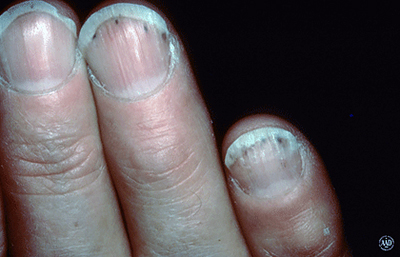
According to the report, these spots occur when microscopic blood clots (thrombi) break away from an infected heart valve. These clots travel through the bloodstream and eventually damage the small capillaries at the fingertips, leading to visible bleeding under the nail. This phenomenon underscores how the body can manifest systemic infections through external, seemingly minor physical symptoms.
Understanding ‘Splinter Hemorrhages’
In medical terms, these thin, dark vertical lines are known as splinter hemorrhages. They typically appear as reddish-brown or black lines, measuring about 1 to 3 mm in length and run parallel to the direction of nail growth. As the nail grows, these lines typically move toward the tip of the finger.
While these marks can be a red flag for cardiovascular issues—including infective endocarditis, vascular diseases, or aortic thrombi—they are not always indicative of a disease. Many splinter hemorrhages are caused by simple trauma, such as:
- Accidental impact or bruising of the nail
- Pressure during athletic activities
- Habits like nail-biting
- Micro-bleeding during acrylic nail procedures
In most cases of trauma, only one or two lines appear, and they disappear naturally as the nail grows out. However, when associated with heart valve infections, particularly those caused by Staphylococcus, they can be a vital diagnostic clue.
Recognizing these signs early is essential for public health, as conditions like endocarditis can lead to severe complications, including heart failure and organ damage, if left untreated. If unusual nail discoloration appears alongside systemic symptoms, seeking immediate medical evaluation is critical.
