
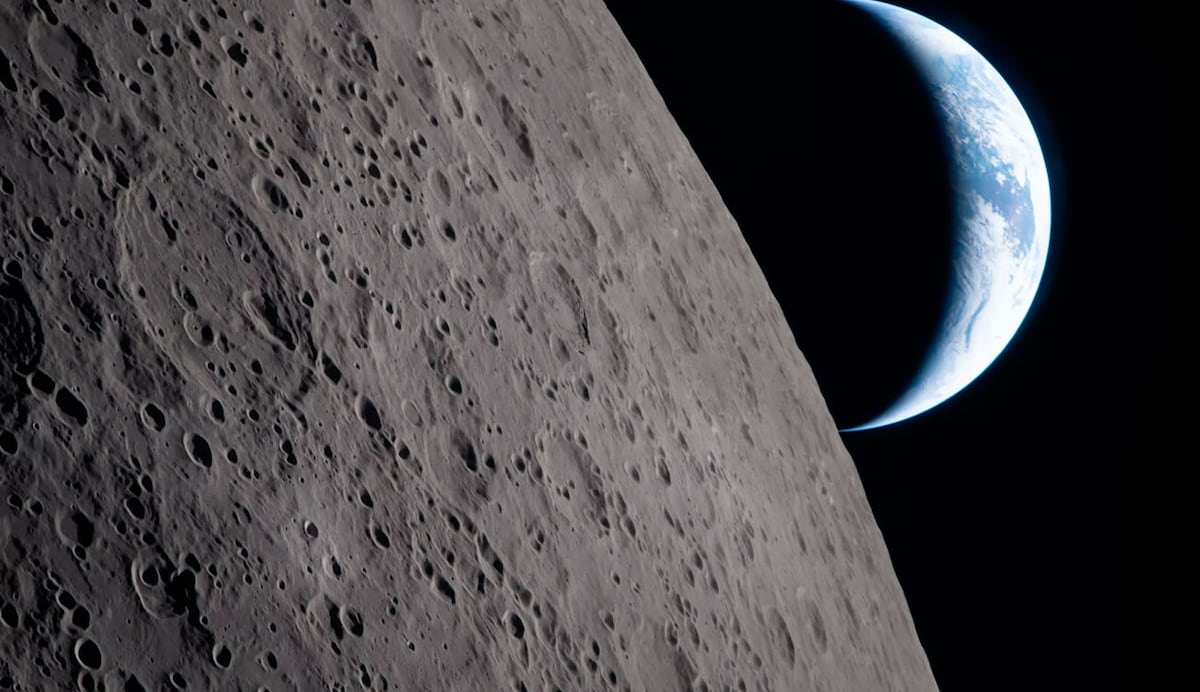
NASA Unveils Stunning Far-Side Moon Imagery as Artemis II Returns to Earth
NASA has released a series of breathtaking images captured by the crew of the Artemis II mission, including the first-ever photographs taken from the far side of the moon. These visuals, which provide an unprecedented look at the lunar surface, were shared as the Orion spacecraft began its journey back to Earth after successfully circling the moon on a record-breaking mission.
The mission’s success is a testament to international cooperation in deep-space exploration. Among the key personnel supporting the voyage is a Spanish engineer based in Houston, who is tasked with monitoring the “heart” of the Orion spacecraft. Reflecting on the magnitude of the achievement, the engineer noted that the fact that humans have visited a world different from our own is an event that impacts everyone.
While the mission achieved significant milestones, it also highlighted the grueling realities of life-support engineering in space. Reports indicate that the Artemis II onboard toilet experienced several technical failures, including three distinct malfunctions, instances of frozen urine, and an unidentified “mysterious smell.” These glitches underscore the immense difficulty of maintaining basic sanitation and hygiene systems during long-duration lunar flybys.
The release of these high-resolution lunar photos and the data gathered from the Orion windows provide critical insights for NASA. By analyzing both the breathtaking visual successes and the mechanical failures of the mission, engineers can better refine the technology needed for future permanent lunar settlements.
As the crew continues their return trip, the mission serves as a bridge between early lunar exploration and the next era of human presence in deep space, proving that while the vistas are inspiring, the technical challenges of surviving the void remain a primary focus for innovation. The mission’s trajectory, which some have described as “fooling around” with the moon, is actually a calculated step toward establishing a sustainable human presence beyond Earth’s orbit.
