
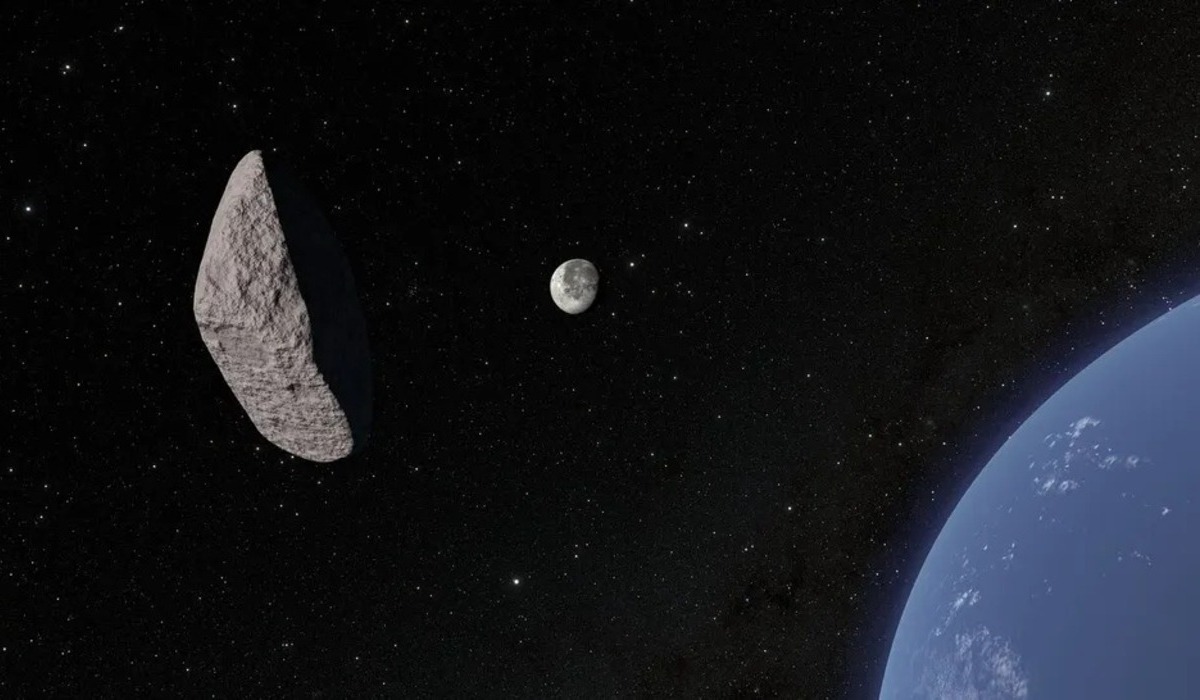
NASA has officially confirmed that asteroid 2024 YR4 poses no threat to either the Moon or Earth. Initial observations last year suggested a small possibility of a lunar impact, but recent data from the James Webb Space Telescope (JWST) definitively shows the asteroid will pass safely by. This type of ongoing monitoring is crucial for understanding and mitigating potential risks from near-Earth objects.
According to data collected on February 18 and 26, experts at NASA’s Center for Near-Earth Object Studies at the Jet Propulsion Laboratory now predict that asteroid 2024 YR4 will fly past the Moon at a distance of 13,200 miles on December 22, 2032. The revised prediction comes after earlier analyses indicated a 4.3% chance of a collision with the Moon.
The asteroid was first discovered in late 2024 by the ATLAS system in Chile. Early in 2025, observations of the object were uncertain enough that astronomers briefly considered the possibility of an Earth impact. However, that scenario was quickly ruled out.
Read also : Nuclear Weapon with 100 Kiloton Potential Could Destroy Asteroid 2024 YR4
While the possibility of an impact with Earth was quickly dismissed, the potential for a lunar collision remained uncertain for a longer period. The asteroid became too faint to observe from spring 2025 until it was recently recaptured by the JWST’s near-infrared camera last month.
Initial projections suggesting a potential cosmic collision are not uncommon when observing near-Earth asteroids. A similar situation occurred with asteroid Apophis, which caused concern after its discovery in 2004. Initial calculations suggested a small chance of impact with Earth in 2029 or 2036, but further observations in 2013 eliminated that possibility. The case of asteroid 2024 YR4 has now reached a similar reassuring conclusion.
Read also : Asteroid 2024 YR4 Once Threatened Earth, Now a NASA Research Object
Had asteroid 2024 YR4 impacted the Moon, the consequences would have been significant. With a diameter of approximately 200 feet – roughly the height of a 15-story building – former astronaut Ed Lu, who leads the Asteroid Institute at the B612 Foundation, stated that an object of that size could create a crater 1.2 miles wide on the lunar surface.
“That’s a large amount of material thrown up that would basically end up in orbit around the Moon, or around the Earth. If it hit, you would be able to see it from Earth with the naked eye. A pretty substantial explosion would throw a lot of material up. In fact, I would bet there would be a meteor shower on Earth.”
(ScienceAlert/H-3)
