
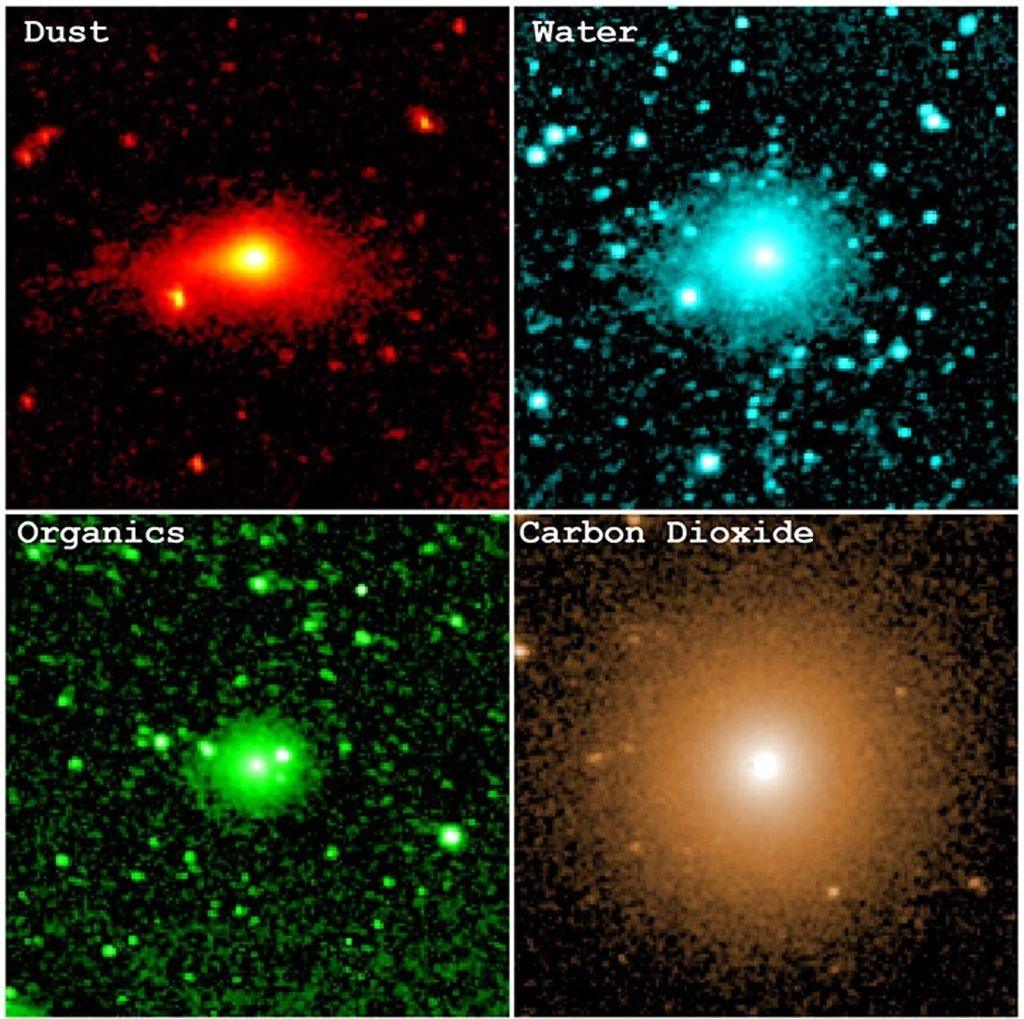
NASA’s SPHEREx mission has detected organic molecules – including methanol, cyanide, and methane – emanating from interstellar comet 3I/ATLAS, marking only the third time such an object has been observed passing through our solar system. The findings, captured in December 2025, offer a rare glimpse into the chemical composition of materials originating from beyond our sun.
The SPHEREx observations revealed a dramatic increase in the comet’s brightness two months after its closest approach to the Sun, a phenomenon linked to the sublimation of water, carbon dioxide, and carbon monoxide from its icy surface. “Comet 3I/ATLAS was full-on erupting into space in December 2025, after its close flyby of the Sun, causing it to significantly brighten,” said Carey Lisse of Johns Hopkins Applied Physics Laboratory in Laurel, Maryland. “Even water ice was quickly sublimating into gas in interplanetary space.”
Researchers also noted that the comet is releasing carbon-rich material that had been locked in ice deep below its surface. This discovery is significant because organic molecules are the building blocks for life as we recognize it, though they can also be created through non-biological processes. The data suggests that the comet’s subsurface ice layers were gradual to evaporate, as solar heat needed time to penetrate the outer layers.
According to Phil Korngut, an instrument scientist at Caltech, the comet likely spent billions of years traveling through interstellar space, where its surface may have been altered by cosmic rays. However, the deeper ice remained largely untouched, offering a snapshot of primordial chemical compounds. The released material consists of relatively large dust particles, forming a small, pear-shaped dust tail, indicating the mass of the ejected material is substantial enough to resist solar radiation.
SPHEREx’s unique near-polar orbit and ability to scan the entire sky allowed it to capture this data as the comet passed through our solar system. This unexpected finding demonstrates the telescope’s capabilities beyond its primary mission of mapping the galaxy and understanding its origins. Comet 3I/ATLAS was initially discovered on July 1, 2025, by the NASA-funded ATLAS telescope in Chile, and subsequent trajectory analysis confirmed its interstellar origin.
延伸閱讀:近9千顆衛星都沒撞到外星飛船?馬斯克:人類必須上太空才能存活
The detection of these organic molecules provides valuable clues about the chemical environment of the early solar system and could facilitate scientists understand how life might originate and distribute throughout the universe. The findings underscore the importance of studying interstellar objects to learn more about the building blocks of planetary systems.
Launched in March 2025, SPHEREx is designed to complete four full-sky infrared maps. The data collected from 3I/ATLAS is an unexpected bonus, showcasing the mission’s versatility. Data from the SPHEREx mission is freely available to scientists and the public. The research team emphasized that these observations will not only help us understand cometary materials but may also reveal clues about the origins of life.
資料來源:SPHEREx、Space.com、NASA Space News


