
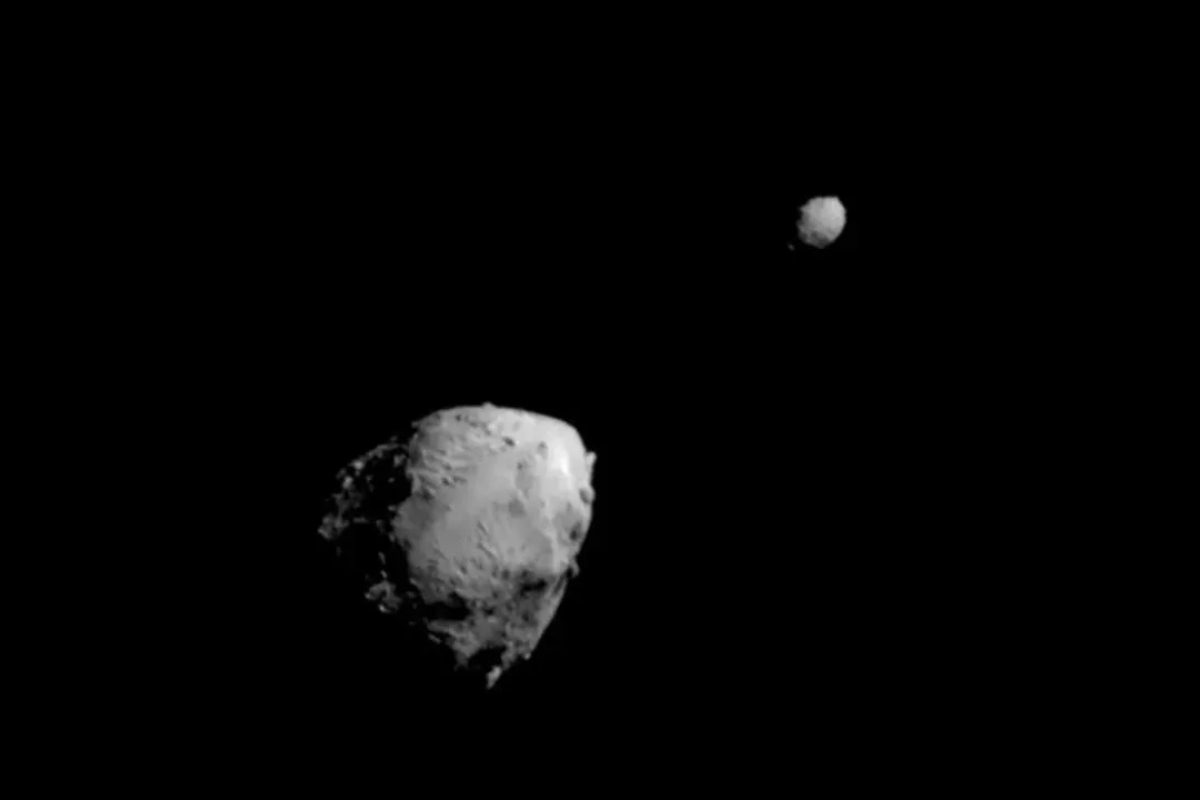
Four years ago, NASA intentionally crashed a spacecraft into a small asteroid to determine if its trajectory could be altered, a test to demonstrate humanity’s ability to protect Earth from threatening space rocks.
The experiment shifted the asteroid Dimorphos, a small moon, into a shorter and faster path around its companion, Didymos. Modern research released on Friday, March 8, 2026, indicates the experiment also nudged both asteroids into a slightly different orbit around the Sun. This finding is significant as it demonstrates the potential for altering an asteroid’s path, a crucial step in planetary defense.
The test on Dimorphos was not based on any actual threat to our planet. However, the successful experiment and further analysis provide solid data for building defenses should such a threat be detected, researchers say.
“This study marks a significant step forward in our ability to prevent asteroid impacts on Earth in the future,” the international research team wrote in their new paper published in the journal Science Advances.
Their detailed observations, outlined in the paper, show that the 2022 Double Asteroid Redirection Test (DART) marked “the first time a human-made object has measurably altered the path of a celestial body around the Sun,” NASA stated.
Rahil Makadia, the study’s lead author, explained that his team tracked stellar occultations – moments when an asteroid passes in front of a star, causing a brief dimming of less than a second – to obtain highly precise measurements of the asteroids’ position, speed, and shape.
Small Change, Significant Deviation
Gathering this data was no easy feat. The team relied on volunteer astronomers from around the world, who recorded 22 of these stellar occultation events.
Using this data, along with additional observations over years, Makadia said the team was able to precisely measure Didymos’ orbit around the sun.
“We were able to measure this change accurately,” he said, and perform calculations that can aid future “planetary defense” efforts.
The orbital change was minute – just 0.15 seconds. However, scientists say that is enough to make a difference.
“Here’s a small change in orbit, but over time, even small changes can add up to significant deviations,” said Thomas Statler, program scientist for small bodies at NASA Headquarters in Washington, in a statement. “The team’s very precise measurements once again validate kinetic impact as a technique for protecting Earth from asteroid hazards and demonstrate how binary asteroids can be deflected by impacting only one member of the pair.”
Source: France24
