
NASA’s Artemis II Crew Returns to Earth Following Historic Lunar Flyby
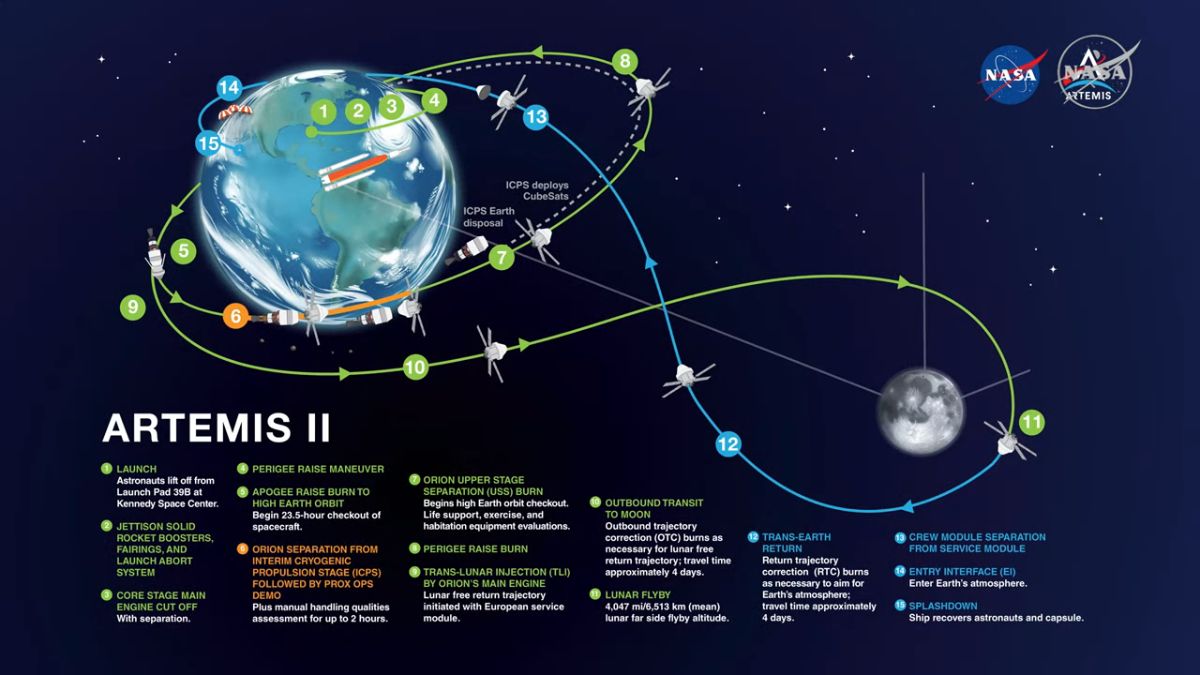
NASA has officially concluded the Artemis II mission, marking the first time in 50 years that humans have ventured back to the vicinity of the Moon. The crew successfully returned to Earth on April 10, 2026, according to reports on their safe arrival, completing a journey that spanned 9 days, 1 hour, and 32 minutes.

The mission launched on April 1, 2026, utilizing the Space Launch System (SLS)—NASA’s most powerful heavy-lift rocket—to propel the Orion spacecraft. This flight was designed as a critical test of deep space systems, serving as a foundational step for long-term lunar habitation and the eventual goal of crewed missions to Mars. The success of this flight provides key conclusions from one of the agency’s most significant tests in decades.
A primary objective of the mission was the exploration of the lunar far side. On April 6, 2026, the crew conducted a seven-hour pass over the Moon’s hidden side, capturing unprecedented images of the lunar surface. These photographs, released on April 7, 2026, reveal regions never before seen by human eyes, including the heavily cratered terrain of the eastern edge and the “terminator”—the dividing line between the lunar day and night.
The crew also documented a rare in-space solar eclipse and a striking “Earthset,” where the planet was seen passing behind the Moon. A collection of visuals from the splashdown and return highlights the technical precision required for such a high-stakes reentry.
The historic flight was manned by a diverse crew, including Pilot Victor Glover, Mission Specialists Christina Koch and Jeremy Hansen of the Canadian Space Agency (CSA), and Dan Florez. This mission serves as a critical bridge in NASA’s broader strategy to return humans to the lunar surface and eventually push further into the solar system.
For a detailed look at the mission’s progression, you can review the comprehensive coverage of the Artemis II return.
