
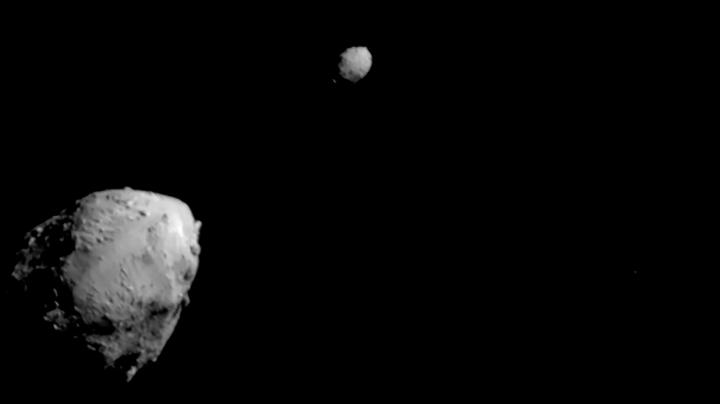
NASA’s intentional collision of a spacecraft with an asteroid in September 2022, as part of the DART (Double Asteroid Redirection Test) mission, has had a broader impact than initially understood. Recent observations reveal the event altered the orbits of both the asteroid Dimorphos and its companion, Didymos, as they travel around the sun.
Didymos and Dimorphos are bound together by gravity, forming a binary asteroid system with a shared center of mass. The NASA DART mission demonstrated that altering the trajectory of one asteroid within such a system inevitably influences the other. This finding has implications for planetary defense strategies, as it shows how even a small change can have cascading effects.
A study published in the journal Science Advances on March 6, 2026, detailed that the asteroid pair’s 770-day orbital period around the sun has decreased by 0.15 seconds. Previous research had already shown that the 12-hour orbital period of Dimorphos around the larger 805-meter diameter asteroid Didymos was shortened by 33 minutes.
This latest research marks the first time a human-made object has measurably impacted the orbit of a celestial body around the sun. “This may be a highly small change in orbit, but over time, even a small change can grow into a significant deflection,” said Thomas Statler, NASA’s lead researcher for small bodies in the solar system, in a NASA press release.
The precision of these measurements further validates kinetic impact as a viable technique for defending Earth against potential asteroid threats, and highlights how a binary asteroid system can be redirected by influencing just one of the pair.
What the DART Mission Accomplished
When DART intentionally collided with Dimorphos, the impact created a large cloud of rock fragments and altered the shape of the 170-meter diameter asteroid. The ejected material carried momentum away from the asteroid, providing an additional push to Dimorphos.
The study revealed that the DART mission’s impact ejected a substantial amount of material from the binary system, causing the system’s orbital period around the sun to decrease by approximately 0.15 seconds. More specifically, the orbital speed of the binary system changed by about 11.7 micrometers per second, or 1.7 inches per hour.
“Over time, small changes in the movement of an asteroid can develop the difference between an object hitting Earth or not,” explained Rahil Makadia, the lead author of the study from the University of Illinois Urbana-Champaign.
Whereas Didymos was not on a collision course with Earth, and the DART mission did not alter that, the change in orbital speed underscores the potential role spacecraft can play in protecting our planet in the future. Early detection of near-Earth objects is key to deploying such “kinetic impactors.”
To that end, NASA is constructing the Near-Earth Object (NEO) Surveyor mission. Managed by NASA’s Jet Propulsion Laboratory in Southern California, this next-generation space-based telescope is the first specifically designed for planetary defense. The mission will seek out some of the most challenging near-Earth objects to detect, such as dark asteroids and comets that do not reflect much light.
