
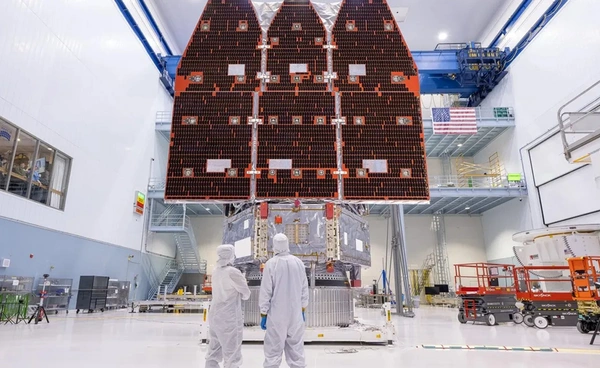
NASA has completed construction of the Nancy Grace Roman Space Telescope, a powerful observatory set to dramatically expand our understanding of the universe. Named for the agency’s first chief astronomer, the Roman Space Telescope builds upon the successes of the Hubble and James Webb Space Telescopes, promising wider and deeper views of the cosmos. With a planned launch in May 2027, the telescope is currently undergoing final testing at NASA’s Goddard Space Flight Centre in Greenbelt, Maryland, and is expected to deliver invaluable data to the scientific community for decades.
NASA Completes Roman Space Telescope, Anticipates Earlier-Than-Expected Launch
NASA has announced the completion of the Nancy Grace Roman Space Telescope, a next-generation observatory poised to revolutionize our understanding of the universe. The telescope is now undergoing final testing and integration, with a launch currently slated for May 2027 – potentially ahead of previous schedules.
The Roman Space Telescope, named after the “Mother of Hubble,” Dr. Nancy Grace Roman, is designed to survey large areas of the sky with unprecedented speed and clarity. It will investigate dark energy, dark matter, and exoplanets, building on the discoveries of the Hubble and James Webb Space Telescopes. This new observatory represents a significant leap forward in astronomical capabilities.
According to NASA officials, the telescope’s wide-field instrument will enable it to capture panoramic images of the cosmos, allowing astronomers to study billions of galaxies. The mission will also utilize gravitational lensing to reveal hidden structures and map the distribution of dark matter.
“The completion of the Roman Space Telescope is a major milestone for NASA and the scientific community,” a NASA spokesperson stated. “This observatory will open up new frontiers in astronomy and help us answer some of the most fundamental questions about the universe.”
The telescope’s development involved contributions from numerous institutions and international partners. Engineers have focused on ensuring the telescope’s sensitive instruments are protected from stray light and extreme temperatures. The early completion suggests efficient project management and technological advancements in space-based observatory construction.
NASA expects the Roman Space Telescope to provide a wealth of data for astronomers for decades to come, furthering our knowledge of the cosmos and potentially leading to groundbreaking discoveries. The mission underscores NASA’s commitment to pushing the boundaries of space exploration and scientific understanding.
