

A modern method for identifying runaway stars – those violently ejected from star clusters – has been developed by Alonso Herrera Urquieta, a doctoral student in the Department of Astronomy at the Universidad de Concepción and a collaborator at the Centro de Astrofísica y Tecnologías Afines – CATA (Centro Basal de ANID). The research, published in May 2025 in Astronomy & Astrophysics (A&A), offers a novel approach to understanding the internal dynamics of star clusters and the evolution of stars within our galaxy. This breakthrough has implications for our understanding of stellar formation and galactic evolution.
Cosmic Chaos: When Three Stars Collide
Star clusters, groupings of hundreds or even thousands of stars born together, are environments where gravitational interactions are frequent and often intense. A common scenario involves the interplay of three stars: a binary system and a single star. These encounters can destabilize the system, resulting in one star being expelled at high speed while the other two remain bound as a binary system – which itself can too be ejected from the cluster.
These ejected stars are known as runaway stars, or “fast escapers.” Unlike stars that slowly drift away from a cluster through natural evolutionary processes, runaway stars are propelled outwards at unusually high velocities due to these dynamic three-body interactions, making them stand out in observational data.
While this phenomenon has been studied theoretically for decades, identifying both stars ejected from the same event observationally has proven challenging – until now.
A Systematic Method for Tracking Ejected Stars
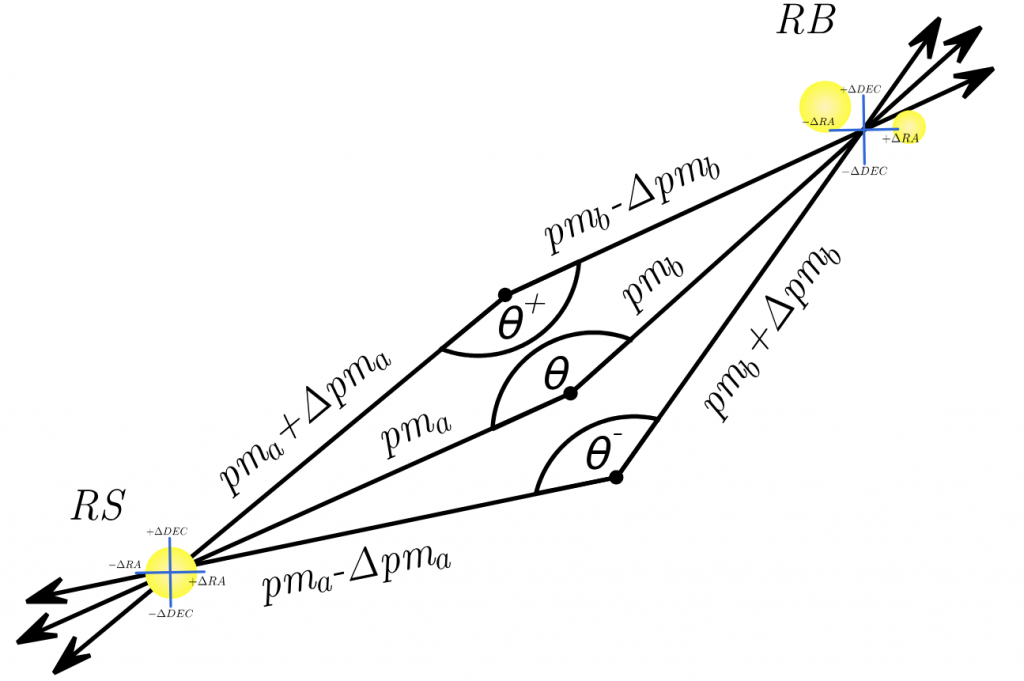
Herrera’s research proposes a new observational method to simultaneously search for the solitary star and the binary system ejected together from a star cluster. The team utilized high-precision data from the European Space Agency’s Gaia satellite (Data Release 3), which measures stellar positions and velocities with unprecedented detail.
As a test of the method, the team analyzed the open cluster M67, one of the most studied in the Milky Way. Evaluating nearly 120 million possible combinations from over 15,000 stars in the cluster’s vicinity, they applied strict physical criteria based on momentum conservation, direction of motion, and ejection time.
The result was the identification of a candidate pair – a fast star and a slower binary system – whose physical and dynamic properties suggest they were jointly ejected from the cluster. While seemingly a small number, the finding aligns with theoretical predictions for the studied field of view.
A Key Contribution to Stellar Astronomy
“The main contribution of this work is that, for the first time, a systematic way to search for both products of a three-body interaction outside the cluster is proposed,” Herrera explained. Previous studies have largely focused on simulations or detecting fast stars individually, without identifying the complete pair.
This advancement not only allows for a better understanding of the internal dynamics of star clusters but could also assist to comprehend the formation of compact binary systems and even detect more extreme objects, such as black holes, capable of ejecting stars at even higher speeds.
The study involved researchers from various national and international institutions, including the Universidad de Concepción, the American Museum of Natural History (USA), the University of Toronto (Canada), the Max Planck Institute for Astrophysics (Germany), the University of Amsterdam (Netherlands), and the University of Wisconsin–Madison (USA), among others.
Next Steps: More Clusters and Open Science
During his first year of doctoral studies, Herrera is expanding the analysis to a much larger number of open clusters, aiming to conduct population studies and compare how variables such as mass, age, or cluster size influence the production of runaway stars.
the code is being optimized to run on mid-range computers, facilitating its apply by other researchers, students, and data analysis enthusiasts.
In parallel, the team is developing an interactive web platform, in collaboration with programmer Gonzalo Díaz, that will serve as a repository of data for more than 2,000 star clusters. This tool seeks to bring astronomy closer to students of astronomy and data science, as well as the general public, promoting scientific outreach and, in the future, citizen science.
