
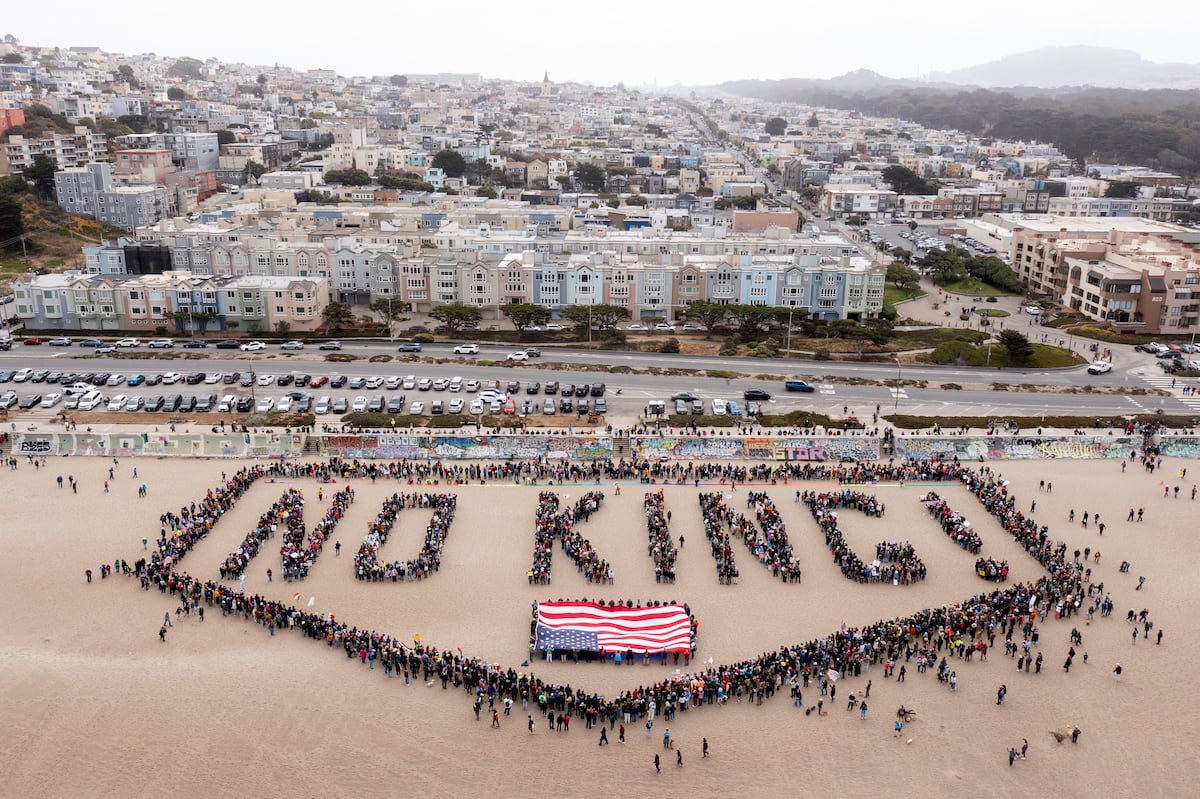
A nationwide protest movement, dubbed “No Kings,” is preparing for a major day of action on March 28, with over 3,000 events planned across the United States. Organizers anticipate millions of participants in what could become one of the largest single-day political mobilizations in U.S. History. The protests reflect growing opposition to the administration of President Donald Trump and address a range of concerns from economic issues to international conflicts.
What is the ‘No Kings’ Movement?
The “No Kings” movement originated as a response to what organizers describe as authoritarian trends within the U.S. Government. At its core, the movement asserts that the United States is not a nation ruled by individuals with unchecked power. “United States does not belong to strongmen, to greedy billionaires, or to those who govern through fear. It belongs to us, the people,” according to organizers.
The movement is backed by groups including Indivisible, progressive organizations, labor unions, and civil rights collectives, which have coordinated national protests since 2025.
When and Where Will the March 28 Protests Take Place?
Events are scheduled in all 50 states, ranging from large cities to rural and suburban areas. Organizers have announced “more than 3,000 local events” are planned for Saturday.
A major event is planned in St. Paul, Minnesota, a state that has become a focal point for the movement following the deaths of two U.S. Citizens during immigration enforcement operations earlier this year. These incidents sparked protests, tensions with local authorities, and widespread public reaction.
In Washington, D.C., the march will begin at 10:00 a.m. Local time, proceeding past landmarks such as the Lincoln Memorial and the Washington Monument, and culminating in a rally scheduled between 1:30 p.m. And 4:00 p.m.
The official No Kings website features a map where individuals can locate the nearest event.
What are the Protesters’ Concerns?
The protests are fueled by economic anxieties and international issues, including the recent offensive launched by the Trump administration against Iran. Organizers are also directly critical of the government’s immigration policies, stating that “their Administration is sending masked agents to our streets, terrorizing our communities,” and that “they are pursuing immigrant families, engaging in discriminatory profiling, arresting and detaining people without warrants.”
How Many People are Expected to Participate?
The movement has drawn increasing numbers of participants with each demonstration. Over 5 million people participated in June 2025, and 7 million in October of the same year, according to organizers. Some estimates suggest that March 28 could notice the largest number of participants in a single day of national political demonstrations in U.S. History, as reported by Time magazine. The anticipated turnout underscores the growing intensity of opposition to the current administration.
What Rights Do Protesters Have?
Organizations like the ACLU remind citizens that protesters have rights protected by the Constitution, though these rights are subject to certain limitations. These include the right to “express themselves in ‘traditional public forums’ such as streets, sidewalks, parks, and plazas, as long as they do not block passage.”
Demonstrating on private property is also permitted with the owner’s authorization, and police cannot restrict the content of a message based on their viewpoint. Participants are also allowed to photograph “anything in plain view, including federal buildings and police, as long as the person is legally in a public space.”
The ACLU provides resources outlining protesters’ rights.
In the event of confrontations or tensions, law enforcement may intervene to maintain order. According to the ACLU, “police can separate protesters and counterprotesters, but ‘should allow them to see and hear each other,’” balancing safety with the right to free expression. These rules apply to both protesters and counterprotesters and form the legal framework governing public demonstrations in the United States.
