
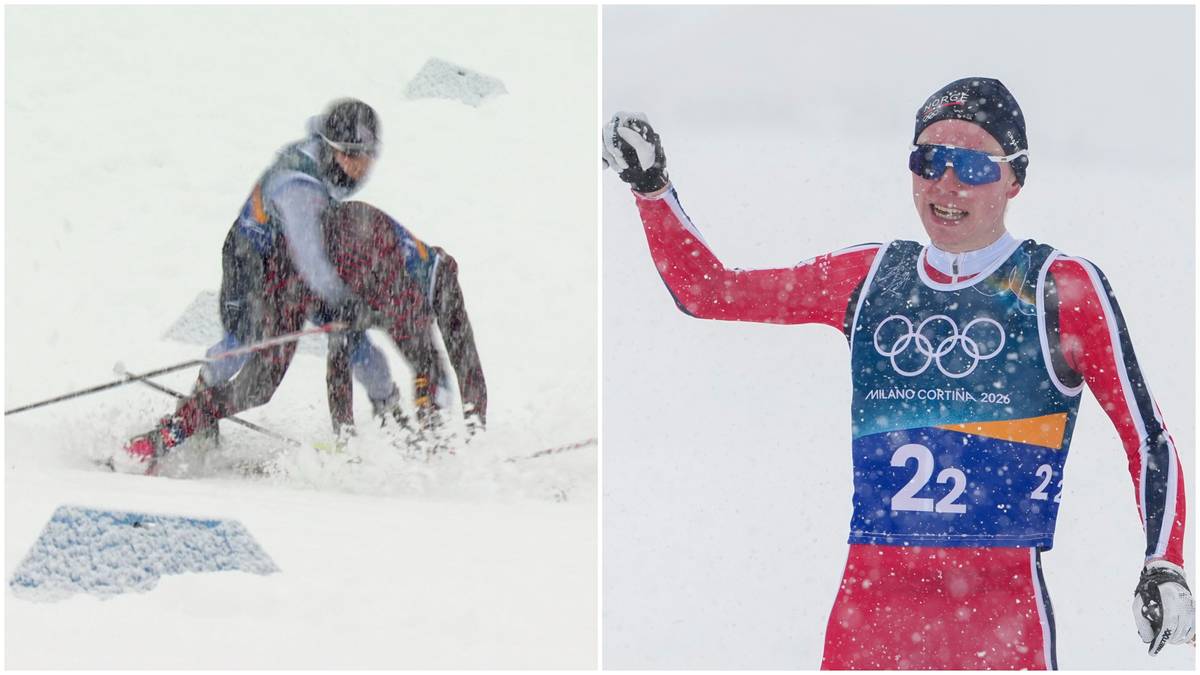
Chaos and crashes marked the combined team sprint. Both Austria and Germany hit the snow in the deep powder. The result left Norway and Finland battling for gold, with Norway ultimately taking the victory.
“He’s going to be a triple winner – what a combined athlete! Now he’s perfect here, Jens Lurås Oftebro!” exclaimed Jann Post as Oftebro secured gold on the final stretch.
With the win, Oftebro claimed his third gold medal of the Games, adding to a stellar performance at the 2022 Olympics where he also contributed to a team gold. These three golds bring his career Olympic medal count to four, tying him with Jørgen Graabak as the most decorated Nordic combined athlete in Olympic history.
“I don’t feel like a king, but it’s cool that others witness me that way. It was also incredible function by the wax team and the support staff,” said Lurås Oftebro.
See the sprint finish here:
Tumbles in the Powder
Several athletes struggled with the deep, soft snow throughout the race. Andreas Skoglund was among those who lost his balance, but managed to stay upright.
“There was so much water and snow on my goggles that I only had about 40 percent visibility out there. It was tough to see where the powder was and where it wasn’t,” Skoglund told NRK.
Germany’s Vinzenz Geiger wasn’t so lucky. He fell twice in quick succession.
FALL: Vinzenz Geiger fell twice in quick succession in the powder.
“Oh! Here’s a fall! What on earth is happening with Vinzenz Geiger? That could be disastrous,” said Post as Geiger suddenly found himself face-down in the snow.
Geiger’s race ended abruptly with the falls. “I was a little unlucky. My left ski got stuck in the deep snow. So I fell, got up again, and fell again. Then the race was over. I’m very disappointed,” said Geiger.
Moments later, Austria’s Stefan Rettenegger experienced a similar fate.
FALL: Stefan Rettenegger also took a tumble in the snow.
That left only Norway and Finland to contend for the lead. Jens Lurås Oftebro proved strongest in the sprint, securing his third gold medal.
“I’m completely moved standing here. It’s incredible. And now he has three out of three possible – if there had been six, he probably would have taken six golds too, it’s just wild what he’s doing,” said his brother, Einar, to NRK after the race.
In the finish area, coach Truls Johansen was overcome with nerves. “I had to turn away the last 100 meters. I didn’t see the sprint, but I heard it from those watching that he was in front the whole way. So it went well,” he said.
“Because it was a wild ski race?”
“Yes, absolutely wild. There were a lot of things happening that we didn’t anticipate. Perhaps the biggest challengers, Germany, with those falls… It was an incredible roller coaster, and then it’s exciting with close duels. Especially when you finish first,” said Johansen.
Wax Adjustments Made
The jury made a change before the competition. Normally, adjustments to skis are not allowed during a race, but today they permitted the application of grip wax between legs.
“That was decided at the team leaders’ meeting. It’s very surprising for us and everyone else. It could be decisive, that those who are best at applying grip wax can secure the Olympic gold,” said sports director Ivar Stuan to NRK.
And the adjustments seemed to make a difference. On the second leg, it was clear that Norway at least didn’t have the worst skis.
“I suppose they’ve hit it well with what they’ve set under the skis,” said NRK’s expert, Fredrik Aukland.
SKITEST: Einar Lurås Oftebro and Jarl Magnus Riiber did what they could to test skis before the team sprint.
Foto: Anders Skjerdingstad / NRK
Before the race, Einar Lurås Oftebro and Jarl Magnus Riiber had been out on the course testing skis.
“We’re trying to find the best skis, so the guys have the best possible conditions to ski fast. But it’s challenging in the course and in the wax room, but we’ll do everything we can to make sure the guys start as well as possible,” said older brother Lurås Oftebro before the start.
At one point during the race, TV cameras caught the Norwegian wax team waving their skis after applying a new layer of grip wax.
“This is about cooling down the skis, it gets very hot when they apply these grip wax products,” explained Aukland.
Between each leg, extra wax was applied to the skis during the combined team sprint. The skis then had to be cooled down in the traditional way.
Leaf Blower Incident in the Jump
Heavy snowfall characterized the jumping portion of today’s combined competition. The snow forced organizers to deploy a team of officials to maintain the track clear of fresh snow.
But when Benjamin Loomis released from the gate for his jump, one of the officials didn’t pay close enough attention. He didn’t quite have time to remove the leaf blower before Loomis hit it.
“I’ve never experienced anything like that. Luckily it happened at the top, and I just tried to talk myself into making a fine jump,” said Ben Loomis to NRK.
See the situation here:
NEAR MISS: Luckily, it turned out okay, but it could have been serious if the official hadn’t reacted in time.
“As I released from the gate, I wondered if he was going to move. He didn’t, and it just gave me a shock. It didn’t hurt, it just left a mark on my suit. I was lucky it hit my shoulder. If it had hit my face, it would have been a completely different story,” said Loomis.
Norwegian coach Emil Wilhelmsen is glad this happened at the very top and not when Loomis had more speed down the hill.
“I expect there was some kind of communication failure that caused this to happen. And it’s not good when I’ve already signaled and Ben is ready, and there are still leaf blowers out on the course. That’s not good,” said Wilhelmsen.

RACE DIRECTOR: Lasse Ottesen of FIS.
Foto: Terje Pedersen / Terje Pedersen
FIS Race Director Lasse Ottesen said the following about the incident:
“An extreme day on the hill. The crew did a brilliant job. It’s very regrettable that we had an incident with Loomis. Luckily, nothing more happened. That shouldn’t happen. The person apologized to the jury, and FIS apologizes to the USA.”
Published Updated
