
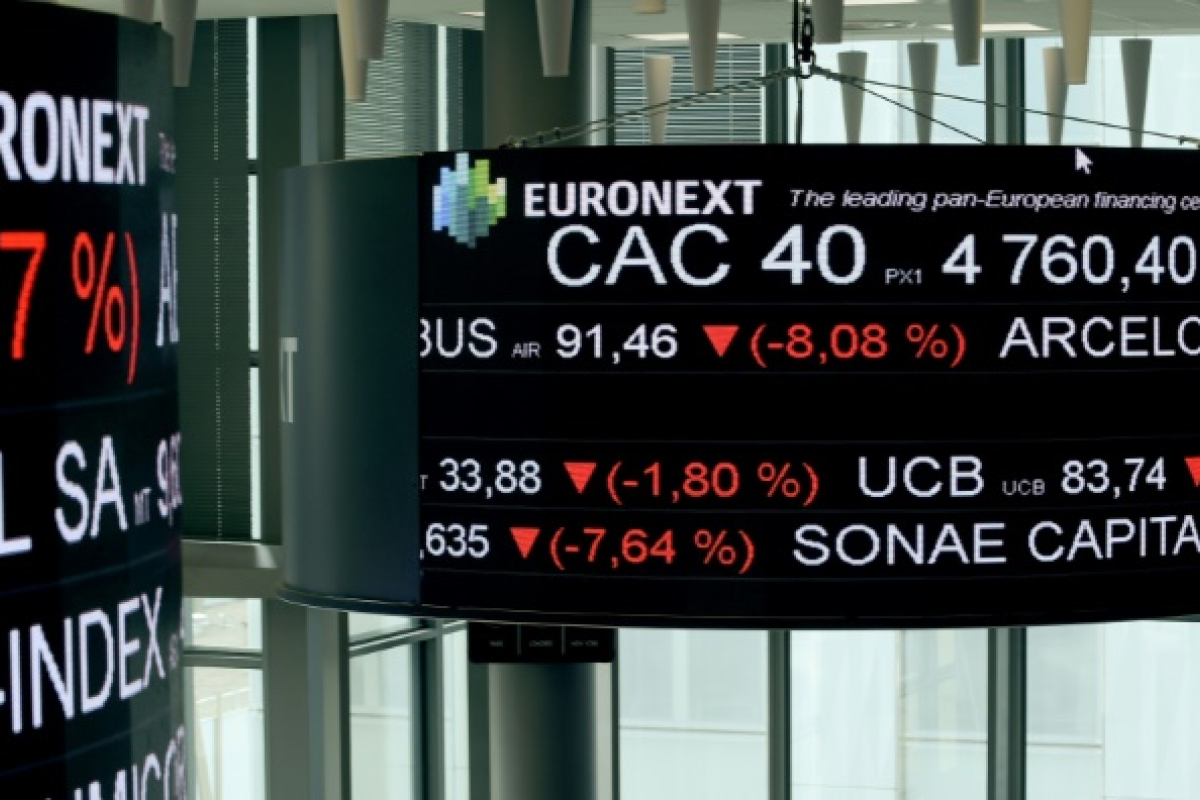
La salle de contrôle d’Euronext, société qui gère la Bourse de Paris ( AFP / ERIC PIERMONT )
European markets showed limited reaction Wednesday to the coordinated release of strategic petroleum reserves aimed at mitigating the impact of ongoing conflict in the Middle East. The decision underscores the complex interplay between geopolitical events and global energy markets.
Thirty-two member countries of the International Energy Agency (IEA) unanimously agreed to release 400 million barrels of oil from their strategic reserves, marking the largest coordinated release in the organization’s history, according to an IEA announcement made Wednesday.
Despite the move, oil prices actually increased during the trading day. Brent crude, the international benchmark, rose 4.79% to $92.01 per barrel by 5:00 PM GMT. West Texas Intermediate (WTI), the U.S. Benchmark, gained 4.60% to $87.29 per barrel.
“The release provides some relief to market pressures and eases concerns about an immediate supply shortage, but it doesn’t reset prices lower,” explained Neil Wilson, a financial analyst at Saxo.
Alexandre Baradez, head of market analysis at IG France, added that the measures announced by the IEA “are already priced in” to the cost of oil.
He noted that the 400 million barrel release will “barely compensate for what has already been lost.”
“Releasing strategic petroleum reserves to lower prices may seem like a quick fix, but history shows it’s often only a temporary reprieve,” cautioned John Plassard, chief investment strategist at Cité Gestion Private Bank.
– Modest Declines for European Bourses –
European stock exchanges closed Wednesday with moderate declines, avoiding a widespread sell-off. The market’s performance suggests investors are cautiously assessing the situation.
Frankfurt’s DAX index experienced the largest drop in Europe, falling 1.37%. London and Paris declined by 0.56% and 0.19%, respectively. Milan too finished lower, down 0.95%.
Rheinmetall, the defense giant and a key component of the Frankfurt DAX, saw a significant drop of 8.02%. The company reported growth in its 2025 operational profit, revenue, and orders, but its 2026 forecasts fell slightly short of market expectations, according to a Berenberg bank note.
In New York, trading was mixed as of 5:00 PM GMT. The Dow Jones Industrial Average fell 0.72%, while the Nasdaq Composite remained relatively flat, up 0.03%. The broader S&P 500 index edged down 0.18%.
– “Very Difficult to Predict” –
“The war in the Middle East abruptly endangers the global economic outlook,” stated Andreas Lipkow of CMC Markets. “Investors remain nervous, financial markets are volatile, and safe-haven assets are in demand.”
Concerns are focused on the potential blockage of the Strait of Hormuz, a critical waterway for global oil shipments.
Iran’s Islamic Revolutionary Guard Corps announced Wednesday that it had targeted a Liberian-flagged ship and a Thai bulk carrier transiting the Strait of Hormuz after ignoring their “warnings.”
European bourses had rebounded Tuesday following comments from the U.S. President suggesting the conflict was “almost” over, which led to a decline in oil prices. The President reiterated Wednesday in an interview with Axios that “there’s practically nothing left to hit” in Iran and that the conflict would end “soon.”
However, “investors are now awaiting a return to calm in the Strait of Hormuz,” noted John Plassard.
– Bond Yields Climb –
Reflecting increased market tension, interest rates on sovereign debt in the Eurozone are rising amid fears of renewed inflation due to soaring energy prices.
By 5:00 PM GMT, the yield on the 10-year German government bond, a European benchmark, reached 2.93%, up from 2.83% at the previous day’s close. The French equivalent climbed to 3.57%, compared to 3.44% on Tuesday evening.
Christine Lagarde, President of the European Central Bank (ECB), affirmed Tuesday that the monetary institution would do “whatever is necessary” to ensure “inflation is under control” despite the surge in energy prices caused by the Middle East conflict.
Outside the Eurozone, the British 10-year interest rate reached 4.68%, up from 4.55%.
