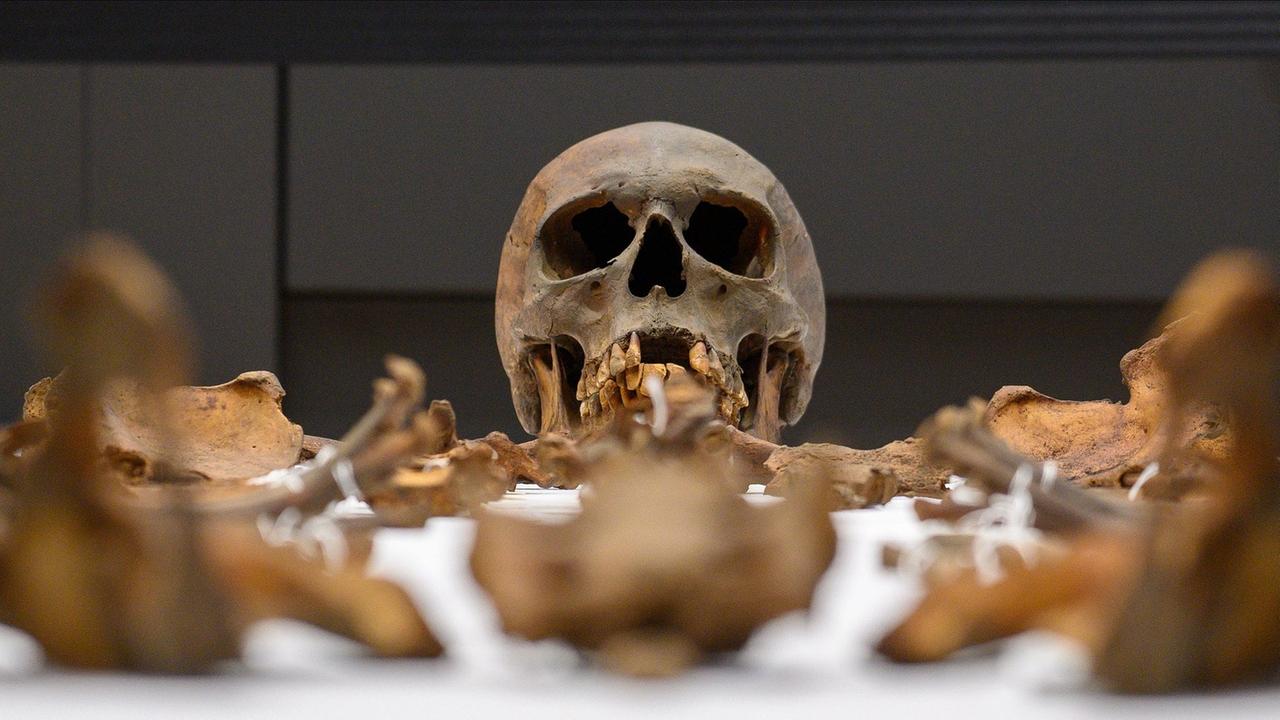
Scientific examinations have confirmed that the remains interred in Magdeburg Cathedral likely belong to Otto the Great. The grave is currently undergoing restoration, allowing for detailed analysis of the bones – and modern insights into the emperor’s lineage.
Bones discovered during the restoration of the imperial tomb in Magdeburg Cathedral “with great certainty” are those of Otto the Great, announced Harald Meller, the state archaeologist of Saxony-Anhalt, on Wednesday. The research results also align genetically, Meller said, indicating the emperor’s identity.
With Otto, We see indeed Otto.
Harald Meller, State Archaeologist of Saxony-Anhalt |
Bones Were Scientifically Examined
Otto I’s remains were exposed and thoroughly examined as part of the renovation of the stone sarcophagus last year. Meller and his team were able to prove that the emperor was related to Henry II. “This consistency made it completely clear that with Otto, it is indeed Otto,” Meller told MDR KULTUR.
These findings are of great importance to archaeologists – not least because in long-inaccessible graves, “the deceased are often exchanged,” Meller explained. With Otto, they now have certainty.
Anthropologists Annika Simm (l) and Jörg Orschiedt during the presentation of the bones of Otto the Great in the lecture hall on the campus of the University Hospital Magdeburg.
Initial scientific results a few days after opening the sarcophagus also revealed that the human remains were of an older man around 60 years of age, who, at approximately 6 feet tall, was above average height for the Middle Ages.
Founder of the Holy Roman Empire of the German Nation
Otto I was already called “the Great” during his lifetime. He reigned as Roman Emperor from 962 until his death in 973, initially uniting the previously fragile East Frankish-German kingdom before uniting it with the Kingdom of Italy. He thus renewed the Roman Empire, which later became known as the “Holy Roman Empire of the German Nation” and lasted until 1806. Otto I died in 973 in Memleben, near Nebra in present-day Saxony-Anhalt.
Source: MDR KULTUR (Sandra Meyer), State Office for Heritage Management and Archaeology of Saxony-Anhalt; editorial revision: op, tmk