
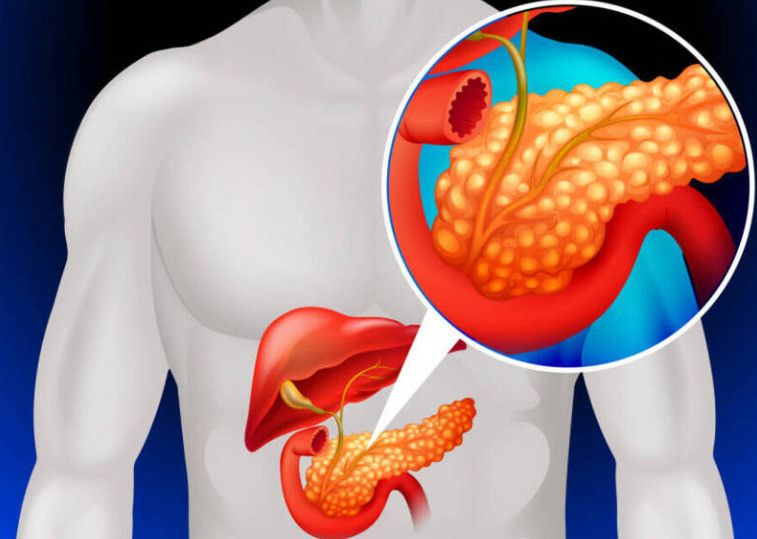
Research reveals that nerves and cancer cells collaborate early in the development of pancreatic cancer and disrupting this “alliance” may weaken the disease before it fully forms. Pictured is an illustration of a pancreatic cancer lesion. (Image from freepik)
Pancreatic cancer is notoriously tough to detect in its early stages, and also presents one of the most challenging cancers to treat. Standard therapies often prove ineffective, prompting scientists to seek new ways to halt disease progression. A new U.S. Study has found that nerves and cancer cells work together early on to drive the development of pancreatic cancer, and breaking up this “alliance” could potentially weaken the cancer before it’s fully established. The research was published in the journal Cancer Discovery.
According to the science website SciTechDaily, researchers at the Cold Spring Harbor Laboratory (CSHL) discovered that the nervous system is involved in pancreatic cancer development much earlier than previously thought. The study reveals that the nervous system actively participates in the development of pancreatic cancer even before tumors appear.
Using advanced 3D imaging technology, the research team confirmed that a type of tumor-supporting cell called myCAFs releases signals that attract nearby nerve fibers. Once these nerve fibers arrive, they interact with the myCAFs, creating conditions favorable for cancer progression.
Further experiments, utilizing both mouse models and human cells, successfully revealed a strong feedback loop between myCAFs and the nervous system. Researchers found that myCAFs release chemical signals that attract nerve fibers from the sympathetic nervous system, which controls the body’s “fight-or-flight” response.
These nerve fibers release norepinephrine, a neurotransmitter, which binds to the fibroblasts and triggers a surge in intracellular calcium. This calcium peak further activates the myCAFs, promoting the growth of precancerous lesions. It also attracts more nerve fibers, reinforcing the cycle and continuously driving disease progression.
The research team reported that when they used neurotoxins to suppress the sympathetic nervous system, fibroblast activation decreased, and tumor growth was reduced by nearly 50 percent.
Because this interaction occurs so early in the process, the research team suggests that targeted therapies could open the door to new treatment approaches. The findings indicate that existing drugs, including Doxazosin, could be effective when used in combination with established therapies like chemotherapy or immunotherapy. This research highlights the complex interplay between the nervous system and cancer development, offering potential new avenues for intervention.
The team plans to conduct further research to identify ways to disrupt the interaction between fibroblasts and nerves.
